In Cambodia’s ancient Khmer heartland, an extraordinary temple reveals a civilisation that imagined the universe in stone—and left behind a living place of devotion.
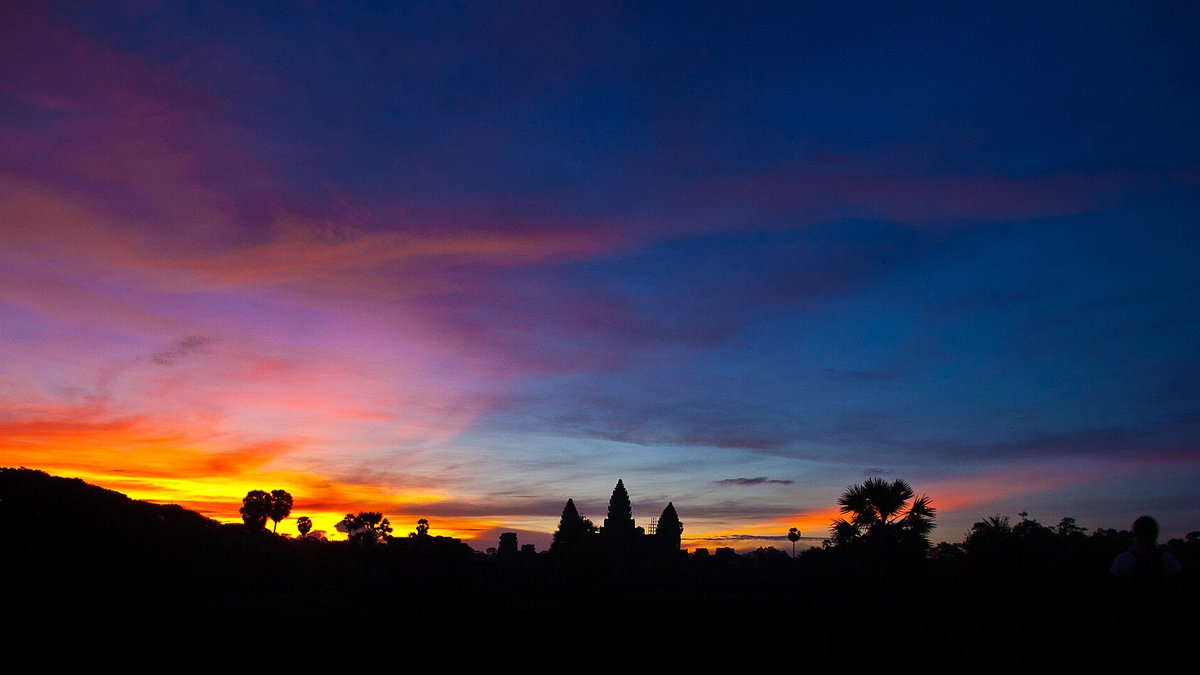
There are monuments that command attention through their height, and others through the stories their walls contain. Angkor Wat possesses both qualities, yet its deepest appeal may be the extraordinary calm of its proportions. Beyond a broad moat, a sequence of causeways, galleries and rising terraces leads towards five towers shaped like lotus buds. Stone, water and open sky seem to form a single architectural thought.
The familiar silhouette has become an emblem of Cambodia, but photographs rarely convey the scale of the whole. Angkor Wat is not simply a temple rising from the forest. It is an immense, carefully ordered landscape, designed to move the eye—and the visitor—from the earthly world towards a sacred centre. Its beauty is inseparable from the intellectual ambition of the Khmer civilisation that created it.
An Empire Written in Stone
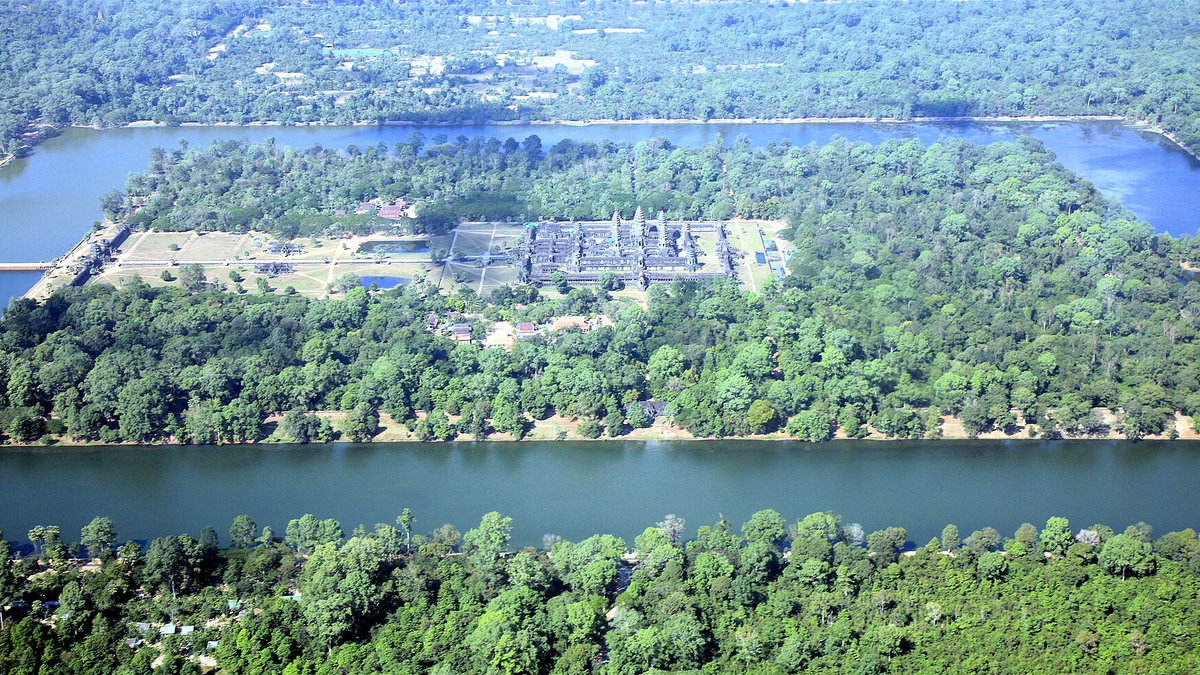
Angkor Wat took shape in the first half of the twelfth century under King Suryavarman II, during a period when the Khmer Empire exercised formidable influence across mainland Southeast Asia. Conceived as a royal state temple and dedicated to the Hindu god Vishnu, the sanctuary expressed more than religious faith. It proclaimed kingship, cultural confidence and a sophisticated command of engineering, sculpture and architectural planning.
The wider Angkor landscape tells an even larger story. For centuries, successive Khmer capitals developed around reservoirs, canals, roads and ceremonial monuments. The civilisation's achievements cannot be measured only by the temples that survive. Its agricultural systems, organisation of labour, religious institutions and relationship with water helped sustain an extraordinarily complex urban region. Many ordinary buildings were made from perishable materials; stone preserves the sacred and monumental, not the entirety of everyday life.
Angkor Wat itself occupies roughly 200 hectares when its moat and outer precinct are included.
The Geometry of the Sacred
In Hindu cosmology, Mount Meru stands at the centre of the universe. Angkor Wat translates that idea into architecture. Its central towers evoke the mountain's peaks; its successive terraces suggest ascent; the encircling moat recalls the cosmic ocean. The symbolism is grand, yet it is communicated through physical experience: distance across water, the rhythm of columns, the transition from sunlit courtyards to enclosed stone galleries.
The temple is unusual in facing west, a direction associated with Vishnu and also discussed in relation to royal funerary symbolism. Scholars have offered different interpretations, and the building resists reduction to one simple explanation. What is clear is the strength of its western axis. The long approach allows the towers to reveal themselves gradually, rather than all at once.
Sandstone surfaces carry much of the artistry, while laterite forms important structural elements. Towers, gopuras or entrance pavilions, and corbelled galleries demonstrate a highly developed architectural language. Seen as a whole, the arrangement is monumental; studied closely, it becomes intimate. A doorway frames another doorway. Carved ornament interrupts an expanse of quiet wall. A change in light brings an almost forgotten figure back into view.
A Gallery of Gods, Kings and Dancers
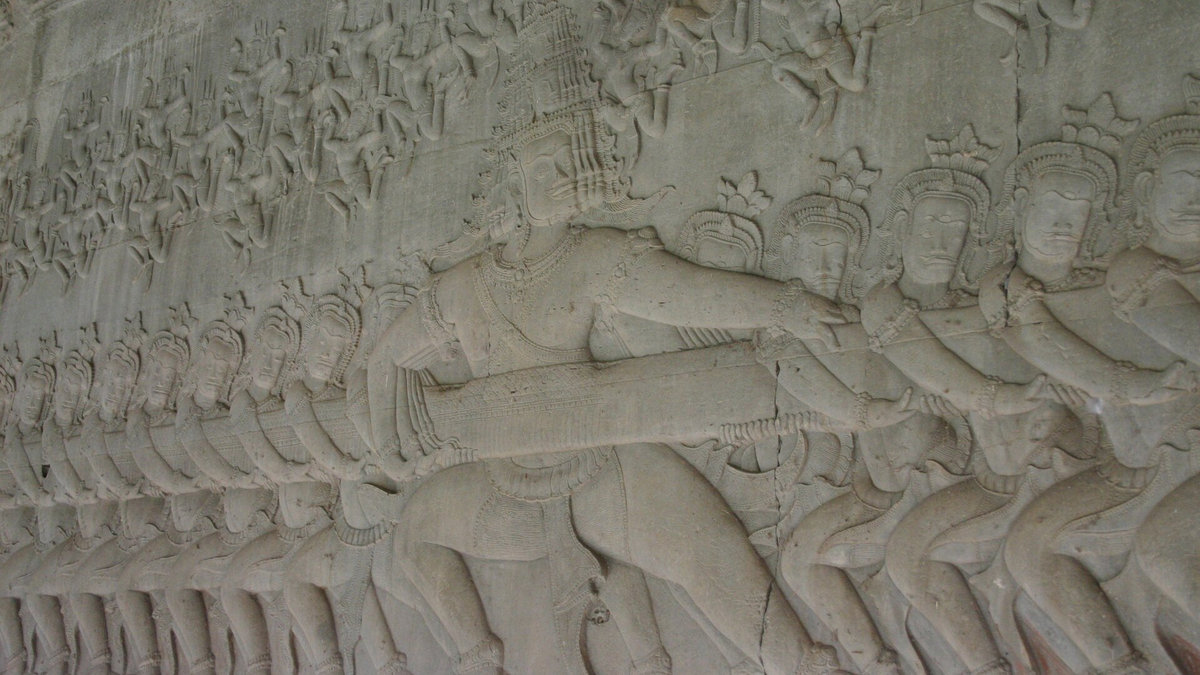
The celebrated bas-reliefs transform the lower galleries into a vast narrative surface. Episodes from the Ramayana and Mahabharata appear alongside scenes linked to Suryavarman II's reign and depictions of heavens and hells. The sculpture is not merely decorative. It communicates political authority, religious ideas and an imaginative world populated by warriors, deities, celestial beings and elaborate processions.
Among the most compelling compositions is the Churning of the Sea of Milk. In this Hindu myth, gods and demons pull at the great serpent Vasuki, using Mount Mandara to churn the cosmic ocean and obtain the nectar of immortality. The scene has an almost cinematic rhythm. The figures seem to generate movement across the sandstone, while the myth gives the temple's architecture another layer of meaning: creation, conflict and the hope of transcendence are all present in a single wall.
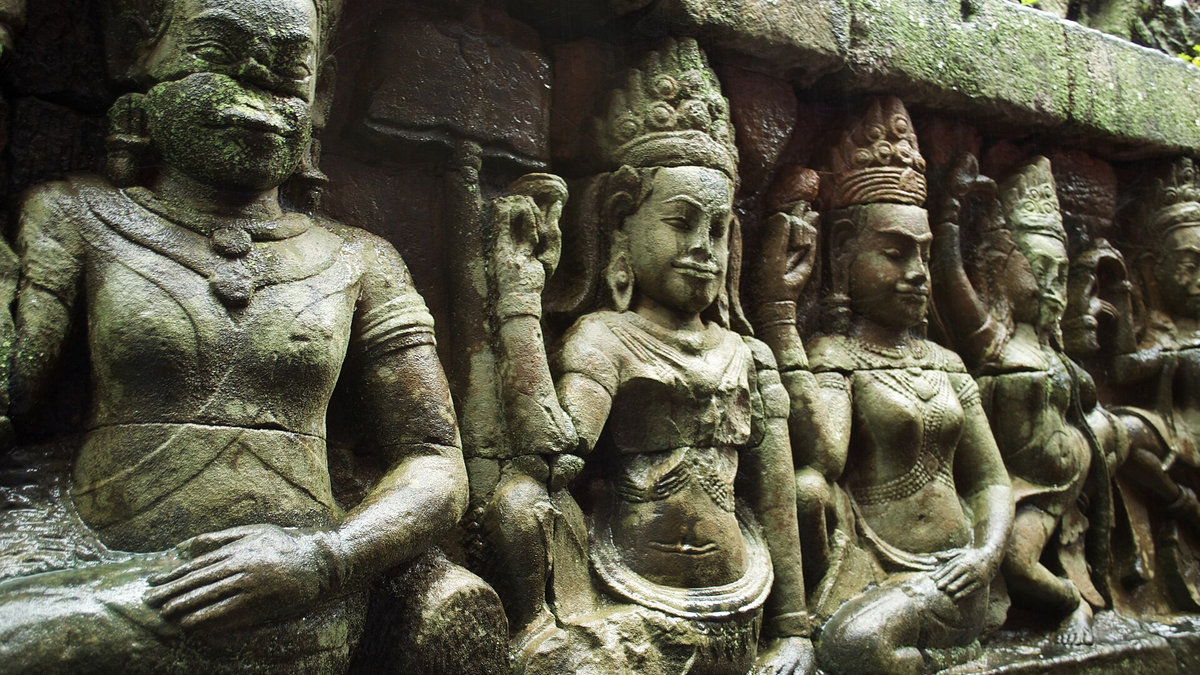
Elsewhere, the carved female figures commonly described as apsaras or devatas bring an entirely different sensibility. Their jewellery, hairstyles and poised gestures display the exceptional finesse of Khmer sculptors.
A Sanctuary That Never Became Silent
Angkor Wat's history did not end with the height of the Khmer Empire. Over time, the temple became a major centre of Buddhist worship, particularly associated with Theravada Buddhism. Its galleries and sanctuaries bear witness to this evolution: Buddhist images, inscriptions and spaces of devotion were incorporated into an earlier Hindu setting.
That continuity matters. Angkor Wat is often described through the language of ruins and rediscovery, as though its meaning began when foreign travellers wrote about it. Such a view obscures the generations of Cambodian worshippers for whom the sanctuary remained significant. The monument is an archaeological masterpiece, but it is also part of a living religious and national inheritance.
The wider Angkor Archaeological Park was inscribed on UNESCO's World Heritage List in 1992. Its protected landscape extends well beyond the iconic temple, embracing former capitals, reservoirs, waterways, communities and forests. Conservation therefore demands more than repairing ancient stone. It involves the careful management of visitors, water, local livelihoods and the spiritual character of places that continue to matter to Cambodian society.
For a culturally attentive traveller, this changes the meaning of the encounter. Respect for worshippers, modest dress and patience around sensitive spaces are not decorative gestures of good manners. They recognise that the site belongs first to a continuing Cambodian history, not simply to the international imagination.
The Art of Seeing Angkor
Angkor Wat is most often pictured at daybreak, its towers reflected in still water as the sky begins to brighten. The image is deservedly famous, but it should be the beginning of a deeper encounter, not its conclusion. Beyond the postcard composition lie corridors where repetition creates serenity, sculpted walls that reward sustained attention and courtyards where the architectural order becomes clear.
Access to some elevated areas is regulated, and opening arrangements can change for religious observances or conservation; the latest instructions from the Cambodian authorities should guide any itinerary.
Siem Reap provides the usual base for discovering Angkor, but the real distinction of the experience is not found in the comforts surrounding the excursion. It lies in the opportunity to approach one of the world's most ambitious sacred buildings with curiosity and restraint. A knowledgeable local guide can help reveal the stories behind a sculpted panel or explain the relationship between the temple and the living traditions around it.
Angkor Wat ultimately refuses to be contained within a single image, however beautiful. Its towers speak of cosmic mountains; its galleries preserve myths and the memory of an empire; its Buddhist life connects centuries that conventional histories too readily separate. The most lasting impression is not simply of grandeur. It is of a civilisation that gave its ideas architectural form—and of a place where those ideas still ask to be read with care.