Among Krabi’s limestone cliffs
At the southern end of Thailand’s Railay peninsula, the limestone does not merely frame the view. It dictates the geography. Vertical walls rise above palms, forested paths end at tidal beaches, and the Andaman Sea enters the landscape in brilliant fragments of blue. Rayavadee is built into this extraordinary setting, not on a conventional beachfront strip but across a green peninsula where the journey from one shore to another is part of the experience. A guest can walk through tropical gardens towards Railay Beach, then turn in another direction towards the sand and cliffs of Phranang Beach. The scenery changes within minutes, yet the resort retains the atmosphere of a sheltered world.
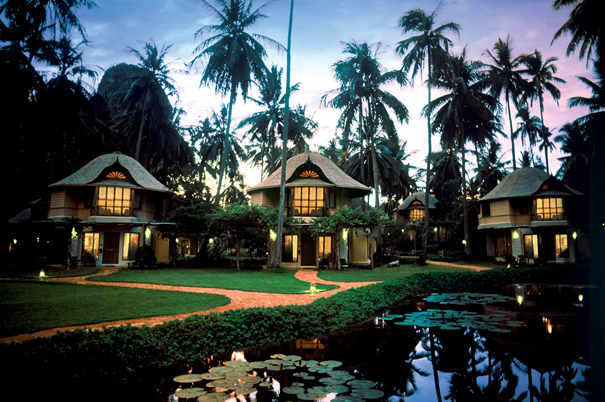
Krabi is often marketed through its most recognisable image: limestone towers rising from turquoise water. At Rayavadee, the geology becomes a daily presence rather than a distant postcard. The rounded roofs of the pavilions echo the shapes of the cliffs, and the accommodation is dispersed among coconut groves rather than gathered in a single hotel block. That decision gives the property its particular identity. The most dramatic architecture here was made by nature long before the first guest arrived.
This is also a coastline that cannot be reduced to a perfectly still image. Tides alter the breadth of the beaches; monsoon patterns influence sea conditions; and boats form an essential part of local transport. The beauty is real, but so is the dynamism of the setting. To appreciate Rayavadee is to accept that the landscape has its own timetable.
Arrival by water
The approach establishes the resort’s difference from an ordinary coastal hotel. Rayavadee sits on the Phranang Peninsula, which is approached by boat rather than by driving to a porte-cochère. The hotel’s published transfer guidance describes a journey from Krabi International Airport to Nong Nuch pier of approximately twenty minutes by road, followed by a further twenty minutes by boat. Actual arrangements depend on the booking and prevailing conditions, and travellers should confirm the designated pier and transfer schedule before departure.
A boat arrival changes the sense of distance. The coast is seen from the water, the cliffs appear at their full height and the peninsula gradually separates itself from the mainland’s roads and towns. It is a memorable introduction, but it also carries practical implications. Late arrivals, rough weather and independent restaurant reservations may require more planning than they would at a resort connected to the road network.
Once ashore, the emphasis shifts to walking. Paths wind between gardens, accommodation and the resort’s dining venues. This is an environment to explore slowly, with enough time to notice the changing light, the plantings and the abrupt appearance of limestone beyond the trees. The experience is less about an isolated private beach than about living for a few days within a remarkable coastal landscape.
Architecture beneath the palms
Rayavadee’s accommodation is arranged as a collection of 94 two-storey pavilions and seven villas. The number is worth understanding: this is not a small boutique hideaway, but its low-rise planning and extensive gardens make it feel quite different from a 101-key hotel tower. Individual buildings occupy pockets of tropical greenery, and their circular forms respond to the natural silhouettes of the peninsula.
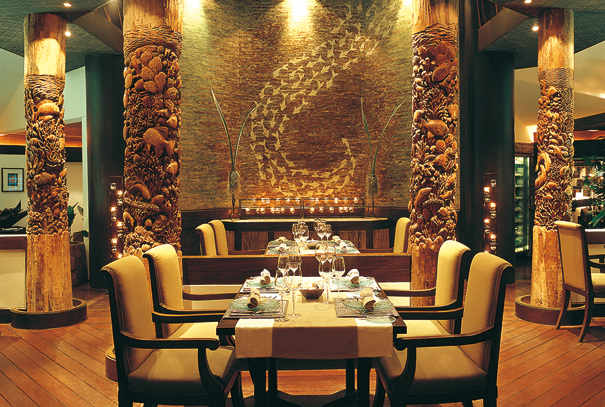
The Deluxe Pavilion, at approximately 90 square metres, provides a useful introduction to the concept. Its two-level arrangement separates the living space from the bedroom, while polished wood, fabrics and Thai-inspired decorative details create a sense of place without relying on an elaborate historical pastiche. The Terrace Pavilion extends the outdoor living proposition; Pool Pavilions add private swimming pools set within landscaped gardens. The different categories are not simply larger or smaller versions of the same room. They offer distinct ways of inhabiting the resort.
Families have their own choices. Two-bedroom Family Pavilions, including versions with private pools, provide space for guests travelling together. At the upper end of the collection, villas offer greater seclusion and dedicated butler service. Some occupy privileged positions near the beaches, while others are set deeper within the gardens. Guests should compare the precise configuration and location of each category rather than assume that every residence offers a sea view.
The architecture’s achievement is its relative restraint. The buildings provide generous interior space, but the overall composition allows cliffs, palms and pathways to remain the dominant elements. It is a form of luxury measured less by architectural spectacle than by the pleasure of being surrounded by a landscape of uncommon beauty.
A room for a different rhythm
A stay in a two-storey pavilion encourages a more residential routine. There is room to sit, read, prepare for an excursion or simply retreat from the heat of the afternoon. The division between living and sleeping areas can be particularly welcome on longer stays, when the rhythm of the day becomes less formal and a hotel room begins to function as a temporary home.
The distinction between the categories is significant. A Pool Pavilion makes privacy and outdoor swimming part of the daily experience. A Family Pavilion provides a different kind of comfort, especially when travelling with children or relatives. The larger villas can support celebrations or longer stays, but their value lies in their individual setting and facilities, not only in their size.
This is a resort where guests should resist the temptation to spend every hour pursuing the next excursion. The gardens and paths are not merely corridors between activities. They are an important part of the stay. A short walk before breakfast, an afternoon spent in the shade or an evening return through the greenery can be as memorable as a scheduled outing. The design allows the experience to expand and contract according to mood.
Four ways to dine
Rayavadee’s dining programme is spread across four venues, each with a different relationship to the surrounding landscape. Raya Dining offers an elegant but informal setting, with both air-conditioned and open-air seating. It is the natural starting point for breakfast and a place where the resort’s emphasis on Thai and international cooking is expressed without the ceremony of a formal tasting menu.
Krua Phranang, beside Phranang Beach, is dedicated to Thai cuisine. The menu draws on familiar traditions of curries, soups, salads and seafood, while the setting allows dinner to become part of an evening by the water. Raitalay Terrace occupies a position near the pool on Railay Beach, offering international favourites and a more casual mood. These different settings matter: the resort’s geography shapes not only the views but the way guests choose to eat.
The Grotto is the most immediately recognisable of the four. Its tables sit beneath an ancient limestone overhang at the edge of Phranang Beach. The place has an almost theatrical quality, with the cliff forming a natural roof and the sea close by. Yet the attraction is not simply a photograph. A leisurely lunch or an evening meal here allows guests to experience the peninsula’s geology at an unusually intimate scale.
The Grotto currently advertises lunch and a Twilight Set Dinner, with advance reservations required for the latter. The resort also makes it clear that non-resident guests must arrange their own boat transfers. Menus, service hours and access conditions can change, so arrangements should be checked directly. The essential experience, however, is unmistakable: dining where rock, sand and sea meet.
Spa, gardens and a living ecosystem
The resort’s wellness offer includes a full-service spa, with massage, body treatments and beauty services. In a destination known for its dramatic scenery, such facilities provide a quieter form of restoration. The contrast between an active morning on the water and an afternoon devoted to rest is part of what makes the peninsula appealing for a longer visit.
Rayavadee also places considerable emphasis on its gardens and environmental setting. Its published sustainability philosophy describes an ambition to coexist with the peninsula’s natural environment, while a 2025 resort release introduced a Garden Walk and forest-bathing experience intended to deepen guests’ awareness of the landscape. Such activities make sense here: the gardens are not incidental ornamentation but part of the property’s spatial identity.
The resort has also described collaborations on beach cleaning and a policy intended to reduce boat activity at Phranang Beach. These are meaningful initiatives, although they should not be mistaken for proof that tourism has no environmental impact. The limestone peninsula is a sensitive coastal environment, and the relationship between hospitality, transport, waste and marine ecosystems requires continuing attention.
For visitors, the most responsible approach is also the most rewarding: respect local guidance, avoid disturbing wildlife, keep beaches free of litter and take the time to understand the place beyond its most famous viewpoints. The peninsula’s beauty is not a disposable backdrop. It is the reason the resort exists.
Beyond the resort: the wider Krabi coast
The Phranang Peninsula is an excellent starting point for exploring the wider Andaman coastline. Boat excursions can reveal other beaches, islands and striking limestone formations, while sea conditions and local regulations determine which routes are practical on a given day. Rayavadee’s activities programme includes opportunities to explore the coast, and its published materials describe experiences that connect visitors with local communities.
One such destination is Koh Klang, an island associated with traditional batik work and rice cultivation. An excursion of this kind offers a different perspective on Krabi, away from the celebrated rock formations and towards the livelihoods and skills that give the province its cultural identity. The contrast is valuable. A memorable trip should leave room for the people of a destination as well as its scenery.
The beaches immediately around Rayavadee are themselves worth understanding. Railay and Phranang are famous and publicly accessible, which means that their atmosphere varies with the time of day and visitor numbers. The resort provides a privileged base, not exclusive ownership of the coastline. Guests seeking uninterrupted solitude should be realistic about the popularity of these places, especially during busy travel periods.
The reward for that realism is a richer experience. The peninsula is beautiful not because it has been sealed off from the world, but because its natural forms remain powerful even amid the movements of boats, visitors and daily life.
A resort defined by its place
Rayavadee’s strongest quality is its refusal to compete with the landscape. Its low buildings, garden paths and varied dining settings make sense because they are designed around the limestone cliffs and beaches of the Phranang Peninsula. The resort has the scale and services of a major luxury property, but its character comes from the way those elements are distributed across the land.
It is particularly appealing to travellers who enjoy walking between different settings, spending time outdoors and treating the journey itself as part of a holiday. Families may appreciate the spacious pavilions; couples may be drawn to private pools or the distinctive dining venues; and visitors interested in nature will find that the setting rewards observation as much as activity.
There are practical considerations. Boat transfers require coordination, public beaches can be busy and coastal weather is never entirely predictable. These are not flaws to conceal but characteristics of a destination that remains connected to the natural world.
The enduring image of Rayavadee is not a single room or restaurant. It is the movement from shaded garden to pale sand, the immense scale of a limestone wall and the feeling of arriving somewhere that could not be reproduced on another coast. In an industry that often makes luxury hotels look increasingly alike, that sense of geographical belonging is the property’s greatest distinction.
Hotel Information
Rayavadee
214 Moo 2, Tambon Ao Nang, Amphoe Mueang Krabi
Krabi 81000, Thailand
Telephone: +66 2 301 1861
Website: Rayavadee — Official Website