Saint-Jean-de-Luz on its own terms
Saint-Jean-de-Luz has never needed to invent a personality for visitors. Fishing boats still give its harbour a working purpose; the old streets are lined with shops, cafés and buildings that speak of a town shaped by the Atlantic rather than by the requirements of a resort brochure. The bay, sheltered by its sea walls, lends the waterfront a gentler character than the exposed surf beaches farther along the Basque coast. From the quays to the market, the town remains compact enough to be experienced on foot.
It is in this setting that Bizipoz makes its proposition. More than a hotel with a fashionable name, the address brings bedrooms, places to eat and drink, events and shared spaces into a single urban project. Its Basque name joins bizia, meaning life, and poza, meaning joy. That idea of conviviality is not confined to a slogan: it informs the relationship between the guest accommodation and the public spaces where residents and visitors can meet.
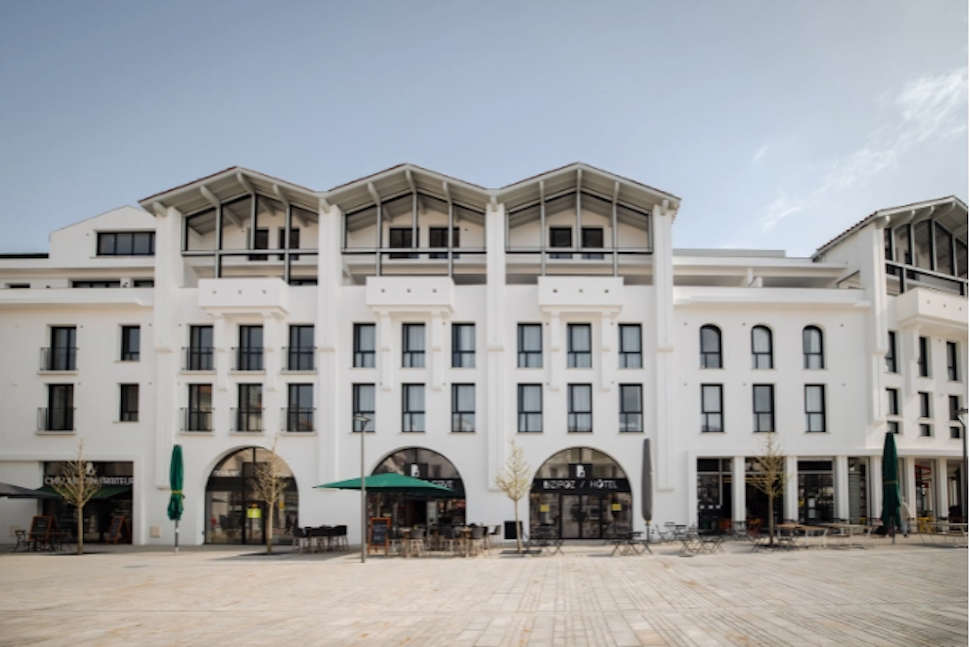
The four-star hotel opened in spring 2025, adding a contemporary design-led address to a town whose accommodation has long been associated with family holidays and seaside traditions. It occupies part of the redevelopment of the Foch area, close to the port, the historic centre and the railway station. The location is practical, but the ambition goes beyond convenience. Bizipoz seeks to become part of the town’s daily social life, not simply a place where travellers sleep between excursions.
For anyone arriving in Saint-Jean-de-Luz for the first time, that distinction matters. The most rewarding stays here are not organised around a checklist of sights. They are shaped by the pleasure of moving between the harbour, the market, the beach and the cafés, with the mountains forming a distant counterpoint to the sea. Bizipoz is conceived for precisely that sort of visit: one in which the hotel is a lively point of return rather than an isolated destination.
Art Deco, reimagined through Basque culture
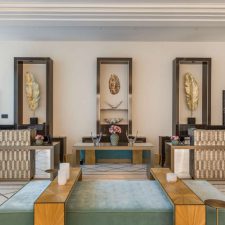
The building takes its visual cues from Art Deco, but its interior identity belongs firmly to the present. The project credits architect Luc Vaichère and scenographer Cyril Houplain, whose contribution gives the hotel an unusually graphic character. The visual language draws on Basque architectural contrasts and the landscape between the Atlantic and La Rhune. Rather than reproduce regional motifs as decoration, the interiors reinterpret them through colour, shape, objects and materials.
This approach is particularly interesting in a destination with such a recognisable architectural vocabulary. Red and green shutters, whitewashed walls and timber framing are familiar sights across the French Basque Country. They can be evocative, but they are also easily reduced to a visual formula. A contemporary hotel has to find a way of acknowledging that inheritance without turning every room into a stage set. Bizipoz attempts the balance by giving artistic intervention a central role.
Houplain is known for a practice that moves between drawing, scenography and the creation of visual worlds. At Bizipoz, that sensibility is expressed through individual pieces and unexpected combinations, not through the neutral palette of an interchangeable international hotel. The result is a property that treats design as an experience in itself, while remaining anchored in the town and the region around it.
The project’s mixed-use character is just as significant as its interiors. Accommodation, food, events and street-level commerce occupy connected parts of the development. This is a different urban model from the self-contained luxury hotel: the public realm is not an inconvenience to be screened out, but part of the reason the building exists. It gives the address a sense of movement and makes it relevant to people who may never book a room.
 @ Bizipoz
Rooms between the harbour and the mountains
The hotel has 52 rooms and suites, with accommodation ranging from approximately 21 to 62 square metres. Its official presentation also mentions an apartment and twelve suites with panoramic views of the port. These numbers describe a property with several ways of staying rather than a single standardised experience. A short weekend for two, a family holiday and a work trip may call for very different configurations.
The interiors are designed to carry the hotel’s visual identity into private space. Artwork, carefully chosen objects and a contemporary use of materials help establish a connection between the architecture and the wider Basque setting. The emphasis is on character without sacrificing the everyday requirements of a comfortable stay. The most successful design hotels are those in which the guest does not have to choose between an interesting room and a practical one.
Outlook is another consideration. The hotel promotes views towards the harbour and, from selected accommodation, towards the surrounding landscape and La Rhune. These are features of particular categories, not promises attached to every room. Travellers who care about a panoramic view should confirm the exact room type when reserving; those intending to spend most of their days outdoors may reasonably place more value on layout and comfort.
Saint-Jean-de-Luz is a destination that encourages an easy movement between inside and outside. There may be a morning spent by the water, an afternoon exploring the streets, and an evening returning from dinner without needing a car. In that rhythm, the room becomes a place to settle briefly and comfortably, while the town remains the principal attraction. The hotel’s central position makes that exchange particularly simple.
The ground floor belongs to the town
One of the clearest expressions of the Bizipoz concept is its bar and restaurant space. Rather than placing all the social activity in a discreet hotel lounge, the project opens onto a larger, animated environment that welcomes local residents as well as overnight guests. The hotel’s official description refers to a food-court area of around 600 square metres, a cocktail bar and terraces. The broader project includes street-level food and retail activity.
The programme changes with the hour. Coffee and informal meetings can give way to lunch, an afternoon drink or an evening shaped by music and conversation. This is hospitality conceived as a shared urban experience, and it is an appealing fit for Saint-Jean-de-Luz. The town already has a strong tradition of social life around its market, cafés and restaurants; Bizipoz adds a contemporary venue to that network rather than asking visitors to withdraw from it.
The current official website describes a restaurant-bar serving seasonal, locally influenced food under chef Sébastien Piniello, alongside cocktails, a coffee-shop function and events. Such programmes are inherently changeable. It is more useful to understand the culinary direction and the social character of the place than to preserve a menu or list of food counters that may no longer be current when the reader arrives.
A lively public space brings a particular kind of energy, but it also makes room selection important for guests who prefer absolute quiet. The appeal of the concept lies in having a choice: joining the gathering downstairs, stepping out into the town, or returning to the privacy of the room. For travellers who enjoy a sociable hotel, the transition between these settings can become one of the most enjoyable aspects of the stay.
 @ Bizipoz
A town with the sea in its history
Saint-Jean-de-Luz is much more than a picturesque coastal stop. Its identity was formed by the sea, by fishing and maritime trade, and by a long relationship with the Spanish Basque Country across the nearby border. The sheltered bay and the working port are essential to its character. The waterfront is attractive, certainly, but it is not simply a backdrop: it belongs to the economic and cultural history of the town.
One of the most celebrated episodes in that history took place in 1660, when Louis XIV married Maria Theresa of Spain in the church of Saint-Jean-Baptiste. The marriage formed part of the diplomatic settlement between France and Spain. The church remains a major landmark, and the event gives the streets of the old centre a historical dimension that can be easy to overlook amid the pleasures of a seaside holiday.
The town’s culinary traditions offer another route into its identity. The market and surrounding shops introduce visitors to local produce, seafood, Basque cheeses and the distinctive sweets associated with the region. The famous macarons of Saint-Jean-de-Luz belong to a particular local tradition, quite different from the brightly coloured Parisian sandwich macaron. These details are not minor tourist curiosities; they express the persistence of local habits and crafts.
For a hotel whose concept is built around joy and social exchange, the surrounding streets provide an ideal extension. A visitor can leave Bizipoz, walk to the harbour, stop at the market and reach the beach without complicated planning. The pleasure lies in the small distances and in the way the town’s working and leisure identities remain visible side by side.
From the bay to La Rhune
The geography around Saint-Jean-de-Luz makes it possible to experience several landscapes in a single stay. The Atlantic is the immediate presence, but the mountains are never far away. La Rhune, whose distinctive summit rises inland, is a familiar landmark and a reminder that the Basque Country cannot be understood only through its coastline. The relationship between sea and mountain has shaped the region’s architecture, food and everyday life.
Travellers with time to explore can move inland towards villages and foothills, or follow the coast towards Ciboure, Hendaye and Biarritz. Each offers a different perspective on the region. Ciboure, just across the harbour, has its own maritime identity and is associated with composer Maurice Ravel, who was born there in 1875. The proximity of such places makes the area particularly rewarding without requiring a demanding programme of long-distance excursions.
The bay itself invites a slower itinerary. A walk along the waterfront, a swim in suitable conditions or a long pause at a café can be as memorable as a full day of sightseeing. The town’s scale allows visitors to move according to the weather and their own interests. When the Atlantic is lively, the sheltered beach offers a distinctive contrast to the exposed coastline elsewhere.
This is where a centrally located hotel earns its place in a journey. It lets guests respond to the destination rather than organise every hour in advance. One day may be devoted to the mountains; another may unfold entirely within the streets and along the shore. Bizipoz is well suited to travellers who prefer that freedom.
Wellness and the working week
The hotel is not only a holiday address. Its published facilities include a sauna, a fitness area and modular rooms for professional meetings. The hotel website describes four modular seminar spaces, while some summary figures elsewhere on the same site mention five; groups should therefore confirm the current room inventory and configuration directly with the events team. The distinction is a useful reminder that event facilities are best assessed against a specific programme, not merely a headline number.
The wellness provision is relatively focused. It is not presented as a destination spa with an elaborate catalogue of treatments, but as a practical place for guests to exercise or unwind. In a town where much of the pleasure comes from walking, swimming and outdoor exploration, that restraint can make sense. The hotel provides a complementary indoor option rather than attempting to replace the landscape outside.
Business travel is another part of the concept. The railway station is only a short walk away, and the hotel’s position makes it possible to combine meetings with the town’s restaurants and waterfront. The public areas can accommodate informal encounters, while the dedicated meeting spaces provide a more structured setting. This flexibility helps explain why the property is designed as a year-round address rather than one whose life depends entirely on the summer season.
Families, couples, groups of friends and professional travellers will not use the hotel in the same way. That diversity is built into the project. The important question for a prospective guest is not whether every facility will be used, but whether the balance between lively communal spaces and private accommodation suits the intended stay.
An address with a clear idea of hospitality
The most distinctive aspect of Bizipoz is not an individual room, an artistic flourish or even its convenient position. It is the decision to make a hotel part of a larger place of encounter. At a time when many lifestyle properties borrow the language of community without offering much connection to their surroundings, this project makes the social spaces an essential part of the architecture and the daily programme.
That ambition has consequences. A guest seeking a secluded retreat with little public activity may prefer a different type of hotel. Someone interested in design, food, local culture and the pleasure of moving between the private and the communal is more likely to appreciate what Bizipoz offers. Its personality is a strength precisely because it does not try to become everything to everyone.
The Basque coast already possesses a powerful sense of place. A new hotel succeeds here not by inventing that identity, but by engaging with it intelligently. The combination of Art Deco references, Cyril Houplain’s scenographic imagination, a lively ground floor and the town’s maritime setting gives Bizipoz a coherent position in the local hospitality landscape.
Saint-Jean-de-Luz remains the main event: the harbour, the bay, the markets, the old streets and the mountains beyond. Bizipoz adds a contemporary way to inhabit it. The hotel makes a persuasive case for a particular kind of journey: the best address is often the one that helps a visitor feel more connected to the destination outside its doors.
Hotel Information
11 rue Marion Garay, 64500 Saint-Jean-de-Luz, France
Telephone: +33 5 59 51 86 07
Website: Bizipoz — Official Website
Tags: Basque Coast, Bizipoz, France, Hotels, Saint-Jean-de-Luz