Beneath the red awnings of Avenue Montaigne
Paris has many grand hotels, but few are as instantly identifiable from the street as Hôtel Plaza Athénée. The red awnings, wrought-iron balconies and geraniums of its avenue Montaigne façade have become a visual shorthand for a particular Paris: one where fashion, architecture, gastronomy and the rituals of hospitality intersect. The address is prestigious, certainly, but the hotel’s appeal is more complicated than a famous postcode. It has spent more than a century developing a relationship with the cultural life of the city around it.
At number 25, the palace occupies a position between the Champs-Élysées and the Seine, within easy reach of the Théâtre des Champs-Élysées and the fashion houses that define the Golden Triangle. The Eiffel Tower is part of the outlook from certain suites, not a view that should be promised indiscriminately to every guest. The city is present in more immediate ways too: in the movement along the avenue, the arrival of shoppers and theatre-goers, and the succession of Parisian afternoons that unfold beneath the hotel’s windows.
There is a temptation to write about a place this famous entirely in superlatives. Yet the more revealing story is one of continuity and reinvention. Plaza Athénée has kept its recognisable face while its restaurants, interiors and services have evolved. Its identity is not frozen in a glamorous past; it is renewed through the decisions made about what to preserve, what to reinterpret and how to remain relevant in a city that has never lacked competition at the highest level of hospitality.
1913: a palace and a new Paris
Hôtel Plaza Athénée officially opened on 20 April 1913, in a building designed by Charles Lefebvre. That date places it at a fascinating moment in Parisian history. The Belle Époque was drawing to a close, modern artistic movements were transforming the city, and the nearby Théâtre des Champs-Élysées opened the same spring. The hotel’s early association with the theatre brought composers, performers and audiences into its orbit, helping establish the address as a place connected to the arts rather than merely to expensive accommodation.
The building was developed in stages during the 1910s. The French Ministry of Culture’s architectural heritage record identifies the façade on avenue Montaigne, roof and several important interior spaces among the protected elements. This precision matters. It is more meaningful to understand the parts of the property that have recognised heritage significance than to suggest vaguely that everything in the hotel has survived untouched since its inauguration.
A grand hotel is, by definition, an architecture of public encounters. Its entrance, galleries, restaurants and salons are places where the city comes indoors. Plaza Athénée’s heritage lies as much in those ceremonial spaces as in the bedrooms above. The building’s architectural language, with its carefully ordered façade and elaborate ironwork, continues to communicate the confidence of early twentieth-century Paris.
The decades that followed brought changes in fashion, travel and the social expectations placed upon a luxury hotel. The property adapted, expanded and developed new dining rooms. But its central role remained remarkably consistent: it was an address where visitors could experience the city not from a distance, but from within one of its most recognisable social settings.
Christian Dior and the invention of a couture address
The hotel’s association with fashion is not a retrospective marketing invention. Christian Dior established his couture house on avenue Montaigne in 1946, and the hotel records that he became a regular visitor, using the property for fashion shows and photography. The proximity was mutually reinforcing. The fashion house helped turn the avenue into an international symbol of couture, while the palace offered a natural setting for the people and occasions that accompanied the industry.
The relationship continues to give Plaza Athénée a distinct identity among Parisian hotels. Its famous façade is often photographed as though it were part of a fashion collection: the repeated rhythm of red awnings, the greenery of the window boxes and the pale stone creating a composition that is at once architectural and theatrical. The appeal is not dependent on a particular season’s trends. It comes from the recognisable visual codes of a place that has lived alongside fashion for generations.
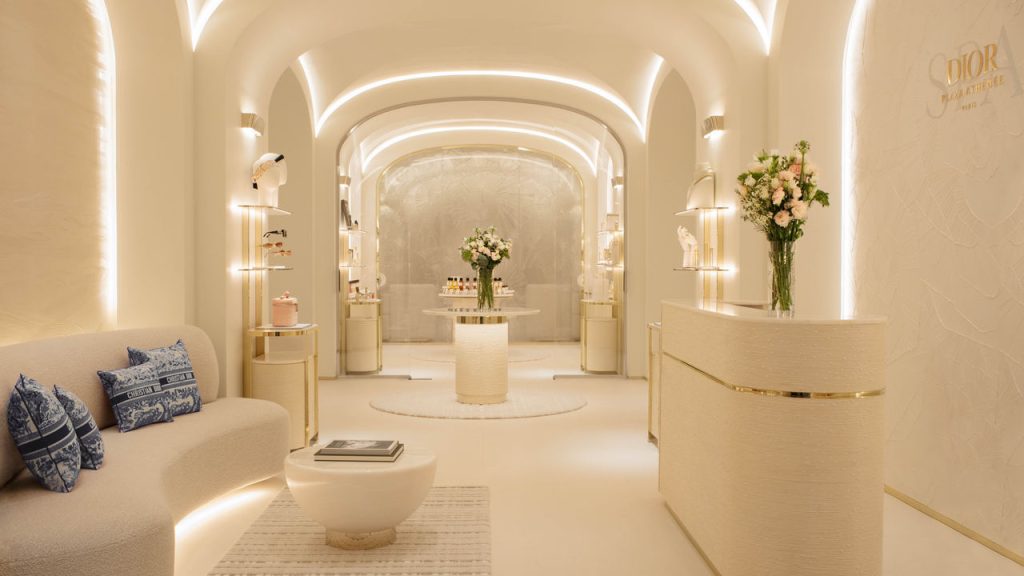
The Dior Spa inside the hotel extends that relationship into contemporary wellbeing. It should not be confused with the historic beginnings of the association: the spa belongs to a later chapter, when beauty and hospitality became more closely integrated within the luxury hotel experience. Together, these layers reveal how a partnership can evolve without losing its cultural reference point.
To stay on avenue Montaigne is to be surrounded by fashion history and its current expression. Boutiques and showrooms are part of the neighbourhood’s daily life, but the pleasure for a visitor is not limited to shopping. The avenue offers a way to understand how Paris has fashioned an international identity through design, craftsmanship, performance and the enduring appeal of carefully staged elegance.
Two visions of Paris behind one façade
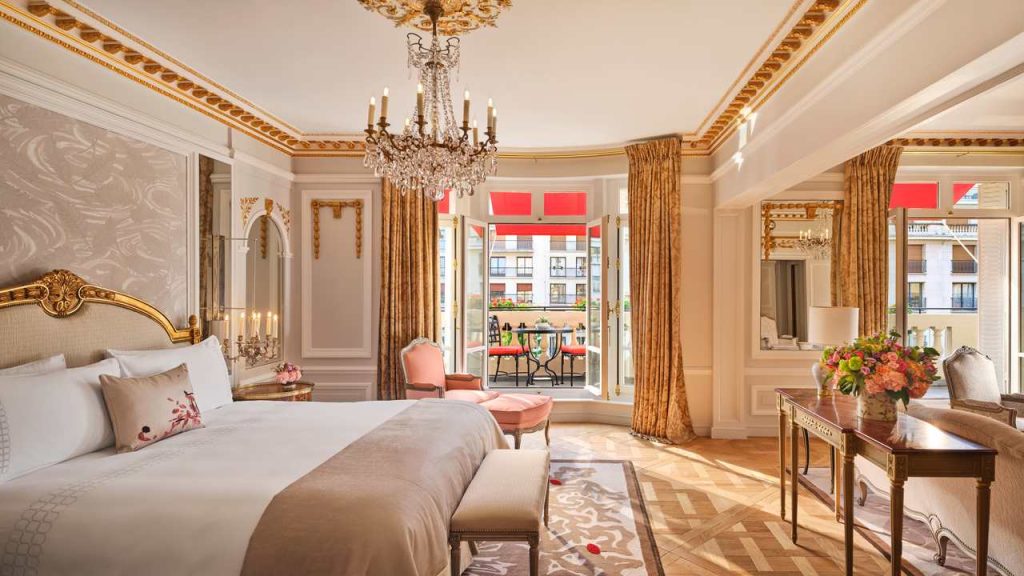
The hotel’s present inventory comprises 154 rooms and 54 suites, according to Dorchester Collection. Across that accommodation, two decorative traditions are especially important. Some interiors evoke the classic French apartment, with period-inspired detailing, generous proportions and a more formal atmosphere. Others draw on Art Deco, with a different emphasis on geometry, materials and graphic clarity. The coexistence of these languages prevents the hotel from becoming a single, endlessly repeated decorative formula.
This variety matters to the guest. A stay in a classic-style room offers one interpretation of Parisian grandeur; an Art Deco interior suggests another. The larger suites provide more room for private entertaining or a longer visit, while selected Eiffel-facing accommodations connect the interiors to one of the city’s most familiar silhouettes. The precise outlook and arrangement depend on the booked category, and they deserve to be checked before arrival.
The Royal Suite is presented as a 450-square-metre residence, an exceptional scale even by the standards of the capital’s luxury hotels. Yet the essential measure of a successful room is not its size alone. Comfort depends on how space is used: whether a sitting area feels genuinely inviting, whether lighting serves different moments of the day, and whether the room allows guests to withdraw from the social intensity of the city outside.
There is a particular pleasure in returning from an afternoon on foot to a room that seems to belong to Paris rather than to an interchangeable international hotel chain. Plaza Athénée’s decorative range gives visitors a choice of Parisian moods, while its location ensures that the real city is never far away.
Le Relais Plaza and the enduring Art Deco dining room
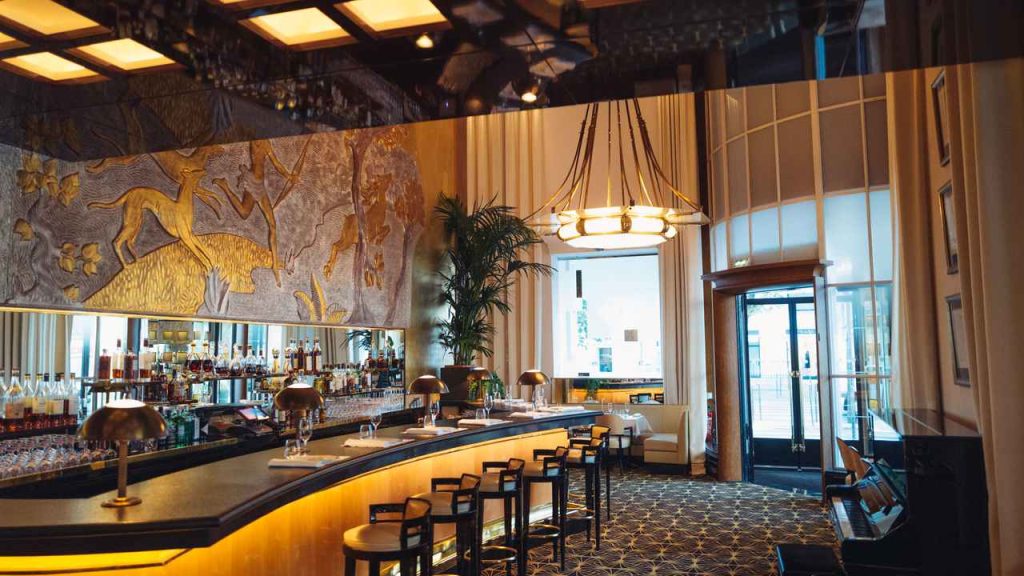
The Relais Plaza opened in 1936, and its dining room remains one of the hotel’s most persuasive historical interiors. Designed by Constant Lefranc, its Art Deco vocabulary was inspired by the first-class dining room of the ocean liner Normandie. The reference captures the glamour of a period when travel, modern design and elaborate social rituals were closely connected. It also gives the restaurant an architectural identity independent of changing menus and culinary fashions.
Today Le Relais Plaza continues as a classic Parisian brasserie, with Victoria Boller named by the hotel among its culinary leaders. The setting invites a different kind of meal from the formal gastronomic restaurant: one shaped by conversation, familiarity and the traditions of French brasserie cooking. The room is not a reconstruction staged for a heritage exhibition. It remains a functioning restaurant, where the history of the design is part of the atmosphere of an ordinary lunch or dinner.
The distinction is important because the Plaza Athénée’s dining offer has never been a single story. It includes formal gastronomy, a historic brasserie, informal social spaces and seasonal outdoor dining. Each venue serves a different moment. The Relais, with its maritime Art Deco inspiration, speaks particularly clearly to the hotel’s ability to carry an older style into contemporary life without reducing it to nostalgia.
A new chapter for the gastronomic restaurant
The palace’s gastronomic restaurant has entered a new phase in 2026 under the name La Grande Table du Plaza Athénée. Current Dorchester Collection material identifies executive chef Jocelyn Herland and chef Anthony Di Prospero among the figures shaping the culinary offer, alongside pastry chef Angelo Musa. The official restaurant information describes the gastronomic table as holding two Michelin stars. These are current distinctions and appointments; they should not be confused with the chefs or restaurant concepts associated with earlier periods of the hotel’s history.
The restaurant is presented as a contemporary exploration of French fine dining. Its importance lies partly in the challenge of renewing a celebrated institution. A palace restaurant must satisfy visitors who arrive with expectations formed by its reputation, yet a serious kitchen cannot survive by repeating yesterday’s achievements indefinitely. The new identity suggests a willingness to treat the culinary programme as something living rather than as a museum of past triumphs.
Angelo Musa’s pastry work forms another part of the hotel’s gastronomic personality. The precision and imagination associated with high-level French pâtisserie are particularly at home in a palace that treats afternoon tea and desserts as occasions in their own right. Rather than invent a dish or attribute an old menu to the current team, the more useful observation is that the hotel continues to invest in the full range of culinary experiences, from a formal tasting dinner to a beautifully prepared afternoon sweet.
For travellers planning a meal specifically around the gastronomic restaurant, reservations and opening days should be confirmed directly. A restaurant’s culinary leadership and menu can evolve; what remains constant is the role of gastronomy in the Plaza Athénée’s public identity.
La Galerie, the courtyard and the theatre of everyday life
Not every memorable moment at a grand hotel takes place at a formal dinner table. La Galerie, redesigned by Bruno Moinard, is one of the palace’s most recognisable gathering places. Its connection to the courtyard and its carefully composed interiors make it a setting for breakfast, a light meal, a meeting or afternoon tea. These less ceremonial occasions often reveal the true social character of a hotel more clearly than its grandest events.
La Cour Jardin offers a striking change of mood. Protected from the avenue by the surrounding buildings, the courtyard becomes an outdoor dining space in warmer months. In winter, the hotel has used it for a seasonal chalet and ice rink, transforming a sheltered urban garden into a festive setting. The appeal lies in the contrast: the busy world of avenue Montaigne on one side, a quieter enclosed space on the other.
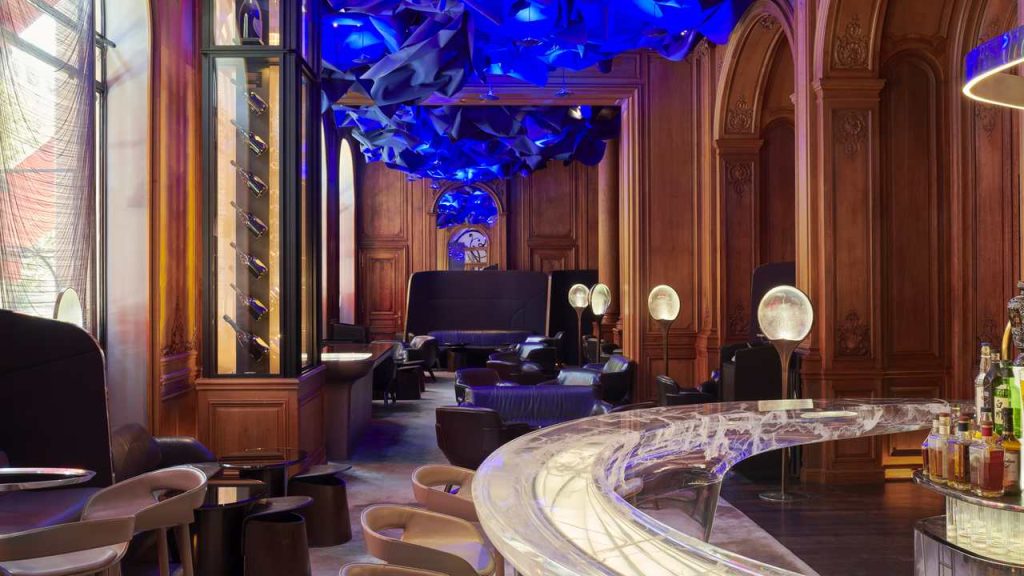
La Terrasse Montaigne, by contrast, faces the street and makes the surrounding fashion district part of the experience. It is an address for observing the movement of the avenue while enjoying a meal or drink. The hotel’s Bar offers another atmosphere, more intimate and deliberately contemporary, with cocktails and champagne as part of its identity.
Together, these spaces explain why Plaza Athénée is not merely a place where visitors sleep. It is a series of social stages, each with its own degree of privacy and formality. One can move from the public life of the avenue to the courtyard, from a brasserie table to the calm of La Galerie, and from a busy afternoon to an evening drink without ever losing the sense of being in Paris.
The Dior Spa and the value of slowing down
The Dior Spa Plaza Athénée brings another dimension to the hotel’s relationship with the world of couture and beauty. The property also offers a fitness studio, allowing guests to balance the pace of the city with time devoted to exercise or wellbeing. The spa’s identity is rooted in the Dior name, but its role within the hotel is practical as well as symbolic: it gives visitors a reason to slow down between appointments, shopping and cultural excursions.
Paris can be an exhausting destination when approached as a sequence of obligatory sights. The temptation to fit every museum, boutique and restaurant into a short stay is considerable. A well-located hotel changes the possibilities. Guests can return for a treatment, rest before dinner or simply spend an hour away from the streets. Such pauses are not a retreat from the city; they can make the rest of the visit more enjoyable.
Wellbeing offerings are also among the services most likely to change in detail, from treatment menus to specialist appointments. The hotel’s official spa information is therefore the appropriate place to confirm availability and book ahead. The enduring attraction is the broader idea: the luxury of choosing one’s own rhythm in a capital that always offers more to do.
An address that belongs to Paris
Avenue Montaigne remains one of the most concentrated expressions of Parisian luxury, but the Plaza Athénée’s location also invites visitors to explore beyond its boutiques. The Théâtre des Champs-Élysées recalls the artistic life of the neighbourhood at the time of the hotel’s opening. The Seine, the bridges towards the Left Bank and the museums around the central districts are within reach. The Eiffel Tower, so often glimpsed from the hotel’s most coveted rooms, is also a reminder that the surrounding city is the ultimate attraction.
What distinguishes the Plaza Athénée from an anonymous five-star hotel is the accumulation of relationships: with the theatre, with Dior, with Art Deco design, with the city’s culinary life and with the rituals of a Parisian palace. None of these associations alone explains its standing. Together they make the address unusually coherent, a hotel whose different eras remain visible in the way it presents itself today.
The red awnings may be its most photographed feature, but the real achievement is the continuity behind them. A palace opened in 1913 has to remain persuasive to guests living in 2026. Plaza Athénée does so not by denying the passage of time, but by allowing the historical and the contemporary to share the same address. In a city that has long made an art of reinvention, that may be the most Parisian quality of all.
Practical Information
Hôtel Plaza Athénée · 25 avenue Montaigne, 75008 Paris, France · Official website · Email the hotel
Tags: Avenue Montaigne, Dorchester Collection, fine dining, French Heritage, Historic Hotels, luxury hotels, Paris