Behind the opera house
In central Brussels, a few footsteps separate the noise of the streets from the stillness of an enclosed courtyard. The Dominican occupies just such a threshold. A short walk from the Grand-Place and immediately behind La Monnaie, the city’s opera house, it offers a version of the Belgian capital that is less concerned with spectacle than with the pleasure of discovering what lies behind a discreet façade. Its address on Rue Léopold places guests among theatres, historic streets, restaurants and the everyday business of a European capital. Yet the hotel’s internal world has its own pace.
Brussels is often described through its institutions, its comic-strip murals or its appetite for chocolate and beer. Those are legitimate pleasures, but they scarcely exhaust the city. There is also a Brussels of unexpected courtyards, intimate galleries, ambitious contemporary design and buildings whose stories have survived repeated reinvention. The Dominican belongs to this second itinerary. It rewards the visitor who is willing to look beyond the obvious landmarks and notice how architecture can change the mood of a journey.
The property is a member of Design Hotels and brings together 150 rooms and suites, a collection of convivial public spaces and a sheltered garden courtyard. The setting is undeniably central, but the experience is not simply one of convenience. Its appeal comes from a tension between the energy of the surrounding streets and the inward-looking character of the building. Here, a city break can include both a full day on foot and the welcome prospect of returning somewhere distinctly removed from the bustle.
A site with several lives
The Dominican’s name is more than a decorative reference. A Dominican monastery was established on this site in the fifteenth century, with the hotel’s own historical account dating its foundation to 1465 under the patronage of Isabella of Portugal, Duchess of Burgundy. The community’s history was far from uninterrupted. Religious conflict, destruction, reconstruction and the political upheavals of the eighteenth century altered the complex repeatedly. The last friars were expelled in 1796, and the former monastery was subsequently demolished.
The distinction is central to the story. The present hotel should not be mistaken for an intact medieval abbey transformed room by room into guest accommodation. Its historical identity rests on the site and on architectural references that interpret that past. The designers have drawn on the vocabulary of cloisters, arches and enclosed spaces, giving the building an atmosphere that recalls the former religious precinct without pretending that every visible surface is centuries old.
The address also carries a striking artistic connection. Jacques-Louis David, the French neoclassical painter whose career had been entangled with the French Revolution and the Napoleonic era, settled in Brussels during his exile. He lived on Rue Léopold from 1816, and the façade of his former home was incorporated into the hotel. David worked here on his late painting Mars Being Disarmed by Venus and the Three Graces, completed in 1824 and now in the Royal Museums of Fine Arts of Belgium.
There is something particularly Brussels-like about this layering of lives: a religious community, a painter in exile, and a modern hotel sharing one urban address across different centuries. The result is not a museum hotel. It is a contemporary place whose atmosphere becomes more interesting when its history is understood.
Architecture with a sense of theatre
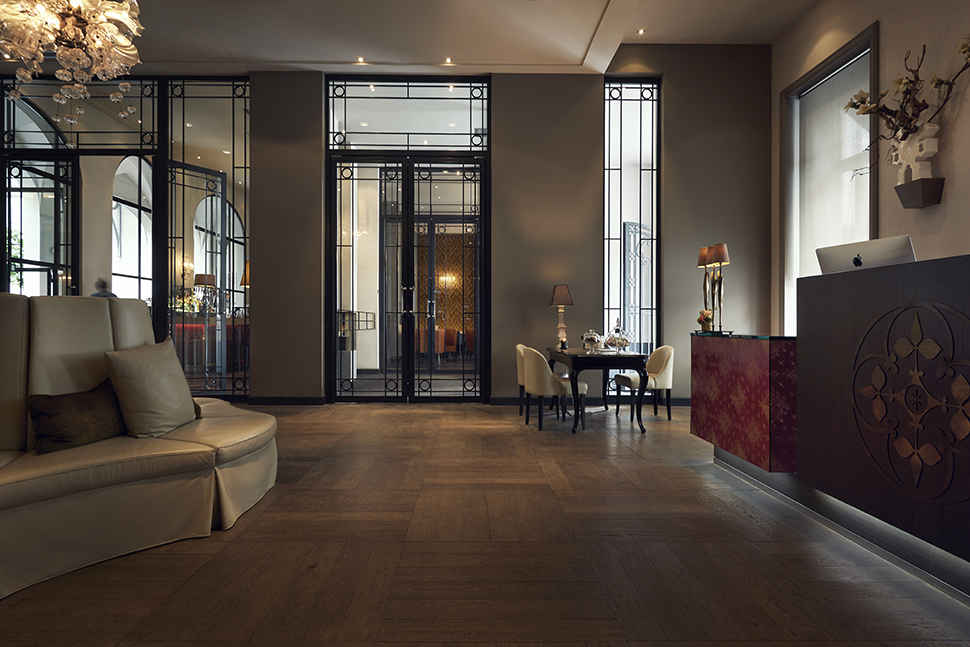
The interiors were conceived by the Dutch design studio FG Stijl, which approached the historical references as material for a contemporary hospitality experience rather than a literal reconstruction. The effect is at once polished and intimate. Tall volumes, carefully orchestrated lighting, textured finishes and richly furnished seating areas provide a visual language that feels appropriate to a building just behind an opera house.
The relationship between public and private space is central to the design. The Grand Lounge invites guests to linger; the bar has the quality of an urban meeting place; and the courtyard creates a different, quieter focus. Instead of relying on one spectacular gesture, the hotel allows its character to emerge through transitions. The movement from street to entrance, from lounge to garden and from corridor to room is part of the experience.
A successful city hotel must perform several roles in a single day. It is a base for exploration in the morning, a place to conduct business in the afternoon, and somewhere to meet or retreat in the evening. The Dominican’s design acknowledges these changing demands. It can feel sociable without being relentlessly public, and stylish without requiring guests to treat the surroundings as an exhibition.
For travellers interested in architecture, the hotel also illustrates a wider European approach to adaptive urban design. The most persuasive projects do not erase the memory of a site, nor do they allow historical references to dictate every modern decision. They find a conversation between the two. At The Dominican, that conversation is expressed through proportion, atmosphere and the careful staging of spaces.

Rooms designed for the pause between excursions
Across its 150 rooms and suites, the hotel develops a consistent language of comfort, warm materials and restrained theatricality. The accommodation is contemporary rather than monastic in any literal sense, but the idea of retreat remains. Courtyard-facing rooms are especially attractive to visitors who want a degree of separation from the streets outside, while other outlooks keep the urban setting in view.
The room categories vary, and prospective guests should compare layouts and outlooks rather than assume that every room offers identical features. The hotel’s current descriptions emphasise carefully chosen textiles, decorative objects, Roberts radios and bathrooms with rain showers or deep baths according to category. These are details that serve the experience rather than merely decorate a checklist.
For a weekend in Brussels, the real luxury may be the freedom to move without a complicated plan. One can return between a museum visit and dinner, leave purchases behind before another walk, or simply spend an hour reading while the city continues beyond the windows. A central hotel becomes much more valuable when its interiors make such pauses inviting.
The larger suites extend this sense of residential comfort. Yet the essential appeal is not measured only in square metres. A memorable room provides a convincing change of rhythm. It makes a guest feel that returning to the hotel is an integral part of the journey, not merely the interval between excursions.
The Grand Lounge, the bar and the garden
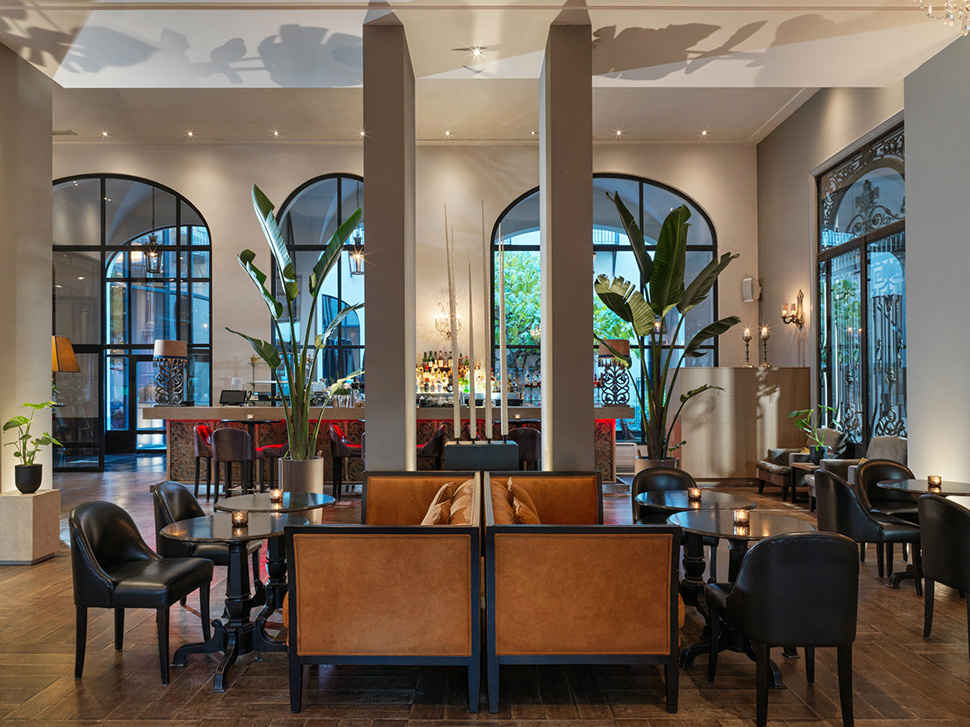
The Grand Lounge is the hotel’s social centre, a place for meals and conversation beneath generous architectural volumes. Its menu is described by the hotel as drawing on familiar international classics, an approach suited to a property welcoming both international visitors and Brussels residents. The appeal is apparent without a signature dish: the setting itself makes an unhurried lunch or evening meal part of the stay.
The Lounge Bar offers a different tempo. With plush seating and a cocktail-led identity, it is conceived for the hour when a day of sightseeing or meetings gives way to conversation. Brussels has no shortage of lively cafés and bars, but the option of a well-composed hotel lounge can be particularly welcome after a long day in the city.
Then there is the courtyard, one of the property’s defining assets. Sheltered by the surrounding architecture and furnished as an outdoor gathering place, it introduces greenery and open air into an exceptionally central location. The hotel’s dining information draws attention to a fig tree in the garden. In favourable weather, the courtyard provides the setting for an outdoor drink or meal, though seasonal arrangements should always be checked directly with the property.
Together, these spaces make the hotel more than a collection of bedrooms. They allow a stay to expand or contract according to mood: a lively drink, a business conversation, a quiet table or a few moments outdoors. This flexibility is a substantial part of its urban charm.

A capital best discovered on foot
The Dominican’s location encourages a kind of travel that suits Brussels particularly well: walking without treating every turn as a scheduled attraction. The Grand-Place is close enough to visit early, before the square fills, or after dark, when its façades take on a different character. Around it, narrow streets lead to independent shops, historic cafés and a constantly changing assortment of places to eat.
La Monnaie gives the immediate neighbourhood a cultural anchor. Visitors with an interest in music and performance can check the opera house’s programme before travelling. Beyond it, the city offers an unusually varied artistic landscape, from the Royal Museums of Fine Arts to smaller contemporary spaces and the graphic culture that has made Brussels internationally recognisable.
The city’s pleasures are not confined to its most famous institutions. A day might move between an exhibition, a bookshop, a chocolate maker and a long lunch, with architecture providing the connecting thread. Brussels rewards curiosity rather than rigid itineraries. Its charm is often found in the transition from a monumental boulevard to an unexpectedly domestic street.
For those extending the trip, the Belgian railway network opens up possibilities beyond the capital. But the temptation to treat Brussels merely as a transport hub would miss the point. Its restaurants, design scene, museums and layered urban history deserve time in their own right. The Dominican is well positioned for visitors who want to give the city that attention.
A thoughtful kind of city luxury
Luxury in a capital city need not mean seclusion from everything that makes the destination interesting. At its best, it means having the choice: to step directly into the cultural life of the city or to withdraw for a while without travelling across town. The Dominican succeeds as a proposition because its architecture, setting and hospitality spaces are organised around that choice.
It is also a reminder that a hotel’s story can be genuinely valuable when treated with care. The former Dominican monastery and the presence of Jacques-Louis David are not interchangeable anecdotes. They belong to this particular street, and they help explain why the hotel feels different from a generic international address. The distinction is subtle but important: history becomes meaningful when it clarifies the identity of a place rather than merely supplying atmosphere.
The hotel has facilities for meetings and celebrations as well as leisure stays, reflecting Brussels’ dual life as a cultural destination and a centre of international business. Yet its most compelling quality is the way these functions coexist with the courtyard and the intimate character of its interiors.
For a traveller seeking a stylish Brussels base with a sense of place, The Dominican offers a persuasive combination: an exceptional central location, a design identity rooted in local history, and enough inviting spaces to make time spent inside the hotel feel as rewarding as time spent outside. In a city that often reveals itself gradually, that is a particularly fitting form of hospitality.
Practical Information
The Dominican Brussels