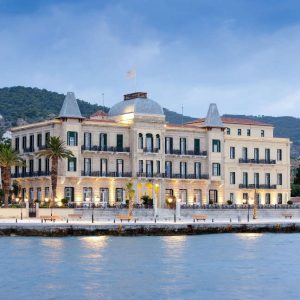
Saint-Tropez across the water
Saint-Tropez is a place that has spent decades turning its own mythology into a destination. The harbour, the cafés, the boats and the crowds are familiar long before a first visit. Across the gulf, however, a different version of the Riviera survives: one of wooded estates, long terraces and an old palace looking towards the water. COMO Le Beauvallon occupies this quieter shore, on the Grimaud side of the bay, where the Mediterranean is less a backdrop to public performance than the organising presence of the landscape.
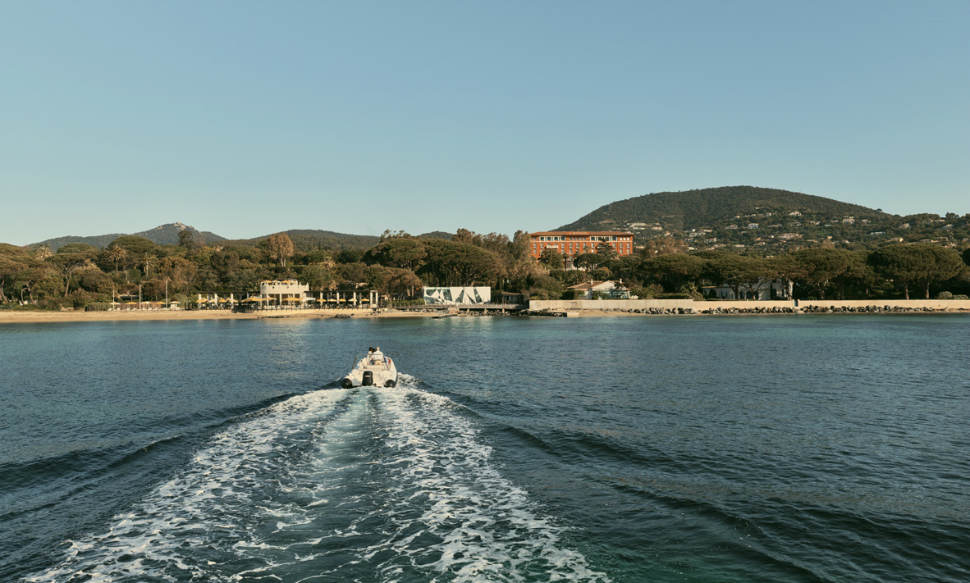
The distinction is geographical as much as emotional. From the hotel, Saint-Tropez is close enough to remain part of the day, yet distant enough to be viewed as a panorama. A complimentary speedboat connection, advertised by the property as an eight-minute crossing to the port, changes the familiar logistics of the gulf. Instead of negotiating the roads at their busiest, guests can approach the village from the sea. The journey itself becomes an introduction to the setting: the coast, the boats and the harbour unfolding in a few minutes.
The property returned as COMO Le Beauvallon on 24 April 2026. It is not a newly invented resort but a substantial reimagining of a hotel that first opened in 1914. Its ten-acre grounds, 42 rooms and suites, gardens, pools and waterfront facilities offer a rare combination in a destination where space and privacy have become increasingly precious. The appeal is not simply that Saint-Tropez is accessible. It is that guests can choose when to join its energy and when to leave it behind.
A palace born in the Belle Époque
Le Beauvallon’s origins belong to the extraordinary period when the French Riviera was being transformed into an international winter and summer playground. Opened in 1914 as Le Golf Hôtel, the original 100-room palace was designed by Swiss architect Julien Flengenheimer for the Bernheim brothers. Its scale and ambition reflected a world in which grand hotels were destinations in themselves, built to accommodate extended stays and the elaborate social rituals of their guests.
The timing was dramatic. The First World War began in the same year, and the hotel was requisitioned as a military hospital. It would again serve as a hospital during the Second World War, before resuming its role in the Riviera’s social life. The building therefore carries a history far more complicated than a succession of glamorous summers. Its endurance speaks to the changing fortunes of the coast and to the capacity of a grand building to be adapted to very different needs.
In the decades that followed, Le Beauvallon became associated with figures from literature, politics and cinema. The hotel’s historical materials name Colette, F. Scott Fitzgerald, Winston Churchill and the poet Paul Géraldy among its visitors. Such names are compelling, but the greater story is the development of a place where artists, travellers and society figures could find a measure of distance from the more public Riviera scene. That balance between sociability and retreat remains essential to its contemporary identity.
After closing as a conventional hotel in 2008, the estate underwent restoration and later operated for private events. A limited return to individual guest stays began in summer 2025, before the full COMO reopening in April 2026. This chronology matters: the present hotel is the result of several stages of revival, not an uninterrupted century of operation.
Ten acres between the pines and the sea
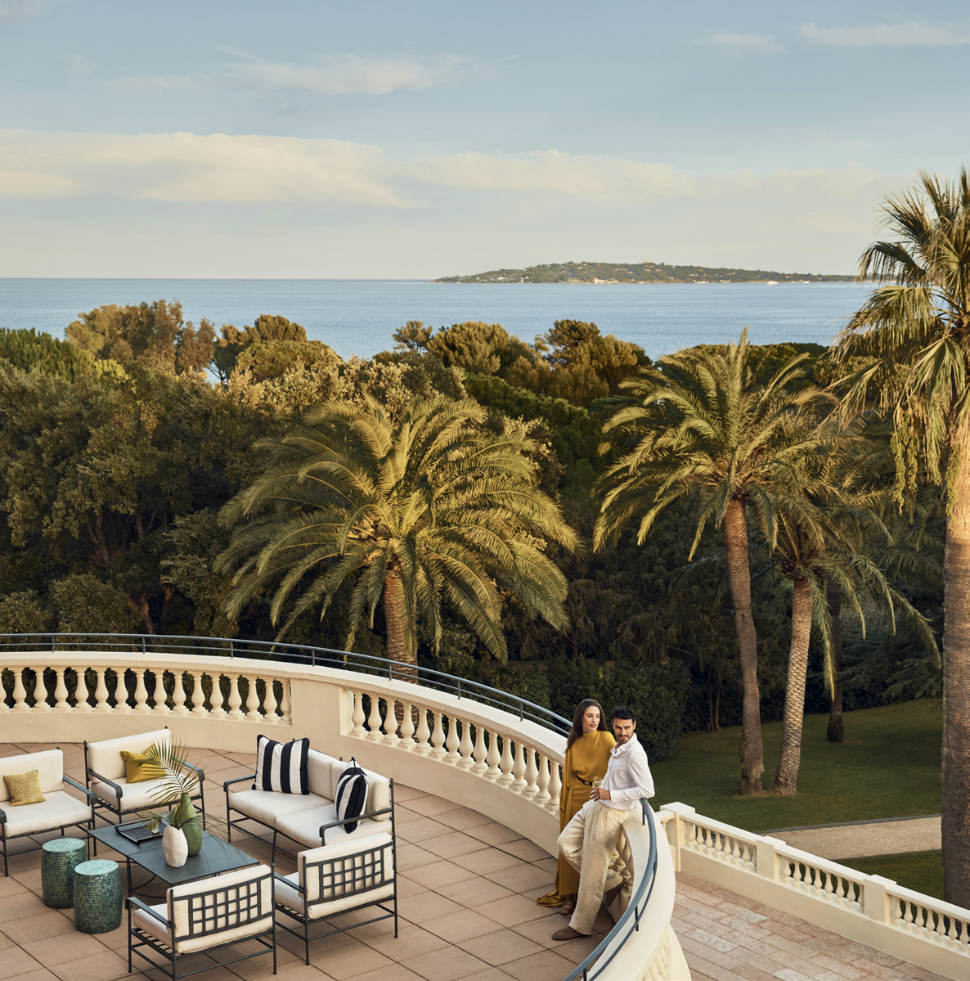
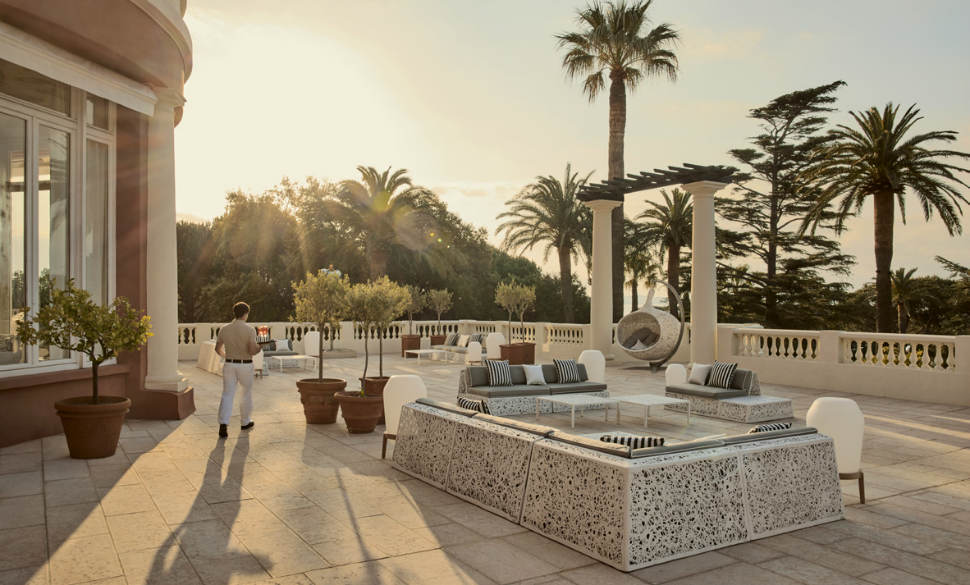
The landscape is arguably the hotel’s greatest asset. Ten acres of lawns, terraces and gardens descend from the main building towards the waterfront. Palms and umbrella pines provide a distinctly Mediterranean canopy, while the estate’s elevation opens perspectives across the Gulf of Saint-Tropez. Unlike a compact beachfront property, Le Beauvallon has room for the experience to unfold gradually. Guests move between the palace, garden paths, the swimming pool and the water rather than occupying a single crowded terrace.
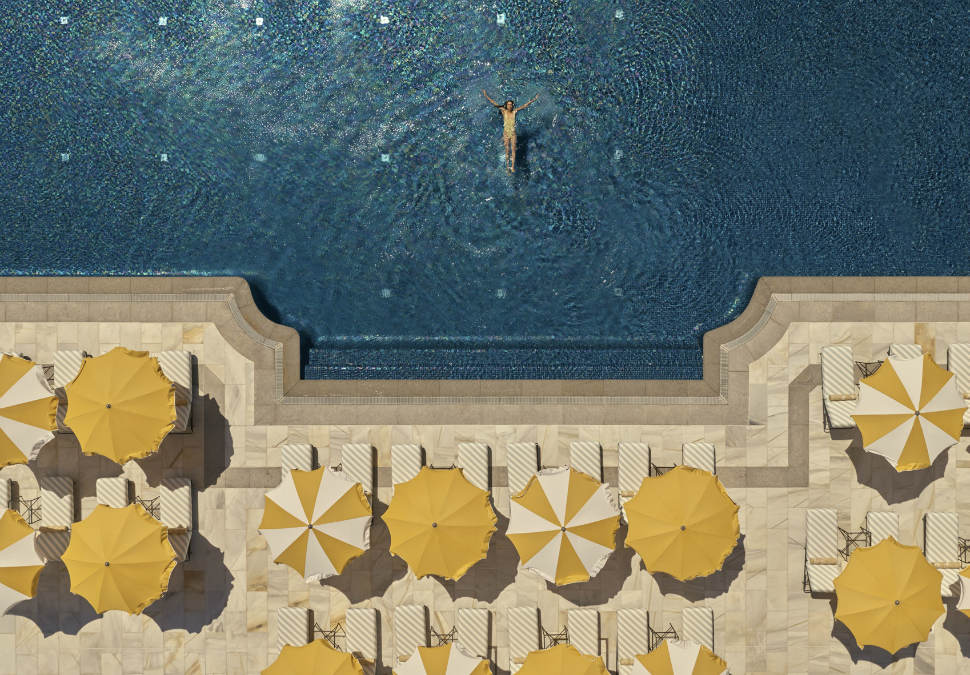
The hotel’s current presentation describes a 25-metre pool and a private pontoon for yacht tenders. At the shoreline, the Beauvallon Sur Mer beach-club complex introduces a more sociable atmosphere, with dining, a lounge and a rooftop bar. These spaces are connected to the larger estate, yet their mood differs from the calm of the main hotel. The contrast gives the property a useful versatility: an afternoon may be spent reading under the trees, followed by dinner near the water without leaving the grounds.
The geography also offers a perspective on the Riviera’s enduring appeal. The coast is not only a collection of fashionable addresses; it is a meeting of hills, light, gardens and sea. At Le Beauvallon, that relationship is unusually legible. The main building looks outward across the gulf, while the grounds provide a sequence of more intimate views. Privacy comes from the landscape as much as from the architecture.
For visitors who know Saint-Tropez chiefly through its summer crowds, this side of the bay can feel like a different destination. It does not deny the glamour of the region. Instead, it restores something of the leisurely distance that once made the Riviera’s great estates so desirable.
Rooms that acknowledge the view
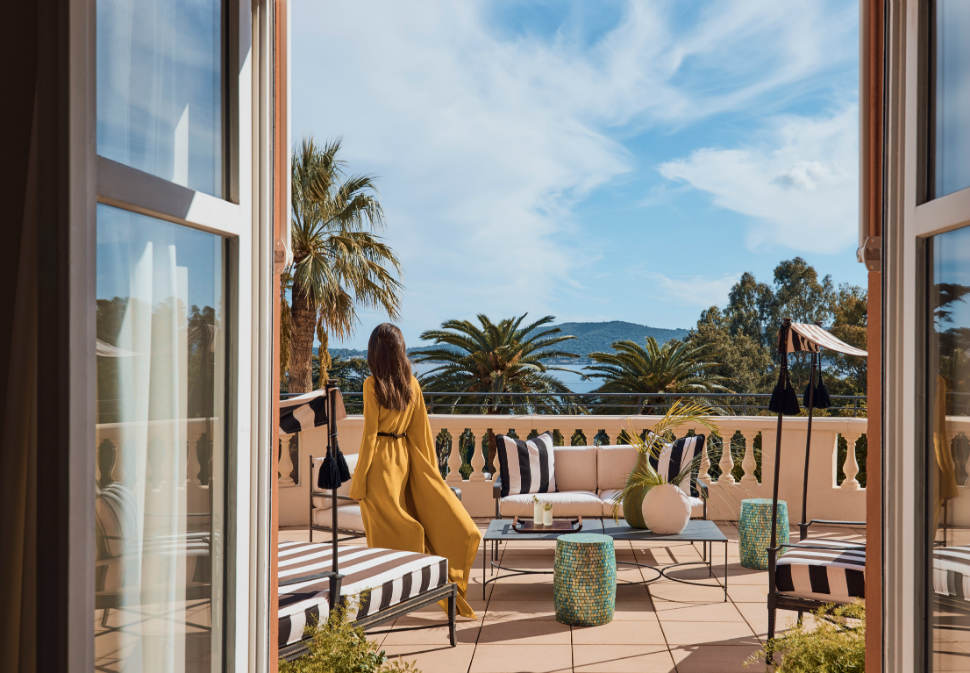
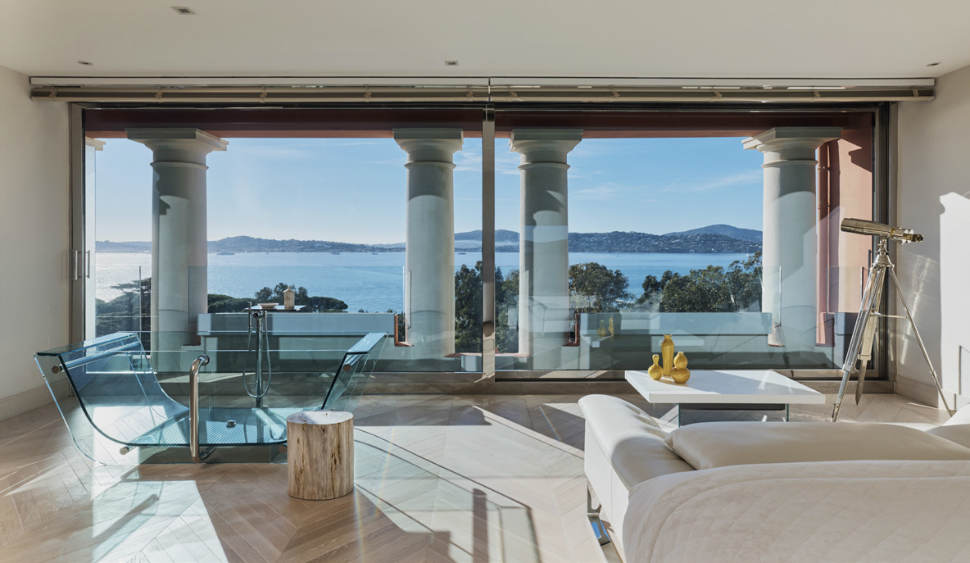
The 2026 reopening established a collection of 42 rooms and suites, replacing the scale of the original 100-room palace with a more spacious contemporary approach. Some accommodation faces the gulf, while other rooms look towards the estate’s greener surroundings. The variety makes room selection important: the experience of waking to the sea differs considerably from that of overlooking the gardens or hills.
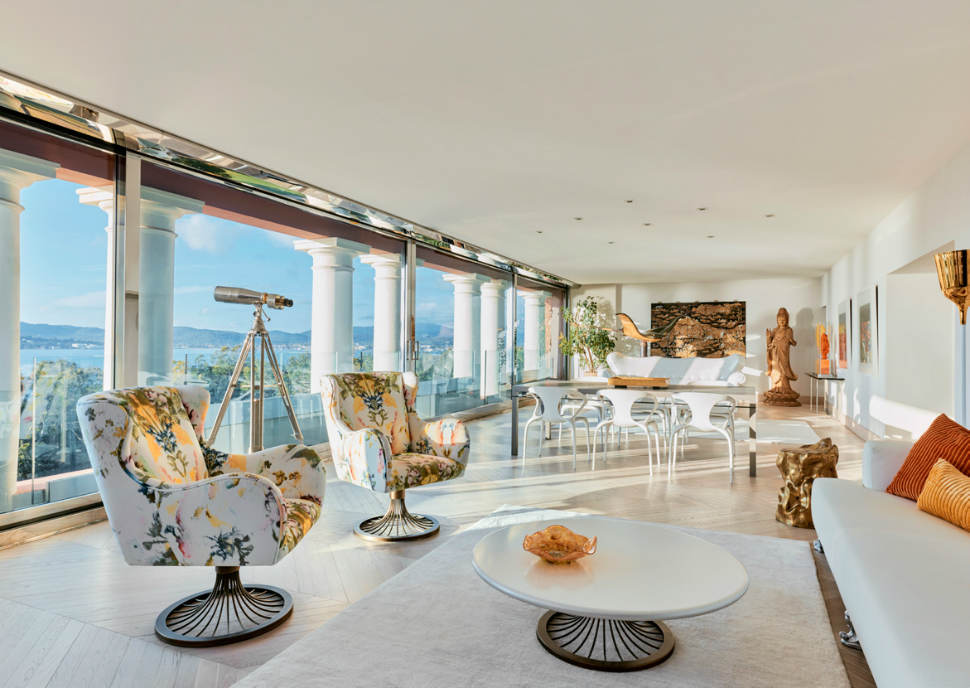
COMO’s design language generally favours calm, carefully balanced interiors, and the Riviera property brings that sensibility into dialogue with the proportions of a Belle Époque building. The aim is not to reproduce the interiors of 1914. It is to make a historic palace comfortable for guests whose expectations include generous bathrooms, intuitive technology and the freedom to spend time privately in their rooms.
The sea-facing suites are naturally among the property’s most distinctive offerings. Here, the view is not a decorative bonus but part of the room’s identity. The light changes through the day; boats move across the gulf; the far shore takes on a different character towards evening. Such details give a room a connection to place that no amount of generic luxury styling can replace.
The collection also includes the COMO Suite, positioned by the hotel as a signature accommodation. Prospective guests should compare the current room descriptions and layouts rather than assume that every category includes the same terrace, outlook or facilities. At a property defined by its varied spaces, those differences can determine the shape of a stay.
Yannick Alléno and a cuisine with two horizons
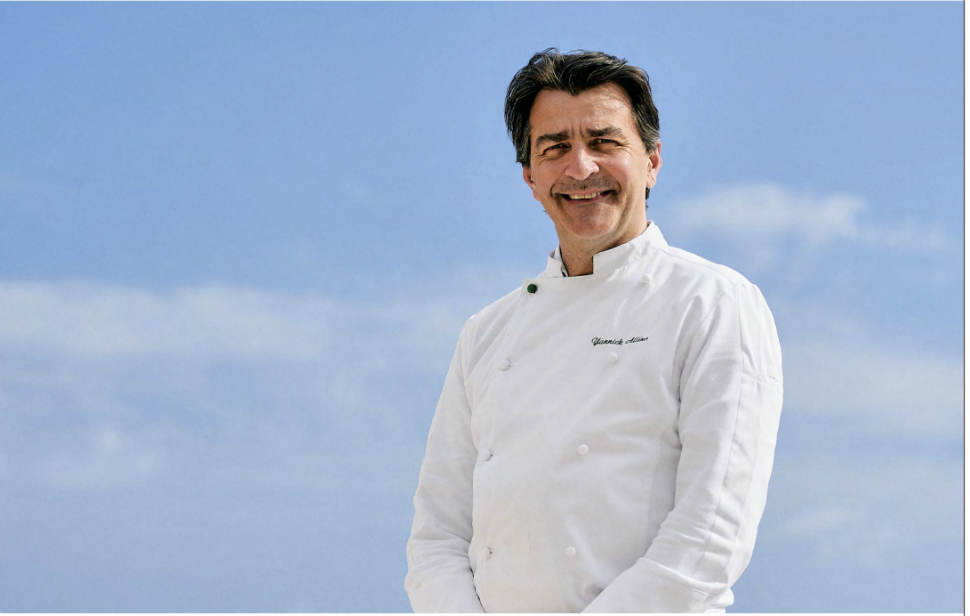
The culinary programme is central to the hotel’s new identity. COMO entrusted its direction to Yannick Alléno, whose approach at Le Beauvallon moves between Mediterranean traditions and a wider international vocabulary. The most striking expression is Beauvallon Sur Mer by Yannick Alléno, the waterfront restaurant that combines the atmosphere of a Riviera beach club with a menu drawing on Southeast Asian and Mediterranean influences.
The pairing makes sense in this particular location. The Riviera has always been an international crossroads, its hospitality shaped by visitors from across Europe and beyond. Alléno’s cuisine acknowledges that history without treating Provençal ingredients as a fixed repertoire. The intention, according to the chef’s own account, is a conversation between different culinary traditions, with attention to flavour, texture and the pleasure of eating beside the sea.
The setting is part of the proposition. Beauvallon Sur Mer extends beyond a conventional dining room to include a lounge and panoramic rooftop, making it a place for a long lunch, an evening meal or drinks as the light changes over the gulf. It is a destination within the destination, and one that can be approached by sea as well as from the hotel gardens.
The Winter Garden offers a contrasting experience. Under a light-filled glass roof, the restaurant draws on Mediterranean cooking, Niçoise influences and French classics. It serves as an all-day social space, connecting the heritage of the main building with the informal pleasures of contemporary Riviera dining. Rather than requiring guests to adopt a single culinary mood, the hotel offers distinct settings for different hours and occasions.
Specific menus, opening periods and reservations should be checked directly. What endures beyond the individual dishes is the ambition to make gastronomy an integral part of the estate’s identity, not merely an amenity added to the accommodation.
Design, art and the architecture of leisure
The revival of Le Beauvallon raises an interesting question: how does a hotel preserve the authority of a century-old palace while creating spaces that belong to the present? The answer is not a uniform period style. The project allows historic architecture, contemporary furnishings and art to coexist, preserving the building’s sense of occasion while avoiding the weight of excessive nostalgia.
At Beauvallon Sur Mer, French designer Dorothée Delaye was commissioned to reinterpret the Belle Époque atmosphere. The design references include wrought-iron curves, carefully worked timber and details that evoke the craftsmanship of classic Riviera boats. The effect is not a literal reconstruction but a new setting shaped by the visual memory of the coast. Such references are most persuasive when they remain connected to the experience of being beside the Mediterranean.
Contemporary art adds another dimension to the estate. The property’s reopening materials describe an extensive collection of works and the presence of a pavilion originally created by Toyo Ito for the Serpentine Gallery in 2002, subsequently relocated to the grounds. The pavilion gives the landscape a surprising architectural counterpoint: an experimental structure set against the more formal language of the Belle Époque palace.
This conversation across periods is one of the hotel’s most distinctive qualities. A visitor encounters not one frozen historical moment but a sequence of ideas about leisure, design and beauty. The palace speaks of the early twentieth century; the contemporary interventions belong to another era; the landscape ties them together. The result is a Riviera property that treats heritage as a living resource rather than a costume.
Wellness in the COMO tradition
The hotel’s wellness offering brings the COMO Shambhala philosophy to the Mediterranean. The brand’s approach combines treatments, movement and a broader interest in balanced living, and the Riviera property includes treatment spaces and opportunities for yoga and fitness. These facilities sit comfortably within the estate’s larger rhythm, where gardens and the sea already encourage time away from the pressures of a busy itinerary.
Wellness here need not become an elaborate programme. A morning swim, a walk through the grounds and a treatment before dinner can be enough to alter the tempo of a holiday. Guests seeking a more structured experience can explore the current COMO Shambhala treatments and classes, checking schedules and availability with the hotel before arrival.
The connection between wellness and food is also part of the brand’s identity. COMO Shambhala Kitchen is associated with lighter, nutrition-conscious dishes that complement the broader dining programme. This is not a substitute for the indulgence of a long Riviera lunch, but an additional choice. The property’s strength lies in allowing different approaches to coexist.
It is tempting to describe every Mediterranean hotel as a sanctuary, but the word has meaning only when supported by space and a genuine capacity to withdraw. Le Beauvallon’s wooded grounds, multiple terraces and distance from the busiest streets give that promise a physical basis. The setting does much of the work before a guest has booked a treatment.
The freedom to cross the gulf
One of the property’s cleverest advantages is the boat connection to Saint-Tropez. The hotel advertises a complimentary crossing of approximately eight minutes to the port, transforming a journey that can be frustrating by road into an excursion across the water. It allows guests to experience the village’s boutiques, cafés and harbour without making the traffic an unavoidable part of the day.
There is also access by boat towards the beaches of Pampelonne, according to the hotel’s reopening announcement. These services are subject to the hotel’s current arrangements and operating conditions, so travellers should confirm schedules and availability. The essential point is that the gulf becomes a means of connection rather than a barrier between the quiet estate and the social life of Saint-Tropez.
The location also encourages exploration of the less celebrated parts of the coastline. Grimaud and the surrounding villages offer different perspectives on the region, while the hills above the sea provide a reminder that the Riviera is more than its beach clubs. A stay can move between cultural excursions, a market visit, time on the water and an afternoon without plans.
That flexibility is the defining luxury of the address. The hotel does not ask guests to choose between seclusion and the attractions of Saint-Tropez. It offers a way to experience both, with the freedom to decide how much of each belongs in the day.
A Riviera legend, returned to the present
The return of Le Beauvallon is significant because it gives new life to a historic building without reducing its identity to nostalgia. The 1914 palace, its wartime history, its artistic associations and its long years of transformation remain part of the story. But the hotel now has to succeed on the terms of contemporary travel: comfort, service, gastronomy, wellness and the quality of time spent in its spaces.
Its strongest advantages are unusually concrete. The ten-acre estate provides room to breathe. The elevated position offers broad views of the gulf. The waterfront restaurants and beach club create a lively counterpoint to the main building. And the boat transfer places Saint-Tropez within easy reach while preserving a sense of distance from its crowds.
For travellers drawn to the Riviera’s architectural heritage, Le Beauvallon offers an opportunity to inhabit a surviving grand-hotel landscape rather than merely admire it from outside. For those more interested in food, the involvement of Yannick Alléno provides a reason to explore the estate’s restaurants. For guests seeking a slower holiday, the gardens and sea-facing rooms may be sufficient attractions in themselves.
The finest Riviera hotels do not need to manufacture an atmosphere. They have a relationship with the coast that becomes apparent in the way a building meets the light, a garden descends towards the water or a terrace frames the opposite shore. At COMO Le Beauvallon, that relationship has survived more than a century of change. Its new chapter is most compelling when it lets the landscape, rather than the legend, speak first.
Practical Information
COMO Le Beauvallon