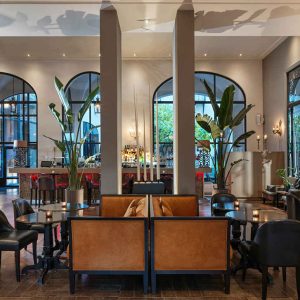
A private address beside the Madeleine
Paris has perfected the grand entrance. Its grand hotels have turned the lobby into a public theatre, with marble, flowers and the reassuring choreography of a famous address. Hôtel de Pourtalès, at 7 Rue Tronchet in the eighth arrondissement, proposes something more private. The building has the stature of a historic mansion, but its contemporary hospitality is organised around the freedom of staying in a beautifully appointed Parisian residence. The pleasure is not necessarily to be seen arriving. It is to have a place in the city that feels entirely one’s own.
From the Madeleine, the neighbourhood opens in several directions. The boutiques of the Faubourg Saint-Honoré are within walking distance, the Opéra district offers another version of Parisian spectacle, and the broad urban perspectives around Place de la Concorde are close at hand. This is an excellent base for visitors who want to experience Paris on foot, allowing a morning of exhibitions or shopping to develop into an unscripted afternoon. The hotel’s appeal lies partly in how easily one can return, close the door and change the pace of the day.
A private apartment changes the experience of a city in ways that go beyond square footage. It changes how guests use the city. Breakfast need not be a public occasion. A conversation can take place in one’s own sitting room. Families and friends can gather without commandeering a restaurant table, while travellers working between appointments can preserve a degree of domestic order. At Pourtalès, those possibilities are supported by hotel services rather than left to the guest to arrange alone.
A nineteenth-century mansion with an artistic past
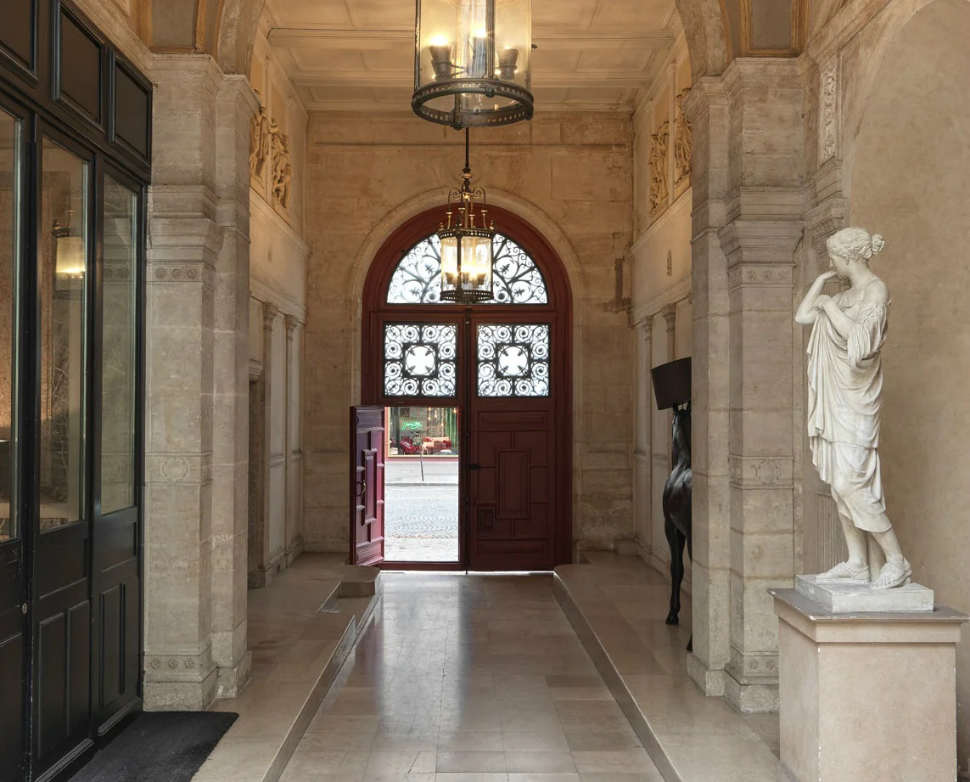
The story begins in 1839, when architect Félix Duban built the mansion for Count James-Alexandre de Pourtalès. The official French heritage register describes a façade inspired by Florentine palaces of the Quattrocento, an unusual architectural gesture that gives the address a character distinct from the more familiar image of Haussmannian Paris. Inside, a monumental staircase once led to the count’s apartments and art collection. The building was conceived not only as a residence but also as a setting for collecting and display.
The mansion did not remain unchanged. The heritage record identifies alterations in 1865–66 and 1869–70, with Hippolyte Destailleur among the architects associated with its later history. Subsequent adaptations reflect the many lives of a major Parisian property. In 2002 the entire hôtel particulier, together with its plot, was listed as a Monument historique. That protection is more than a decorative accolade: it recognises an architectural history worth safeguarding while the building continues to serve contemporary purposes.
Understanding this past makes the present-day experience more interesting. Historic residences can be turned into hotels in ways that either flatten their identity or make it almost impossible to live comfortably within them. Here the proposition is different: contemporary interiors and services inhabit a place with a documented architectural pedigree. The old and the new need not compete. The elegance of the setting comes from the tension between a mansion designed for nineteenth-century collecting and a residence conceived for today’s mobile, privacy-conscious traveller.
The luxury of having room to live
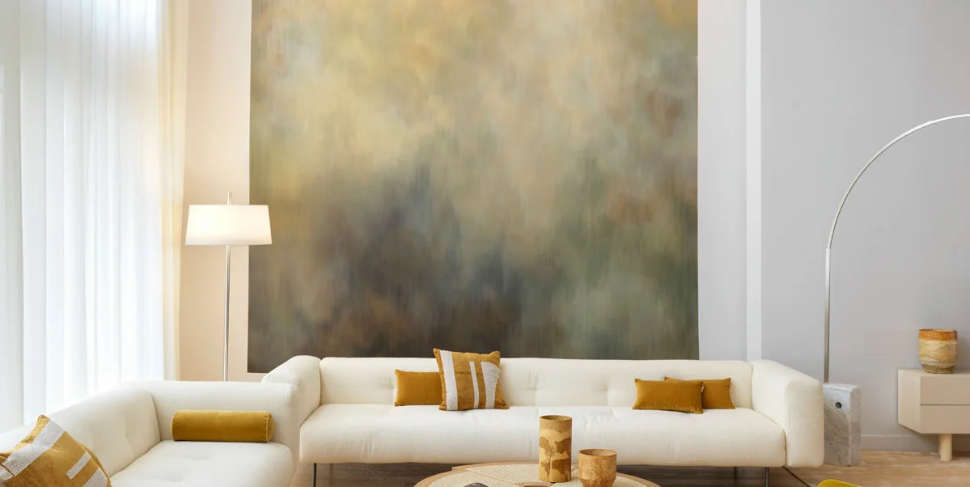
The hotel’s current accommodation collection comprises eleven suites and apartments, according to its official website. This is an important correction to older descriptions that referred to nine principal apartments and separate accommodation for accompanying staff. The present inventory ranges from intimate one-bedroom suites to large family suites and penthouses. Rather than promise that every room is alike, the property presents a set of distinct addresses within the same historic building.
The Madeleine and Tronchet suites offer one-bedroom layouts of approximately 70 and 75 square metres respectively. The two-bedroom Opéra Suite, Garden Suite and Garden Loft provide alternatives for guests travelling together, with different arrangements of bedrooms, bathrooms and living areas. The three-bedroom Pourtalès Suite and Historical Penthouse draw more directly on the mansion’s heritage, while the larger contemporary configurations answer the needs of groups who want to remain under one roof.
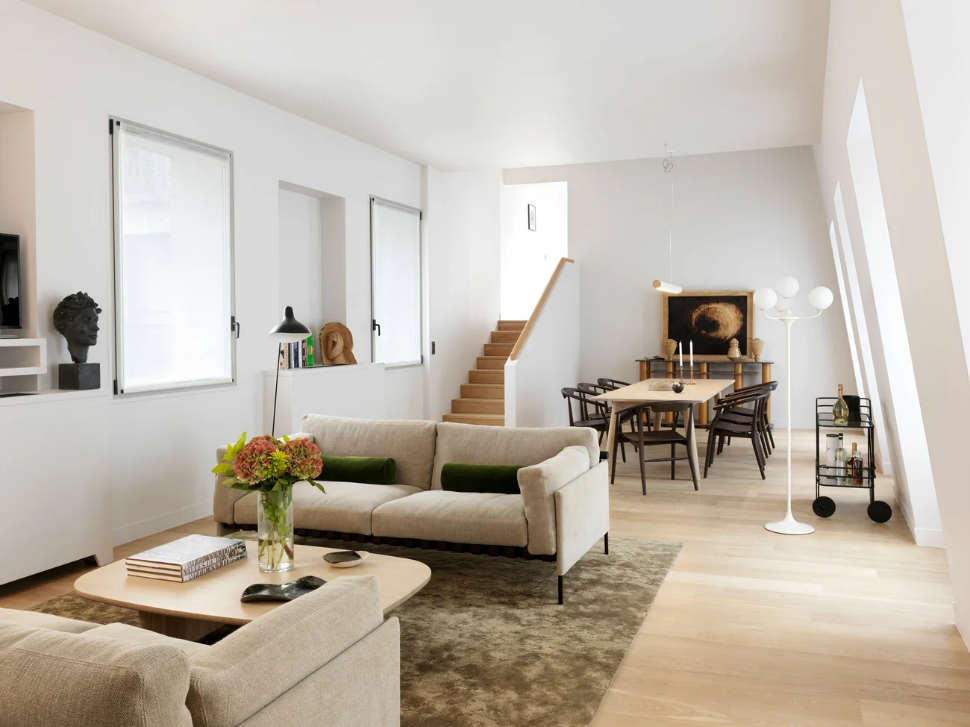
The hotel’s English accommodation pages describe fully equipped kitchens and generous reception spaces as part of the suite experience. This domestic infrastructure matters. A kitchen allows the simplest meal to become an unhurried private occasion; a proper sitting area makes it possible to host a visitor without turning a bedroom into a meeting room. For families, it can also make a demanding city itinerary more manageable. The freedom to set one’s own rhythm is the greater luxury.
Design is part of that freedom. Contemporary furnishings and clean lines sit within the scale of an old Parisian residence. Instead of attempting to reproduce a nineteenth-century interior in every detail, the rooms establish a dialogue between historical proportions and modern habits. The result is better understood as residential hospitality than as a conventional palace suite: a place for settling in, even if only for a few nights.
Gardens above and below the rooftops
Two of the property’s most remarkable accommodation options make particularly good use of outdoor space. The Garden Duplex extends over approximately 345 square metres on two levels and includes a private garden of 86 square metres. In central Paris, that combination of space and greenery changes the character of a stay. The city remains close, yet the garden offers an entirely different scale of experience: a quiet outdoor setting for conversation, reading or an intimate gathering.
At the opposite end of the spatial imagination is the Sky Penthouse, a triplex of approximately 367 square metres with a panoramic rooftop terrace of 92 square metres. The hotel’s official presentation highlights views across Paris, including the Eiffel Tower from selected vantage points. The appeal is not merely the familiar skyline. It is the possibility of experiencing the capital from above, away from the traffic and the dense geometry of the streets.
These are distinctive categories, not amenities available with every booking. Travellers considering them should check the exact suite and its configuration rather than assume that all accommodation includes a garden or terrace. That precision is essential when describing a property built around individual spaces. The difference between a courtyard outlook, a private garden and a panoramic rooftop is not incidental; it can shape the entire mood of a visit.
A private table in a gastronomic city
Paris is one of the world’s great restaurant cities, but there are occasions when the most appealing table is the one that does not require leaving home. Hôtel de Pourtalès builds its dining offer around that idea. Its current website describes gastronomy shaped by two chefs, private-chef arrangements, in-suite meals and room service. It also advertises breakfast served until 1 p.m., a small but revealing detail for guests who prefer their mornings without the discipline of a conventional dining-room schedule.
The appeal of private dining here is not that it replaces Parisian restaurants. Rather, it adds another possibility to the itinerary. One evening may belong to a celebrated dining room; the next might be spent with friends around a table in the suite. Families with young children, guests recovering from long journeys and visitors who value discretion may find the second option particularly attractive. It allows the experience of the city to continue in a more personal register.
The hotel also mentions rare-wine selections and bespoke culinary arrangements. These should be understood as services to discuss with the concierge, not as fixed inclusions with every reservation. The distinction gives guests a clearer sense of what can be arranged. The best private hospitality does not promise an identical experience to every guest; it gives people the means to create one that fits the occasion.
Service without the spotlight
A discreet address still needs a capable team. The hotel’s official services include a concierge available around the clock, private chauffeurs, personal shopping, pressing, floral arrangements and assistance with luggage. Communication is offered through familiar channels including WhatsApp, Telegram and text messages. The intention is practical: guests should be able to arrange the details of a stay without repeatedly navigating formal hotel procedures.
Wellness follows the same private-residence logic. The property advertises a fitness facility available 24 hours a day, with options for coaching, yoga, massage and professional beauty treatments in the suite. These arrangements are best confirmed ahead of arrival, particularly when a specific therapist, time or treatment is important. Their value lies in bringing services to the rhythm of the guest, rather than asking every guest to adapt to a fixed timetable.
Families are also considered. The hotel’s published services include baby equipment and support for guests travelling with children, while pets are welcomed under its stated arrangements. This is a significant aspect of the concept: the residence is not only for couples on a romantic weekend or executives seeking anonymity. It can also function as a practical, comfortable base for a multi-generational Paris visit.
Privacy is often described as an abstract luxury, but in practice it consists of many small decisions. Who comes to the door? How are transfers organised? Can a guest entertain without turning a private evening into a public event? A hotel that answers such questions well can make a city feel easier to inhabit. At Pourtalès, the published service philosophy is built around precisely that kind of attentiveness.

Paris beyond the front door
The Madeleine district is especially rewarding because it connects several versions of the capital. Its monumental church gives the neighbourhood a formal centre, but nearby streets offer the more intimate pleasures of pâtisseries, cafés, specialist shops and fashion houses. A walk towards Place Vendôme leads into the world of jewellery and grand Parisian architecture; another towards the Opéra reveals a different theatrical tradition.
The museums of central Paris are within reach, as are the Seine and the gardens that punctuate the city’s dense urban fabric. Visitors can plan ambitious days, but this is also a neighbourhood in which it is perfectly reasonable to do very little: browse a bookshop, stop for coffee, examine a shop window, return to the hotel and head out again at dusk. Such moments are not a failure of itinerary planning. They are part of the pleasure of being in Paris.
For travellers with a particular interest in design, the mansion itself provides an instructive counterpoint to the contemporary city. Duban’s Renaissance-inspired architecture belongs to a moment when Parisian patrons looked beyond France for visual ideas. The building’s subsequent transformations tell another story, that of a capital continually adapting its grand private houses to new forms of use. Staying here offers an unusually direct encounter with that process.
The pleasure of remaining discreet
Hôtel de Pourtalès is most compelling when its residential concept is allowed to speak for itself. Its character sits between the ceremony of a palace hotel and the independence of a private apartment. It occupies the space between the two, pairing residential independence with an unusually attentive range of services and the architectural character of a protected Parisian mansion.
The property will appeal especially to visitors who value privacy, to families who need space, and to travellers for whom the freedom to entertain or work in their own rooms is more meaningful than a crowded hotel lobby. Its large suites and outdoor spaces can make a longer stay particularly attractive, although the smaller configurations also offer an introduction to this quieter style of Parisian hospitality.
Ultimately, the address suggests a different way of measuring luxury. It is found in the ease of moving between city and home, in the ability to choose company or solitude, and in the pleasure of occupying a place whose history is not merely invented for the brochure. Paris supplies the theatre outside. Hôtel de Pourtalès allows its guests to decide how much of that theatre they wish to bring indoors.
Practical Information
Hôtel de Pourtalès