On the shores of the Seto Inland Sea
The most celebrated view of Miyajima is often the one seen from the island itself: the vermilion torii of Itsukushima Shrine standing against the tides of the Seto Inland Sea. KAI Miyajima offers a reversal of perspective. From the mainland shore at Miyajimaguchi, the island becomes the horizon, its wooded slopes rising above a stretch of water crossed by boats, ferries and the everyday traffic of the coast. It is a setting in which a famous destination can be encountered from a more contemplative distance.
Opened on 23 July 2026, Hoshino Resorts’ first KAI property in Hiroshima Prefecture occupies an address in Hatsukaichi rather than on Miyajima island. That geographical distinction is essential. The ryokan faces the island across the water, offering access to its cultural landmarks while remaining rooted in the quieter rhythms of the mainland shore. Guests do not sleep beside the shrine itself. They experience its landscape from across the strait, and that perspective is central to the hotel’s identity.
The opening also marks an interesting development in Japanese hospitality. KAI, the hot-spring ryokan brand of Hoshino Resorts, has made a speciality of interpreting regional culture through bathing, food, craft and design. At Miyajima, the challenge is unusually delicate. Itsukushima is not merely a picturesque landmark but a place of deep religious and historical significance. The hotel’s strongest idea is therefore not to reproduce the island’s monuments inside its walls, but to acknowledge their presence through the landscape and the traditions of the surrounding coast.
A coastline with a long memory
The Seto Inland Sea is often imagined as a serene expanse of islands, but its beauty is inseparable from human activity. Shipping routes, fishing communities and coastal settlements have long connected its shores. Oyster cultivation remains part of the waterscape around Hiroshima, where rafts and working boats offer a reminder that the sea is both a cultural setting and a source of livelihood. KAI Miyajima’s location allows these everyday details to coexist with the distant silhouette of the sacred island.
Itsukushima Shrine, recognised as a UNESCO World Heritage site, is celebrated for the relationship between its architecture and the sea. The great torii appears to stand in the water at high tide, while the exposed shore at low tide changes the composition entirely. For visitors, this means that the same place can look remarkably different over the course of a day. The tide is not an incidental backdrop; it is part of the encounter with the shrine and its setting.
A stay on the opposite shore offers the possibility of observing those changes without trying to compress the entire island into a single sightseeing excursion. Miyajima can be explored on foot, with time for the shrine precincts, wooded paths and traditional streets, before returning to a quieter vantage point. The journey between island and mainland becomes part of the experience rather than a logistical inconvenience. In a region defined by movement across water, that feels entirely appropriate.
Fifty-four rooms turned towards the sea
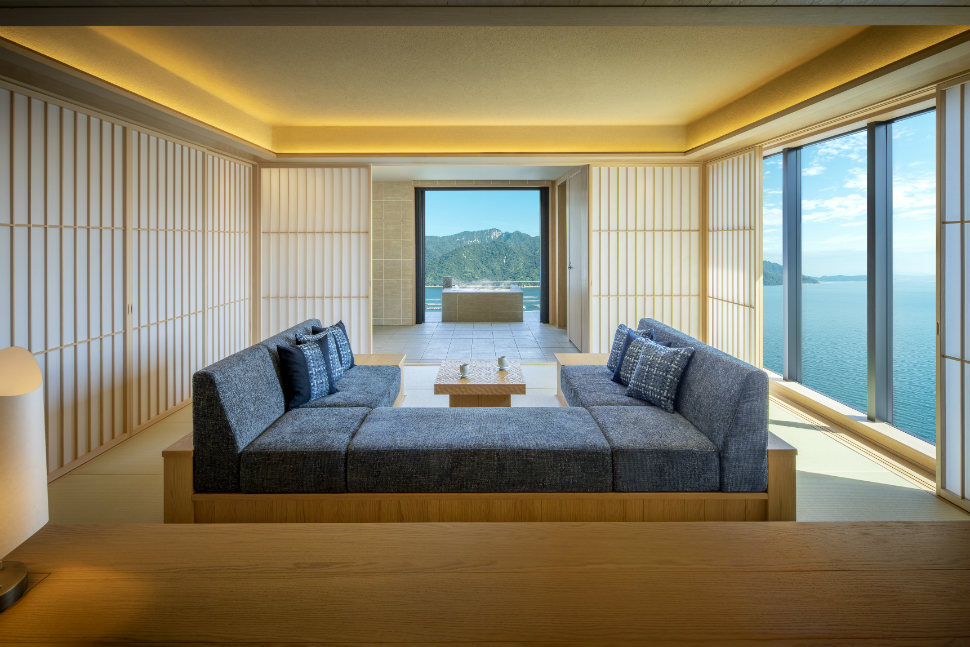
KAI Miyajima has 54 guest rooms, all designed with ocean views. The property’s accommodation mix includes four special rooms, 26 Japanese-style rooms with private open-air baths, four rooms with terraces, 18 additional Japanese-style rooms and two dog-friendly rooms. In total, 30 rooms have private open-air bathing facilities. These distinctions are worth understanding before booking: an ocean view is a defining feature across the property, but a private outdoor bath is not included in every category.
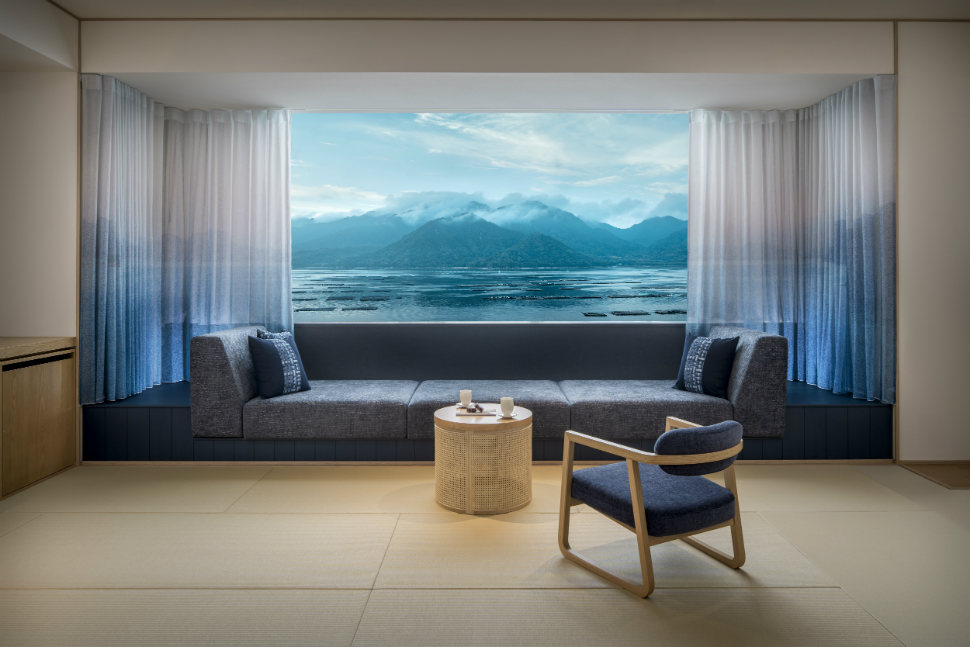
The signature Umigiri rooms take their name from the sea mist that can form over the Setouchi waters. The visual idea is subtle: graduated blues and soft transitions evoke the way water, air and islands sometimes dissolve into one another. Rather than treating the view as a picture framed by a window, the rooms attempt to extend its colours and textures into the interior. The effect depends less on theatrical decoration than on allowing the changing light to do its work.
Regional craftsmanship adds a more tangible layer. Hoshino Resorts has highlighted Aji glass, Fukuyama denim and Otake washi paper in its presentation of the signature rooms. Each material carries an association with local making, and each offers a different tactile response to the same landscape. Denim suggests durability and everyday craft; paper brings delicacy and filtered light; glass catches the shifting colours of the sea. Together, they make a stronger argument for regional identity than a collection of generic Japanese motifs ever could.
Tatami flooring throughout the ryokan encourages guests to move barefoot, introducing a physical change of pace from the moment they settle in. The gesture is simple, but it matters. The atmosphere of a ryokan is created not only by what is seen, but by how a guest moves, sits, rests and pays attention to the surrounding space.
Bathing at the edge of the horizon
The top-floor bathing area is one of the property’s principal attractions. Its open-air bath is conceived to create a visual continuity between the water of the onsen and the Seto Inland Sea beyond. This is not an infinity pool in the conventional resort sense, but a hot-spring experience in which the horizon becomes part of the ritual. The arrangement invites guests to remain still long enough to notice the passage of light and the changing atmosphere over the islands.
Indoor bathing spaces offer a contrasting orientation, with windows framing the mountain landscape and baths at different temperatures. The distinction between warmer and milder water allows the bathing ritual to unfold at a personal pace. It is an approach consistent with the broader KAI philosophy: an onsen is not simply an amenity to be checked off, but a meaningful part of the stay.
There is also an important cultural dimension. Japanese hot-spring bathing has its own etiquette, and travellers unfamiliar with communal onsen should acquaint themselves with the customary practice of washing before entering the water. The experience is often quiet and unhurried. At KAI Miyajima, the natural setting adds another reason to slow down: a view that rewards patience more than activity.
For guests choosing accommodation with a private open-air bath, the relationship to the landscape becomes more personal. Those rooms offer a different form of privacy, while the shared bathing areas remain a defining expression of the ryokan’s architecture. Neither experience should be confused with the other when planning a stay.
The return of the Setouchi stone bath
Perhaps the most distinctive wellness element is the revival of the region’s ishiburo, or stone-bath tradition. Hoshino Resorts describes the practice as an ancient form of bathing rooted in the Setouchi area, with origins traced to the Kamakura period. KAI Miyajima interprets this heritage through a contemporary stone-bath facility, sometimes described in English as the Setouchi Ancient Sauna.
The historical reference gives the experience a specificity that is often missing from luxury wellness. It is not an imported treatment renamed for the destination. It is an attempt to reconnect visitors with a form of bathing associated with the region itself. As with any modern interpretation of a historic practice, the present facility should not be mistaken for an untouched medieval structure. Its significance lies in the decision to bring an older cultural idea into a contemporary hospitality setting.
The combination of hot springs and stone bathing makes a persuasive argument for spending time at the property rather than treating it only as a base for Miyajima sightseeing. There is a rhythm to the experience: explore the island, return across the water, bathe, rest and sit down to dinner. The day becomes more than a succession of attractions. It acquires intervals in which the landscape and the memories of the excursion can settle.
Hiroshima on the table
Food provides another way of understanding the Setouchi region. Hiroshima is known for oysters, citrus fruit, particularly lemons, and its own distinctive style of okonomiyaki. These are not merely items on a list of local specialities; they reflect the relationship between coastal agriculture, fisheries and the urban culture of the prefecture. At KAI Miyajima, the kaiseki-style dining programme draws on these associations while adapting them to the composed sequence of a ryokan meal.
Kaiseki is often described too simply as Japanese fine dining. In a ryokan, it is also a structure for hospitality, one in which successive courses, seasonal ingredients and the choice of tableware create a sense of progression. The hotel’s official descriptions refer to playful interpretations of Hiroshima’s food culture, including hot-pot preparations and regional ingredients. The aim is not to reproduce a street-food stall inside an elegant dining room, but to allow recognisable local flavours to enter a more formal culinary language.
The details of menus naturally change with the season and availability. That is a strength rather than a limitation, provided the cooking remains attentive to the place. The sea visible from the rooms is also a working landscape, and its culinary traditions deserve to be treated with the same seriousness as the shrine across the water.
Breakfast offers another opportunity to experience the ryokan at a different pace. In the context of a stay shaped by bathing and views, the morning meal is not merely a preliminary to sightseeing. It is part of a sequence in which the hotel encourages guests to inhabit the day more deliberately.
Dance, storytelling and a sense of place
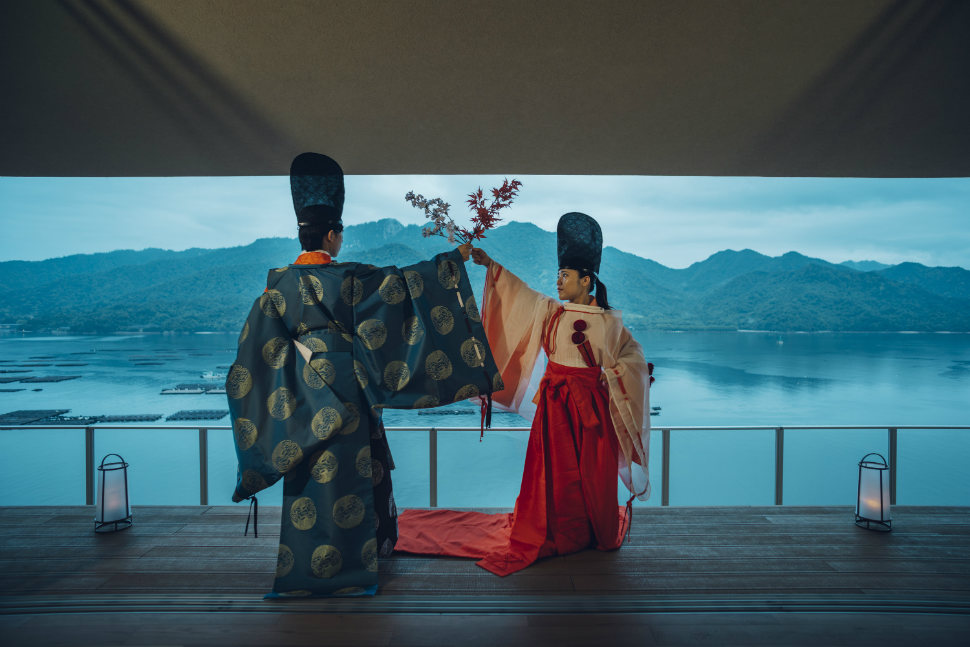
KAI’s approach to regional culture extends beyond architecture and dining. At Miyajima, its cultural programme draws on the history of the island through storytelling and performances inspired by shirabyoshi, a style of dance associated with the Heian period. The reference is particularly apt in a destination where the relationship between religion, courtly culture and performance has a long history.
Such activities can easily become superficial if they are presented as generic entertainment. Their potential value lies in offering visitors an accessible introduction to traditions that may otherwise remain unfamiliar. A short performance cannot replace a serious exploration of Miyajima’s history, but it can provide a point of entry, a detail that encourages further curiosity about the place.
The most rewarding way to approach the experience is to allow the hotel and the island to inform one another. The cultural programme introduces themes; a visit to the shrine and its surroundings gives those themes a physical context. Returning to the ryokan then brings the experience back to the scale of an evening, a room and a view across the water. This exchange between destination and accommodation is the real ambition of a locally rooted ryokan.
Exploring Miyajima without rushing
Miyajima is among Japan’s best-known cultural destinations, and that popularity can make a visit feel hurried. Itsukushima Shrine and the great torii are obvious priorities, but the island deserves more than a single photograph. The approaches to the shrine, the changing shoreline and the forested interior offer different experiences, while the view towards Mount Misen places the religious complex within a larger natural landscape.
Travellers should check ferry schedules and local access information when planning their movements. KAI Miyajima is on the mainland, at 1-1-6 Miyajimaguchinishi in Hatsukaichi, approximately five minutes by car from JR Miyajimaguchi Station according to the hotel’s information. It is not a ryokan from which guests can simply walk to the shrine. That practical distinction matters, especially for visitors planning an early start or a late return.
Hiroshima city is another possible part of a longer journey, with a historical significance that calls for thoughtful attention. A stay combining the city and the island offers two very different perspectives on the prefecture. KAI Miyajima’s contribution is to make the coastal landscape itself part of that exploration, rather than simply supplying accommodation near a ferry terminal.
A new address, an older rhythm
KAI Miyajima is a new hotel, but the most compelling aspects of its identity are rooted in much older patterns of life. The movement of boats across the Seto Inland Sea, the ritual of bathing, the use of local materials and the continuing significance of Itsukushima all help explain why this particular shore is more than a convenient location. The property is strongest when those elements remain connected.
Its 2026 opening brings a contemporary architectural and hospitality interpretation to the area without placing the hotel on the sacred island itself. The distinction creates the possibility of two complementary experiences: the intensity of a visit to one of Japan’s great historic sites and the calm of watching that site from across the water. A room with an ocean view, a long bath and an evening meal can make the second experience as memorable as the first.
For travellers interested in Japanese design and regional culture, this is the essential proposition. The appeal is not to escape Miyajima, nor to reduce it to scenery, but to discover how a landscape can shape the pace and texture of a stay. At KAI Miyajima, the sea is never merely outside the window. It is the thread that connects architecture, craft, food and the quiet rituals of hospitality.
Practical Information
KAI Miyajima
Practical Information
KAI Miyajima
1-1-6 Miyajimaguchinishi, Hatsukaichi, Hiroshima 739-0412, Japan
Tel. +81 50 3134 8096