Bordighera, beyond the Riviera’s bustle
On the western edge of Liguria, the Riviera begins to change its accent. France is close, the hills press towards the water, and a succession of coastal towns carries the memory of a time when a winter beside the Mediterranean was considered a restorative art. Bordighera, between Sanremo and Ventimiglia, is among the most rewarding of these places. Its reputation rests not on an extravagant marina or a single headline attraction, but on a more complicated inheritance: palms and gardens, a medieval hill town, British winter residents, a French architect and a painter who discovered that the light here was almost impossible to capture.
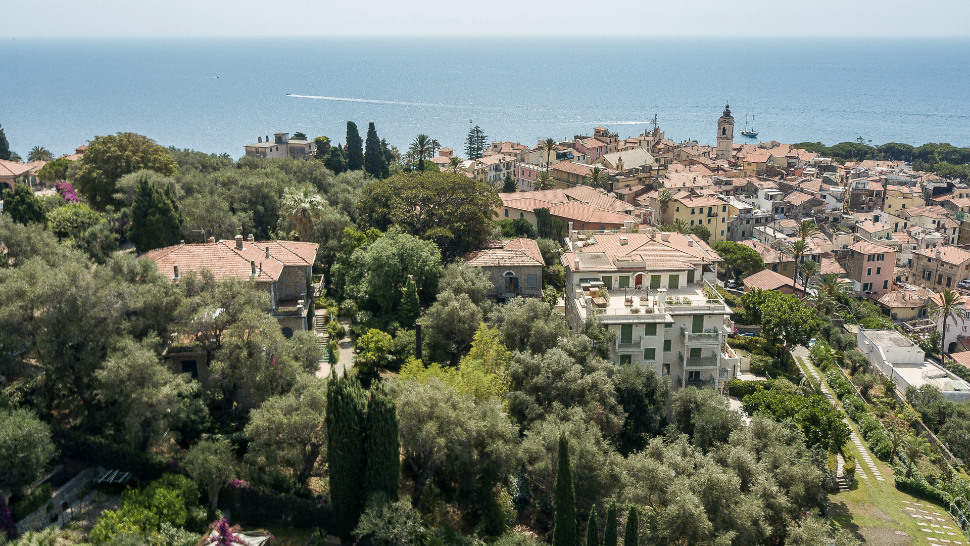
The first impression is of an unusually green coastline. Trees rise above villas, palms mark the streets, and the Mediterranean remains visible through gaps in the architecture. But Bordighera is not a resort constructed entirely around the visitor. It is a working Italian town, with shops, residential streets, cafés and a railway station close to the sea. That everyday quality gives its beauty a useful counterweight. It is possible to enjoy the Riviera here without feeling that every moment must be arranged as a performance.
The destination rewards a simple principle: leave enough time to move between its different levels. The seafront has one personality, the elegant Via Romana another, and the old settlement on the hill yet another. A traveller who sees only the beach misses the gardens and the architecture; one who remains among the villas misses the intimacy of the narrow streets above. Bordighera is best understood through these transitions.
Bordighera Alta, the town above the sea
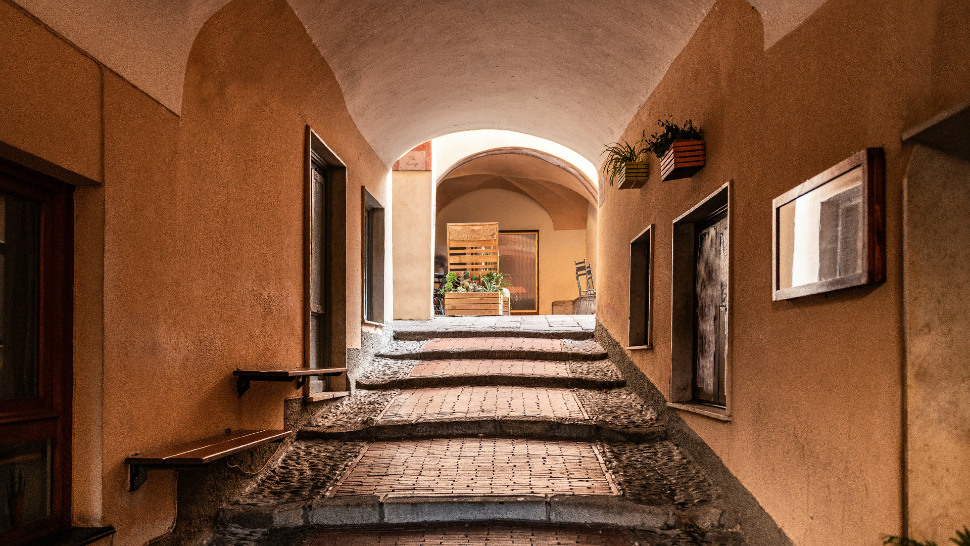
The historic centre, Bordighera Alta, occupies the higher ground overlooking the coast. Its compact network of caruggi, the narrow lanes characteristic of Ligurian towns, is enclosed by an old defensive structure whose form is still legible in the settlement. Arches connect buildings, stairs interrupt the streets, and small squares appear where the tight urban fabric briefly opens. The effect is not grandiose. Its attraction lies in scale, texture and the way the town reveals itself a few metres at a time.
The ascent is worth making slowly. There are changes of level and steps, and the streets are more enjoyable when approached as a place to explore rather than a route to complete. At certain corners the view opens towards the sea; elsewhere, the eye is drawn to painted façades, stonework and the everyday details of doors and balconies. Restaurants and small businesses give the old town an evening life of its own, distinct from the promenade below.
This part of Bordighera is also a reminder that the Riviera existed long before the nineteenth-century visitors who made it fashionable. The international villas belong to a later chapter. The hill town preserves the smaller, more enclosed urban language of coastal Liguria, and it gives the destination a historical depth that a waterfront alone could never supply.
The winter colony and the architecture of Charles Garnier
In the nineteenth century, Bordighera attracted a substantial community of British winter residents. The climate was one reason; the possibility of creating a life among gardens and villas was another. Their presence left lasting traces in the built environment, including an Anglican church, a library and the remarkable museum established by Clarence Bicknell. The town acquired an international character without losing its Ligurian foundations.
The French architect Charles Garnier was another important figure in this transformation. Best known for the Paris Opéra, he chose Bordighera for his own residence and designed Villa Garnier, as well as other buildings associated with the town. His work is an especially revealing link between the French and Italian Rivieras: a celebrated Parisian architect finding a different architectural vocabulary in the Mediterranean landscape. The local tourism authority also identifies Villa Etelinda, the Terrasanta church and Palazzo Garnier among his projects.
These houses were not simply places to sleep during the winter. They expressed an idea of cultivated leisure, combining architecture, planting, views and the social life of a cosmopolitan community. Today, a walk along Via Romana offers a way to read that history in the streetscape. Gardens soften the boundary between private property and public road, while the façades hint at the ambitions of the people who once made this coast their seasonal home.
Queen Margherita of Savoy added another distinguished chapter. She spent winters in Bordighera and commissioned a new villa in 1914, following earlier stays at Villa Etelinda. The buildings associated with her presence help explain why the town’s Belle Époque identity is more than a retrospective marketing invention. It was formed by real residents whose tastes reshaped the landscape.
Claude Monet and the difficulty of Mediterranean light
Claude Monet came to Bordighera in 1884, intending a relatively short visit. He remained for nearly three months. The attraction was the landscape itself: palms, olive trees, distant hills and the changing light that could turn familiar vegetation into an unfamiliar arrangement of colour. The official tourism account records his fascination with the countryside and the difficulty of translating its brilliance into paint.
Monet stayed at the Pension Anglaise and worked in locations that can still be traced around the town, including Via Romana and the hills towards Bordighera Alta. His paintings were not generic images of an agreeable coastline. They were experiments in seeing a particular place, where the saturated greens of gardens and the blue of the sea produced relationships of colour unlike those of northern France.
For visitors, this history offers a compelling alternative to the conventional sightseeing route. The pleasure is not to stand before a view and claim it is unchanged since 1884. Towns grow, gardens evolve and buildings alter the landscape. It is to recognise the same underlying elements that challenged Monet: the contrast between shadow and sun, the vertical rhythm of palms, the layering of foliage and the luminous horizon. Bordighera’s relationship with art remains rooted in its physical setting.
Clarence Bicknell and a garden of knowledge
A different kind of curiosity shaped the work of Clarence Bicknell. The Englishman arrived in Bordighera as an Anglican clergyman and developed a remarkable career as a naturalist, archaeologist and artist. In 1888 he founded a museum on Via Romana that became both a place of study and a meeting point for the town’s international community. It remains one of the most distinctive cultural addresses on the Riviera dei Fiori.
The Museo Bicknell brings together several strands of his research. There are materials relating to the prehistoric rock engravings of Mont Bégo, studies of plants, butterfly collections and a substantial library. Bicknell’s attention ranged from the coast to the mountains, linking the apparent leisure of a Mediterranean winter town to serious scientific inquiry. His botanical watercolours are another reminder that art and observation were closely connected in this circle.
The museum’s garden is almost as memorable as the collections. Two monumental Moreton Bay fig trees stand near the building, their extraordinary growth giving the site an atmosphere quite unlike that of a conventional urban museum. Wisteria climbs the portico. It is a place where the history of collecting, gardening and intellectual exchange can be experienced in a single visit. Opening arrangements can be limited, so checking the museum’s current schedule before setting out is advisable.
The legacy of the British community also survives in the International Civic Library. Together, the museum, library and former Anglican church tell a story that is often overlooked in accounts of the Italian Riviera: the region was not merely a picturesque destination for visitors, but a place where international residents built enduring cultural institutions.
Palms, succulents and the landscape beyond the villas
Bordighera calls itself the city of palms, and the description has a genuine historical basis. Date palms have long been cultivated here, including for the traditional woven fronds known as parmureli, associated with Palm Sunday. In the nineteenth century, the landscape gardener Ludwig Winter contributed to the town’s botanical identity through his palm gardens. His name remains attached to an important part of Bordighera’s horticultural history.
The botanical story is broader than palms alone. The Pallanca Exotic Garden, set on the coastal slopes, is known for its extraordinary collection of succulents. Its appeal comes from the contrast between sculptural plants and the Mediterranean setting. The gardens offer a different aesthetic from the lush planting around the old villas, demonstrating how the mild climate allowed a wide range of species to thrive.
For those who prefer walking, the Sentiero del Beodo follows the line of an old aqueduct route above the town. It provides another perspective on the relationship between cultivation, water and settlement. This is not a promenade to be attempted without thought for conditions: footwear, heat and the state of the path matter. But the route makes clear why gardens and the surrounding hills are inseparable from Bordighera’s identity.
Even without visiting a formal garden, the vegetation changes the experience of the town. A monumental fig can become a landmark, a palm grove a reminder of an older agricultural practice, and an unexpected flowering tree a reason to stop. The landscape is not a decorative layer added to Bordighera. It is one of the principal ways the place tells its story.
The sea, Sant’Ampelio and the long promenade
The coastline provides Bordighera with its most immediate pleasure. Lungomare Argentina runs for approximately two kilometres between the railway and the beach, offering space for an unhurried walk beside the Mediterranean. The promenade was inaugurated in 1947 in connection with a visit by Eva Perón, whose name it bears. Today it is part of the everyday life of the town as well as an obvious route for visitors.
The sea here is not the carefully staged backdrop of a private beach club. It belongs to a coastline of pebbled shores, changing light and broad views towards the western Riviera. In the evening, the walk can be especially rewarding, when the sky softens and the hills beyond the French border begin to recede into the distance. The atmosphere depends on the season, but the basic appeal remains: room to walk, to look and to spend time without a destination.
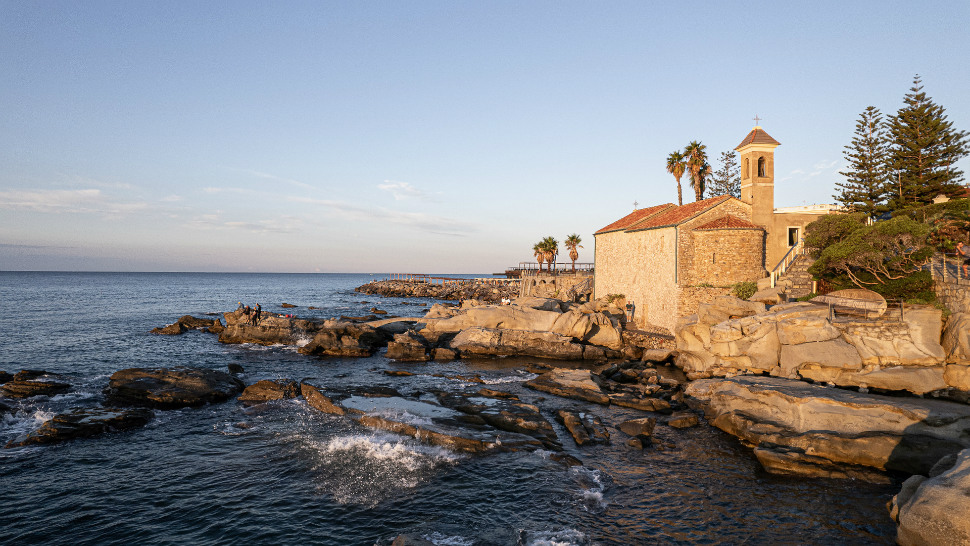
At Capo Sant’Ampelio, the small church stands close to the rocks at the water’s edge. The cape marks Liguria’s southernmost point and is associated with the hermit who gave the site its name. It is an evocative place precisely because its scale is modest. The religious building, the rocky shore and the open sea create a composition very different from the more elaborate villas inland.
Nearby, the former powder magazine known as the Marabutto offers another vantage point. These coastal landmarks make an appealing sequence with the old town above. Taken together, they show how Bordighera’s identity moves between maritime life, religious memory and the cultivated landscapes of the hills.
The pleasures of staying longer
Bordighera is close enough to other celebrated destinations to be treated as a day trip, but that approach misses much of its appeal. The town rewards an overnight stay, and even more a few days without an overfilled itinerary. Mornings can belong to the gardens or the old town; afternoons to the water, a museum or a long lunch. The smaller discoveries are often the most satisfying: a shaded lane, a glimpse of the sea between villas, or the way the town changes when the day visitors have departed.
Its location also makes it a useful base for exploring western Liguria. Sanremo lies to the east, Ventimiglia and the French border to the west, while inland villages offer another side of the region. Yet there is no need to turn every day into an excursion. The strongest reason to choose Bordighera is the experience of remaining there long enough for its individual layers to become familiar.
The culinary pleasures are those of Liguria and the wider Mediterranean: olive oil, seasonal vegetables, seafood and the traditions of a coastline connected to both land and sea. Rather than claim a single restaurant or dish defines the town, it is better to leave room for local recommendations and seasonal menus. Food, like the gardens, is most enjoyable when approached with curiosity rather than a checklist.
There are Riviera towns that announce themselves through scale and spectacle. Bordighera makes a quieter proposition. Its history includes an architect of international renown, a major Impressionist painter, a naturalist whose collections endure and generations of residents who shaped a remarkable botanical landscape. None of those stories needs exaggeration. Together they make the town distinctive. To travel here well is to give them time—and to discover that time itself may be the most persuasive luxury of all.
Destination Information
Bordighera
Liguria, Italy
Official tourism information: Visit Bordighera.
Tags: Bordighera, European Hospitality City 2026, Italian Riviera, Liguria, Mediterranean, Travel Guide