Julien Allano’s table in Bonnieux
The road into Bonnieux rises through one of the Luberon’s most recognisable landscapes: cultivated slopes, pale stone, and villages that appear to have grown out of the hills themselves. Yet the most compelling reason to stop is not always a panoramic view. At 2 Rue Lucien Blanc, in the centre of the village, chef Julien Allano has made a restaurant out of a personal idea about cooking, memory and the people who grow food around him. JU – Maison de Cuisine does not present Provence as a picturesque theme. It treats the region as a living source of ingredients, skills and relationships.
The restaurant occupies an old stone house rather than an imposing country estate. Its scale is important. A visitor arrives in a working village, not an enclosed gastronomic resort, and enters a room where the chef can be seen behind a wooden counter. This proximity between dining room and kitchen changes the encounter. The preparation of a meal is no longer a remote performance taking place behind a closed door; it becomes part of the restaurant’s rhythm.
Bonnieux attracts travellers for its historic streets, surrounding vineyards and the beauty of the Luberon. It is also a place where an ambitious chef can make a convincing argument for staying close to the source. JU’s approach is rooted in that argument. Rather than promising an immutable list of signature dishes, Allano offers a succession of courses that follows the season and the producers available to him. The menu is a conversation with the countryside, not a catalogue of Provençal clichés.
Julien Allano takes his own name to the table
Allano’s career has been shaped by important kitchens in the south of France, including La Mirande in Avignon and Le Clair de la Plume in Grignan. Those addresses established his reputation within the world of fine dining. Opening JU in Bonnieux in March 2024 was a different proposition: the chance to build a restaurant whose identity would be inseparable from his own convictions, rather than from the traditions of an established hotel or house.
The chef’s official account makes the family connection explicit. JU is also a tribute to his father, who was a cook, and to the generous Sunday meals of his childhood. This does not mean that the restaurant is nostalgic in its techniques. The point is subtler: a gastronomic experience can be precise and contemporary while preserving the sense that food exists to bring people together. The chef’s stated values include simplicity, creativity, ecological responsibility, kindness and virtue. These are aspirations, of course, but they help explain the decisions visible in the room and on the plate.
Allano’s decision to work under his own name has a practical consequence for guests. The restaurant is organised around a distinctive culinary personality. The chef can change the composition of a menu as produce changes, while the broader principles remain consistent. In an age when many destination restaurants are known for endlessly repeated visual signatures, that flexibility is part of JU’s appeal.
The Michelin Guide awarded the restaurant one star in its 2025 selection, and the local tourism authority confirms that it retained the distinction in 2026. Gault&Millau’s 2026 guide rates it 15 out of 20, describing a confident, produce-led approach. The awards are useful indicators, but the more revealing question is what kind of experience Allano has chosen to build. Here, the answer begins with the village, the growers and the freedom to cook according to what is available.
A room shaped by artisans
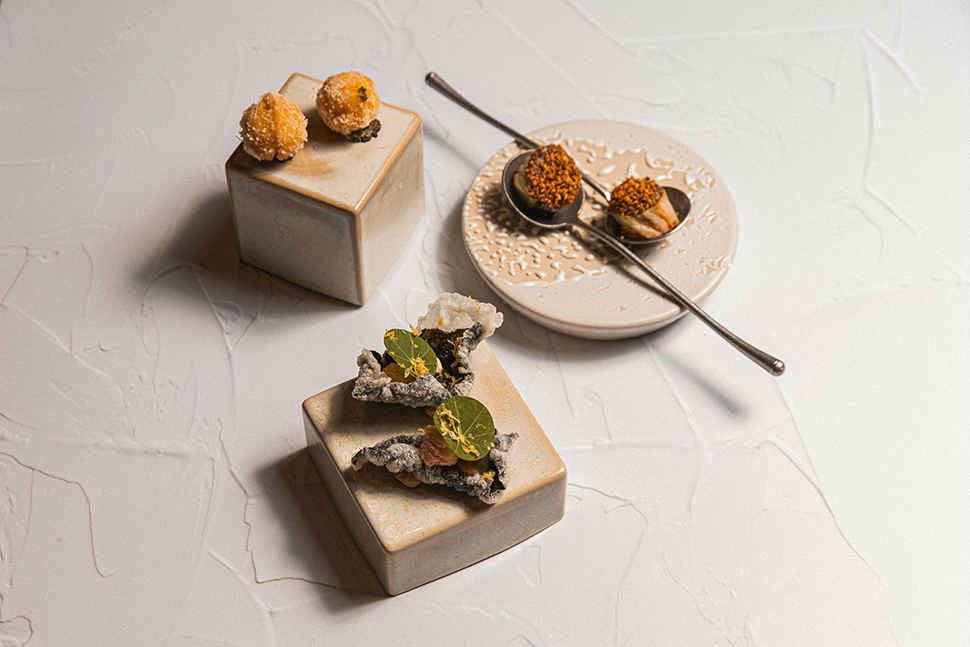
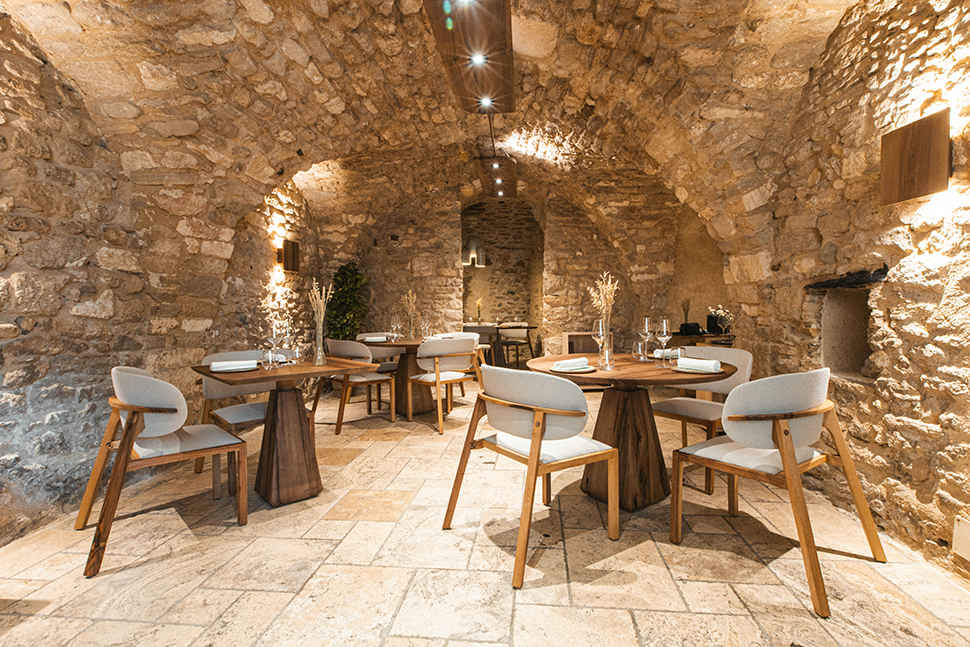
The setting is deliberately intimate. Exposed stone and vaulted ceilings acknowledge the age of the building, while contemporary furniture gives the room a clear identity of its own. The restaurant’s official presentation describes bespoke pieces made in Provence from French walnut, with seating and lighting selected to create warmth without visual excess. The lamps combine walnut and ceramics; the tableware, commissioned from a ceramic artisan in eastern France, brings another hand-made texture to the meal.
These choices are not incidental decorations. They establish a parallel between the work of a chef and the work of a craftsperson. Both begin with material, both depend on technique, and both reveal their quality through details that may initially appear effortless. A carefully shaped bowl can change the way a dish is presented; a comfortable chair can make a long tasting menu feel relaxed rather than ceremonial.
The wooden kitchen counter is perhaps the most telling element. It allows guests to see the chef and his team at work, introducing a sense of transparency into a dining style sometimes associated with elaborate distance. There is sophistication here, but it is not expressed through an intimidating stage set. The restaurant presents itself as a maison de cuisine—a house of cooking—and the architecture supports that description.
In warmer weather, the shaded terrace extends the dining experience onto a pedestrian corner of the village. The atmosphere is different from the vaulted room inside, yet the relationship to Bonnieux becomes even more immediate. Rather than isolating gastronomy from its surroundings, JU invites the village into the experience.
The menu follows the producers
The Michelin inspectors describe a carte blanche menu served in several stages, with ingredients chosen according to the season. Their examples are telling: heirloom wheat, peanuts from Malataverne, green beans from a neighbouring farm and pigeon from Sarrians. These are not necessarily dishes available on a particular evening. They illustrate the sourcing philosophy behind the kitchen and the variety of materials through which Allano expresses the south of France.
The restaurant’s own website begins its menu presentation with the producers. That ordering reverses the usual hierarchy in which a famous chef’s name dominates and agriculture appears only in a footnote. It encourages diners to think about the person who grew the vegetable or raised the bird before considering the technical transformation that follows. It also makes a persuasive case for the Luberon as a gastronomic landscape rather than simply a scenic destination.
The cooking is contemporary, and it would be misleading to describe it as a straightforward reproduction of regional classics. What matters is the flavour vocabulary of Provence—its vegetables, herbs, grains, livestock and Mediterranean influences—interpreted through the judgement of an individual chef. The menu can move between delicacy and intensity, but it is intended to preserve a recognisable connection to the raw ingredients.
This approach asks something of the diner as well. A carte blanche meal is an invitation to relinquish some control, to accept a progression chosen by the kitchen rather than construct an evening from a list of familiar dishes. The reward is a more coherent experience, particularly when the restaurant is small enough for the cooking and service teams to work in close dialogue.
A meal told in acts
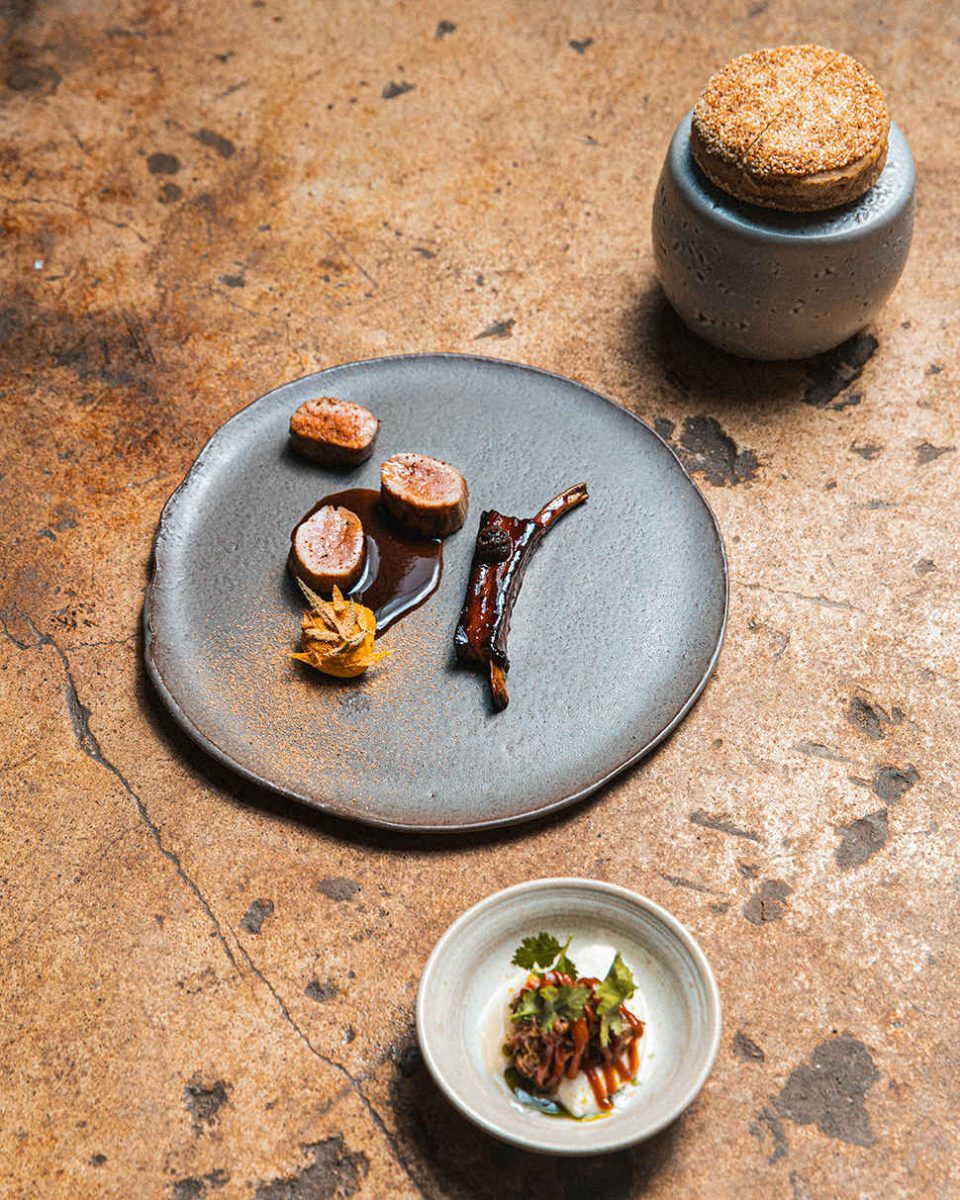
JU describes its principal tasting experience as the Menu Confiance, arranged in four, five or six acts. The theatrical language is apt, although the atmosphere is closer to an intimate gathering than a formal performance. Each course has a place within a progression, and the guest is invited to follow the chef’s decisions as the meal unfolds. The restaurant also offers other formats according to service and availability, so menus and prices are best checked when booking rather than treated as permanent fixtures.
The experience is built around pacing. A long meal can become exhausting when every course insists on being the centrepiece; it becomes more memorable when contrasts are allowed to develop naturally. At a restaurant whose cooking is guided by the season, that rhythm can be established through changes in texture, temperature, acidity and the weight of each preparation. There is no need to invent a tasting note from an unvisited table to appreciate the intelligence of the format.
Gault&Millau’s 2026 assessment singles out the chef’s lively, seemingly spontaneous style while observing that the result is carefully controlled. That combination is central to contemporary hospitality: guests should feel that the evening is generous and relaxed, even when the work behind it is exacting. JU’s design and service philosophy appear intended to make that possible.
The cellar and the ritual of cheese
One of the most distinctive elements of the experience lies below the dining room. The Michelin Guide describes a remarkable vaulted cellar dating from the thirteenth century, used for a dedicated cheese experience. In a region where historical buildings are often turned into decorative backdrops, this is a particularly apt use of the architecture. The setting becomes part of a gastronomic ritual rather than simply a room to admire.
Cheese has long occupied an important place in the French meal, but its presentation can easily become routine. Moving the experience into a historic cellar gives it another dimension. The stone vaults speak of time, preservation and the agricultural traditions from which so many cheeses emerge. The precise selection will change, as it should; the enduring idea is to offer the course as a moment with its own character.
Wine completes another aspect of the conversation between food and place. The restaurant is noted by Michelin for its interesting wine list. In Provence and the Rhône Valley, a thoughtful selection can encompass familiar appellations alongside less obvious producers, and can illuminate the changing character of the meal. Specific bottles and pairings are matters for the current list and the restaurant team, not facts that should be frozen in an article long after a particular vintage has disappeared.
Why the Luberon matters
It is tempting to write about the Luberon only in the language of light and stone. The landscape is certainly beautiful, and Bonnieux provides a memorable vantage point across the surrounding countryside. But the territory is also an agricultural system, with fields, orchards, vineyards and producers whose work changes according to weather, season and economic pressures. A restaurant claiming to cook from its surroundings has to engage with that reality.
JU’s emphasis on named producers gives its regional identity substance. The ingredients are not interchangeable symbols of southern France. They come from particular farms and communities, and their availability is neither infinite nor entirely predictable. A menu built around them must remain adaptable. That is an important distinction between a living local cuisine and a restaurant that simply repeats a set of supposedly traditional dishes for visitors.
Bonnieux itself rewards time beyond the meal. The village’s sloping streets and views offer a different experience in the early morning and late afternoon, when the crowds of a summer day begin to disperse. Nearby villages, including Ménerbes, Oppède-le-Vieux and Roussillon, give travellers further reasons to explore the region. But there is no obligation to turn dinner at JU into a frantic itinerary of picturesque stops. The restaurant makes a stronger impression when the journey leaves enough time to understand the landscape that feeds it.
An individual expression of Provençal gastronomy
JU – Maison de Cuisine is an ambitious restaurant with a notably personal centre of gravity. Its identity does not rest solely on the Michelin star, though that distinction recognises the level of cooking. It comes from the alignment between a chef’s biography, a village address, a room furnished by artisans and a menu that begins with the people who produce the ingredients.
That coherence matters in luxury travel. The most interesting dining experiences do more than provide excellent food in an attractive setting. They explain something about the place in which they exist. In Bonnieux, Julien Allano has chosen to tell that story through a contemporary tasting menu, the intimacy of a visible kitchen and a building that retains the texture of its past.
For travellers interested in the evolving gastronomy of southern France, JU offers a reason to look beyond the famous coastal addresses and spend time in the Luberon. It is a restaurant where technical ambition and the convivial spirit of a family table are not presented as opposites. They are the two ideas from which the house takes its character.
Restaurant Information
JU – Maison de Cuisine
2 Rue Lucien Blanc, 84480 Bonnieux, France
Telephone: +33 4 90 75 88 62
Official website: ju-maisondecuisine.com
Tags: Bonnieux, fine dining, Ju Maison de Cuisine, Julien Allano, Luberon, Provence, Restaurants