Bordighera between gardens and sea
Travel has a way of filling every available minute. There is the early departure, the airport, the luggage, the road beyond the terminal; even a beautiful coastline can become another stretch of geography to be negotiated. Then comes Bordighera. The French border is behind you, the Italian Riviera begins to assert its own character, and the Ligurian Sea opens out beside the road. At the Grand Hotel del Mare Resort & Spa, the reward is not simply reaching a destination. It is the delicious prospect of doing considerably less once you arrive.
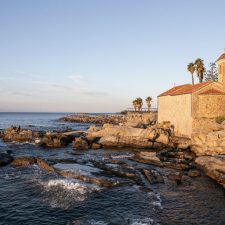
Imagine setting down a bag after the journey and allowing the day to catch up with you. Close your eyes for a moment; open them again to gardens, terraces and the wide blue presence of the sea. The change of mood is almost theatrical, yet nothing here needs to perform. The palms and luxuriant planting, the architecture rising above the coast, the horizon beyond: together they suggest an older Riviera idea, one in which the hours belong to the guest rather than the itinerary.
That feeling has little to do with fashionable notions of escaping the world. Bordighera is not remote. Monaco lies along the coast to the west, and Nice Côte d’Azur Airport makes the resort accessible to international travellers. Yet the atmosphere is distinctly Italian, shaped by a town whose appeal predates today’s enthusiasm for the next undiscovered destination. The Grand Hotel del Mare offers the pleasures of a substantial seaside resort, not a discreet boutique hideaway: room to wander, places to linger and the possibility of an afternoon that never becomes an appointment.
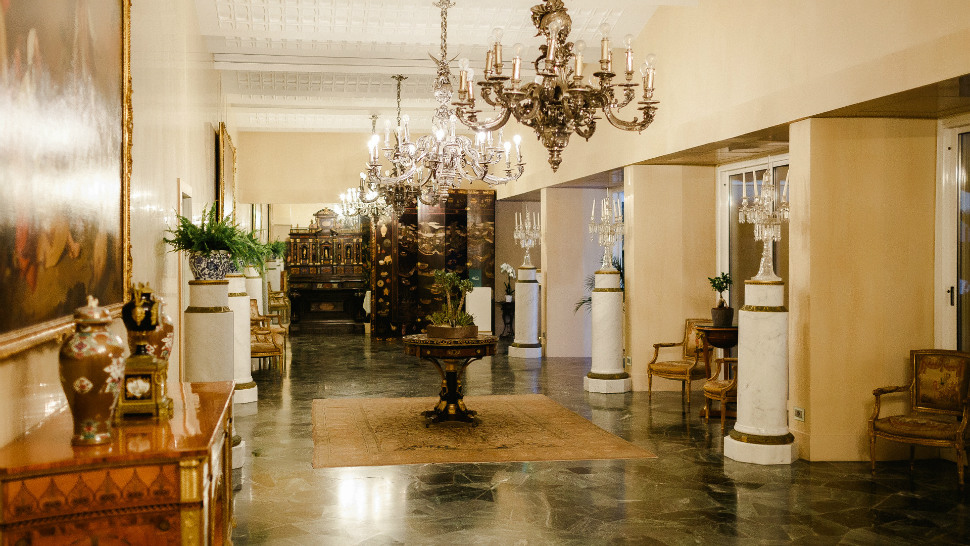
The distinction matters. This is neither a Belle Époque palace nor an attempt to recreate one. Grand Hotel del Mare traces its origins to 1964, when the Italian Riviera was enjoying the confidence of the postwar dolce vita years. Its resort architecture belongs to that later chapter of coastal hospitality, with an openness to light, gardens and the sea that feels of its period. Rather than disguise that identity, the hotel’s collection of paintings, bronzes, tapestries and period furnishings introduces a richly traditional counterpoint. The result is an individual character: not a historical pastiche, but a resort whose different eras are allowed to coexist.
A modernist landmark among exotic gardens
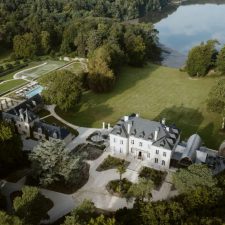
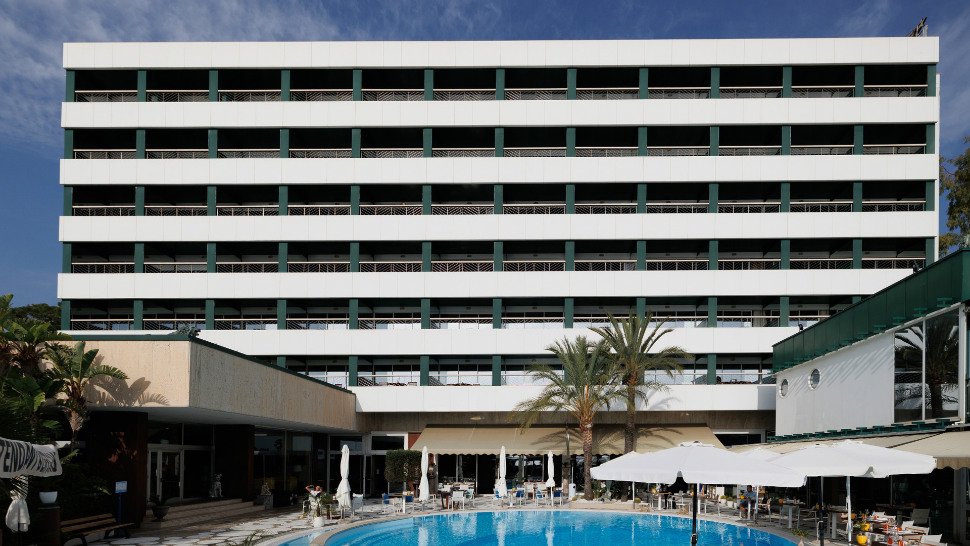
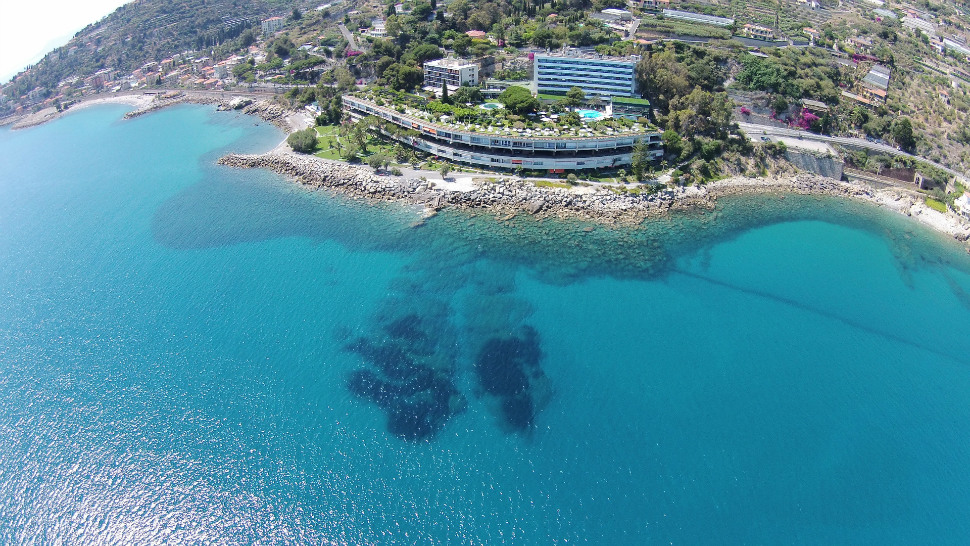
From the outside, the Grand Hotel del Mare makes its presence known. Its scale and geometry are those of a destination hotel built to command a coastal outlook. Balconies and terraces bring the landscape into the composition; the pool, gardens and seafront setting soften the building’s modern lines. It would be misleading to call the architecture quaint. Its interest lies precisely in that dialogue between the confident modernism of a grand resort and the gentler, cultivated world around it.
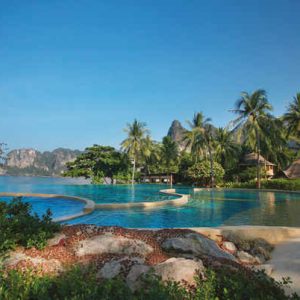
Bordighera has long had an affinity with exotic planting. Palms are part of its visual vocabulary, as recognisable as the pastel buildings and the curve of the coast. At the resort, the extensive gardens do more than provide a pleasant foreground for a photograph. They create a succession of distances: a shaded path, a terrace, a stretch of lawn, and finally the uninterrupted horizon of the Ligurian Sea. The eye moves through layers of green before arriving at blue.
There is a particular luxury in that sense of space. In many fashionable coastal destinations, even the most expensive room can feel hemmed in by the next terrace or the next reservation. Here, the pleasure is in the breadth of the setting. One can imagine taking a book outdoors, finding a different vantage point after lunch or simply watching the light change over the water. The gardens are not an incidental amenity; they are among the reasons to come.
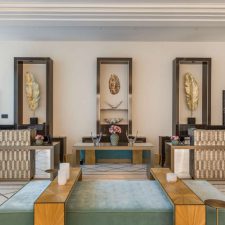
Inside, the mood shifts. Antique furniture, paintings and decorative objects lend the interiors a more collected, traditional character than the exterior might lead one to expect. The contrast is part of the hotel’s personality. A contemporary redesign might have smoothed away these differences in the name of consistency. The Grand Hotel del Mare is more interesting for allowing them to coexist, a reminder that a resort can carry the traces of different eras without losing its identity.
 @ Grand Hotel del Mare
Rooms for the art of doing less
A Riviera stay is shaped as much by what happens between outings as by the outings themselves. The morning begins without a train to catch. Breakfast can take its time. The decision to go into town can be postponed until the sea has been properly admired. This is where the Grand Hotel del Mare’s resort character becomes meaningful: accommodation is part of a wider landscape of gardens, dining rooms and places to pause, rather than simply a place to return to at night.
The relationship with the sea is worth considering when choosing a room or suite. At a property defined so strongly by its coastal position, an outlook is not a decorative extra; it can become the quiet centre of the stay. Equally, the hotel’s more traditional interior vocabulary may appeal to travellers who prefer the familiarity of an established grand hotel to the polished anonymity of an international design template.
It is easy to overplan the Italian Riviera. There are villages to explore, restaurants to try, neighbouring towns and a French border that can make the map seem irresistibly full. But a hotel of this kind argues for leaving some of the calendar blank. The finest hour might turn out to be the one spent doing nothing more ambitious than returning to a favourite terrace, where the light has shifted and the sea looks different from the way it did that morning.
La Veranda: the pleasures of a generous table
If the gardens establish the pace of the day, La Veranda gives it a delicious centre of gravity. The dining experience speaks to a recognisably Italian understanding of hospitality: food is not an interruption between activities, but one of the reasons the day is worth prolonging. Under General Manager Alessandro Dorrucci, the resort’s kitchen and service teams have a setting in which to make that philosophy tangible. The menu moves comfortably between the culinary traditions of Liguria, Italian classics and the broader appetites of an international clientele.
Consider the warm Riviera octopus served with parsley potatoes, listed at €36. It is a straightforward, regionally resonant proposition, without the need for elaborate reinvention. A second octopus preparation brings curry-inflected potato cream and friggitelli peppers to the plate. There are trofie or mandilli de sea with pesto from Prà, potatoes and green beans (€32), an unmistakable reference to Ligurian cooking; borage ravioli with Échiré butter, fried sage and walnuts (€33); and linguine with lobster and a reduced bisque (€45). Each suggests a different appetite, from the comfort of a local classic to the pleasure of a more indulgent lunch.
Then there is the sea bass in a salt crust. On La Veranda’s supplied menu, the branzino is offered for sharing at €99, with a choice of side dish and the alternative of grilling or baking. Salt-crusted fish is one of those enduring Mediterranean preparations whose appeal rests on restraint: the crust protects the fish as it cooks, and the ceremony of opening it belongs naturally to a table in no hurry to finish. The menu does not state the fish’s weight, so the price should be appreciated for what it is—a documented offer in a luxury resort—rather than used for an imprecise comparison with other restaurants.
Those drawn to the grill have their own reason to linger. A tomahawk is listed at €50, grilled simply or accompanied by Colonnata lard, while Ligurian-style rabbit with Taggiasca olives, pine nuts and thyme (€45) brings the hinterland into the picture. It is an engaging range: the kitchen does not demand that every guest share the same idea of a perfect Riviera meal. A couple might order the salt-crusted fish and a bottle of local white; another table might choose pasta, a substantial steak and the pleasure of a second coffee as the afternoon drifts on.
The prices are part of the story, but not the whole story. At a five-star resort, a €99 fish to share or a €50 tomahawk is a noteworthy invitation to enjoy the restaurant rather than treat it as an occasional extravagance. The menu also lists a €6 cover charge, a detail worth including when considering the bill. What matters more than a dramatic claim about value is the combination of setting, choice and a kind of culinary generosity that suits the Riviera. Lunch can be the occasion, not merely a pause before the next one.
 @ Grand Hotel del Mare
A wine list with its feet in Liguria
The wine list follows the same logic of place and possibility. Liguria is represented by Pigato and Vermentino from the Riviera di Ponente, alongside Rossese di Dolceacqua, a red whose name immediately connects the glass to the hills behind the coast. The supplied list includes a Pigato from Cascina Feipu Dei at €45 a bottle and a Rossese di Dolceacqua from Maccario at €55. These are wines that give a meal geographical character without requiring a lecture in regional viticulture.
For guests inclined to travel farther by the glass, the cellar ranges across Italy and beyond, from Franciacorta and Champagne to celebrated Tuscan estates. The names Sassicaia, Ornellaia and Masseto appear on the list, alongside more approachable bottles. It is the sort of breadth that allows the same dining room to accommodate a spontaneous lunch and an occasion planned well in advance.
One of the resort’s more distinctive spaces is La Grotta di Bacco, described in its wine documentation as an intimate tasting room set into a rocky alcove. The idea has an appealing theatricality of its own: after the bright expanse of the gardens and the sea, wine brings the experience inward, towards stone, conversation and the pleasures of taking one’s time. It is another expression of the property’s character, where a sense of occasion need not mean formality.
An afternoon with no particular destination
The temptation after lunch is to reach for the car keys. Bordighera’s old town, with its lanes and elevated position, deserves attention; so does the seafront, and the wider Riviera dei Fiori offers plenty of reasons to explore. Yet one of the most persuasive arguments for staying at the Grand Hotel del Mare is that the afternoon can be spent exactly where it began. Return to the gardens. Find a place near the pool. Watch the changing colour of the Ligurian Sea. There is no need to turn a weekend into a checklist.
The resort’s spa and wellness facilities belong naturally to this slower rhythm. Their appeal is not simply a catalogue of treatments, but the possibility of moving between indoor comfort and an expansive outdoor setting. The contrast is what makes a coastal resort different from a city spa: after an interval devoted to oneself, the horizon is still waiting outside. The sea remains the constant, even when the day’s activities change.
This is also a useful way to understand the property’s slightly vintage sensibility. It is not nostalgia for old-fashioned service or a demand to dress for a bygone age. It is the freedom to enjoy the things that grand resorts have always done well: a generous lunch, a well-kept garden, a room with a view, the quiet ceremony of an evening drink. None of these pleasures is new. That is precisely their attraction.
 @ Grand Hotel del Mare
Bordighera, between two Rivieras
Bordighera occupies an intriguing position on the map. The glamour of Monaco is close enough to be part of a wider itinerary, while Nice Côte d’Azur Airport connects the coast to international routes. The hotel describes the drive from Monaco as roughly half an hour and the journey from Nice Airport as around fifty minutes, although traffic on the Riviera can alter both. Proximity, however, does not mean sameness. Crossing into Italy changes the cadence: the language, the coffee, the menu and the relationship between the coast and its inland villages.
The town’s historic centre offers a counterpoint to the scale of the resort. Its streets invite a more intimate kind of discovery, while the palm-lined coastal landscape recalls the long history of travellers who came to this corner of Liguria for its climate and light. A weekend can comfortably hold both experiences: a morning in town, a lingering lunch at La Veranda, and an afternoon back among the gardens. The hotel and Bordighera do not compete for attention; they make one another more compelling.
There is no shortage of resorts promising an escape. What distinguishes the Grand Hotel del Mare is a more particular proposition: the chance to inhabit, for a few days, a version of the Italian Riviera that values continuity as much as novelty. Its modernist lines, traditional interiors, exotic planting and generous table do not belong to one immaculate design narrative. Together, they make something more individual—a resort with a recognisable past and a setting that remains its greatest luxury.
A Riviera resort with a history of its own
The hotel dates its foundation to 1964, a significant point of distinction in a region where many grand addresses tell stories rooted in the nineteenth century. By the mid-1960s, the Riviera had become a place of modern leisure as well as inherited aristocratic tradition. Grand Hotel del Mare’s seafront setting and generous landscaped grounds belong to that more expansive idea of a Mediterranean holiday. Today the resort describes a park of more than a hectare, a private beach club and an outdoor seawater pool. These details explain the appeal more effectively than any borrowed palace mythology: there is space here to experience the coastline at different speeds.
The hotel’s official descriptions also identify La Veranda and the seasonal Sunrise pool restaurant as distinct dining settings, with the Lounge Bar & Terrace offering another way to enjoy the sea views. At the Grand Spa del Mare, a seawater vitality pool, Finnish sauna, Turkish bath and sensory showers give the wellness programme a specifically maritime character. Treatments, access conditions and seasonal facilities should be confirmed with the property before travel. Rather than turning these offerings into a list of superlatives, they are best understood as parts of a coherent resort experience, from a morning swim to a late dinner overlooking the Ligurian Sea.
The luxury of staying a little longer
As evening approaches, the argument for leaving the schedule open becomes stronger. The sea has not moved, but its colours have; the gardens feel different from the way they did at arrival. Perhaps there is time for another walk, perhaps a glass of Rossese, perhaps nothing more than a few quiet minutes looking towards the horizon. The day’s pleasures have been modest in the best sense: food prepared with care, space to breathe, a coast that needs no embellishment.
For travellers accustomed to airports, appointments and carefully engineered itineraries, that may be the most seductive aspect of the Grand Hotel del Mare. It offers not a fantasy of another century, but a living trace of the Riviera’s enduring art of leisure. You arrive with the journey still in your shoulders. Somewhere between the gardens, the table and the Ligurian Sea, you realise that it has finally fallen away.
Hotel Information
Grand Hotel del Mare Resort & Spa
Via Portico della Punta 34, 18012 Bordighera, Italy
Telephone: +39 0184 262201
Official website: Grand Hotel del Mare
Tags: Bordighera, Grand Hotel del Mare, Italian Riviera, Liguria, luxury hotels, Mediterranean, Wellness