On a quieter stretch of the Chao Phraya, a restored 1923 residence offers a rare way to encounter Bangkok: through its architectural memory, the rituals of river travel and the intimacy of a house with a remarkable past.
Bangkok is a city that rarely stands still. Its river carries long-tail boats, ferries and the reflections of towers; its streets seem to reinvent themselves between one visit and the next. Yet on the banks of the Chao Phraya, a small historic residence offers another rhythm entirely. Praya Palazzo is not a hotel designed to compete with the capital’s skyscrapers. Its appeal lies in the opposite proposition: an intimate encounter with the city through the survival of a remarkable private house.
To understand the property, it helps to begin with the journey. The hotel describes access by its own private boat, a crossing that makes arrival part of the experience rather than a routine transfer. The water is not merely a backdrop to the hotel; it is the way into its world. For a visitor accustomed to Bangkok’s energetic traffic, the change of perspective can be striking. Buildings are seen from the river, the city’s sounds shift, and a historic mansion becomes the destination.
A Bangkok residence with an Italian accent
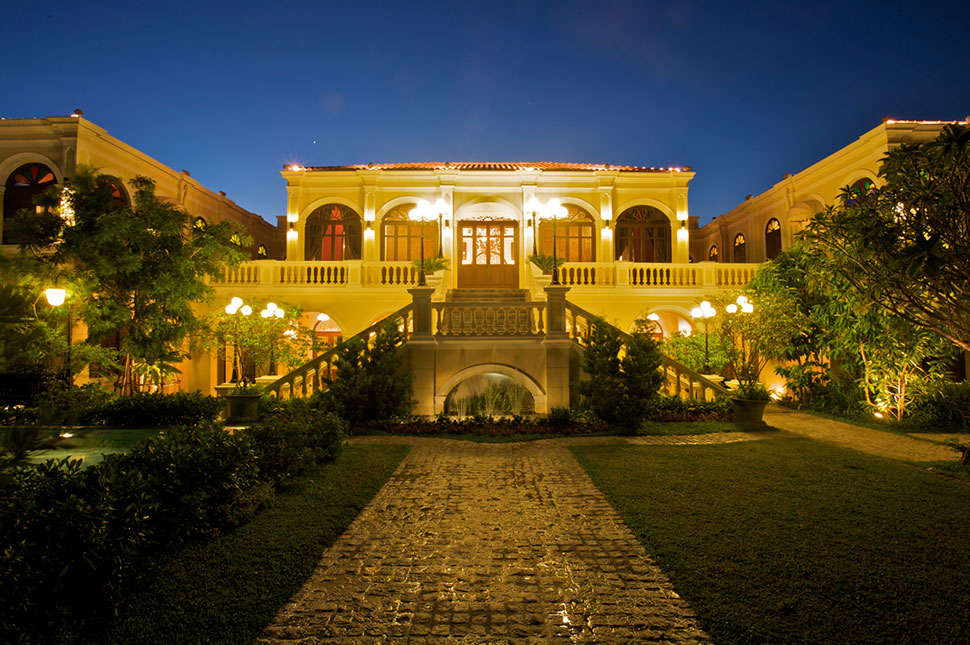
The story begins in 1923, when the residence was known as Baan Bang Yee Khan. According to the property’s historical account, it was built for Praya Chollabhumipanish, a nobleman associated with the Royal Court Customs Department. Italian artistic influences were then visible in Bangkok, and the owner’s residence took inspiration from Palladian architecture. That combination makes the house an intriguing chapter in the city’s architectural history: a European classical vocabulary interpreted in a Thai riverside setting.
Its location was practical as well as beautiful. In an era when the river was fundamental to the movement of people and goods, a house on the waterfront connected its owner directly to the life of the capital. Today the same position gives the property its distinctive identity. Rather than treating the Chao Phraya as scenery glimpsed through a hotel window, Praya Palazzo invites guests to consider the river as the historic heart of Bangkok.
From family home to school, and back to hospitality
The building has lived several lives. The family left in 1946, as Bangkok’s transportation patterns increasingly shifted from waterways to roads. The residence subsequently served educational purposes, including the Rachakarun School and later the Indara Vocational School. Such changes of use are part of the reason the property matters. Its history is not a carefully invented hotel narrative: it reflects the changing priorities of the city around it.
After a period of decline, the house attracted the attention of Wichai Pitakvorrarat and his wife, who undertook its restoration. The hotel dates its revival as Praya Palazzo to 2009, with the first overnight guests arriving in 2011. Restoring a building of this kind requires more than returning a façade to photogenic condition. The challenge is to allow contemporary hospitality to occupy a historic structure without erasing the character that made it worth saving.
The result is a property whose scale is part of its luxury. The original Références CHR report described fifteen rooms and suites, although prospective guests should check the hotel’s current accommodation categories directly. Unlike the large international properties lining other stretches of the river, the experience here is deliberately residential. The attraction is the sense of entering a place with a past, rather than an anonymous collection of guestrooms.
Luxury measured in quiet moments
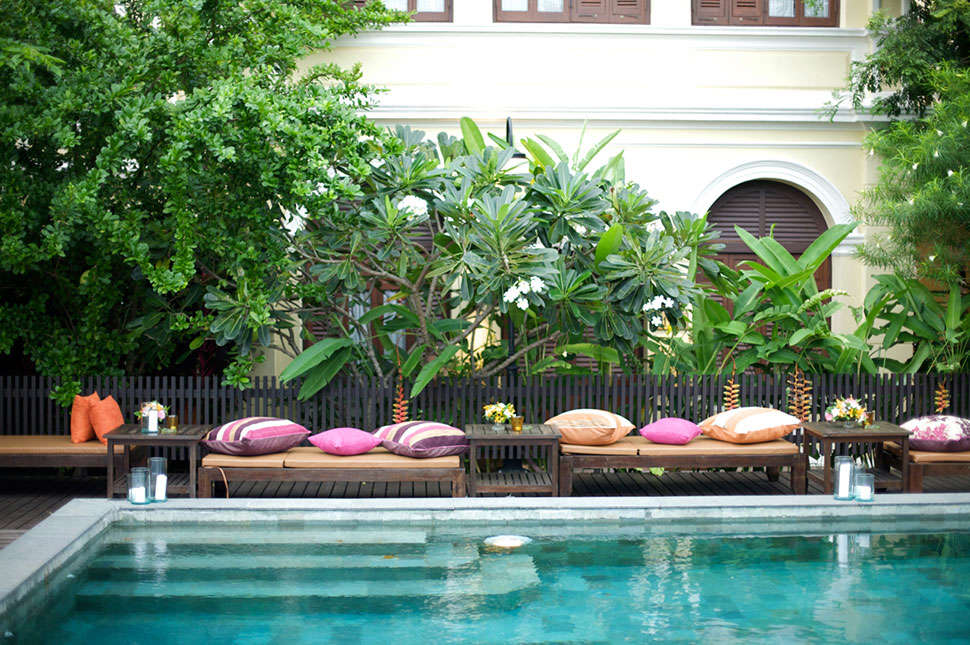
Praya Palazzo’s architecture is the first reason to visit, but it is not the only one. The hotel’s gardens and pool create a different kind of Bangkok afternoon: one spent reading, lingering over a drink or simply watching the water rather than pursuing another appointment across the city. The original report also highlighted the riverside swimming pool and the property’s restaurant and lounge.
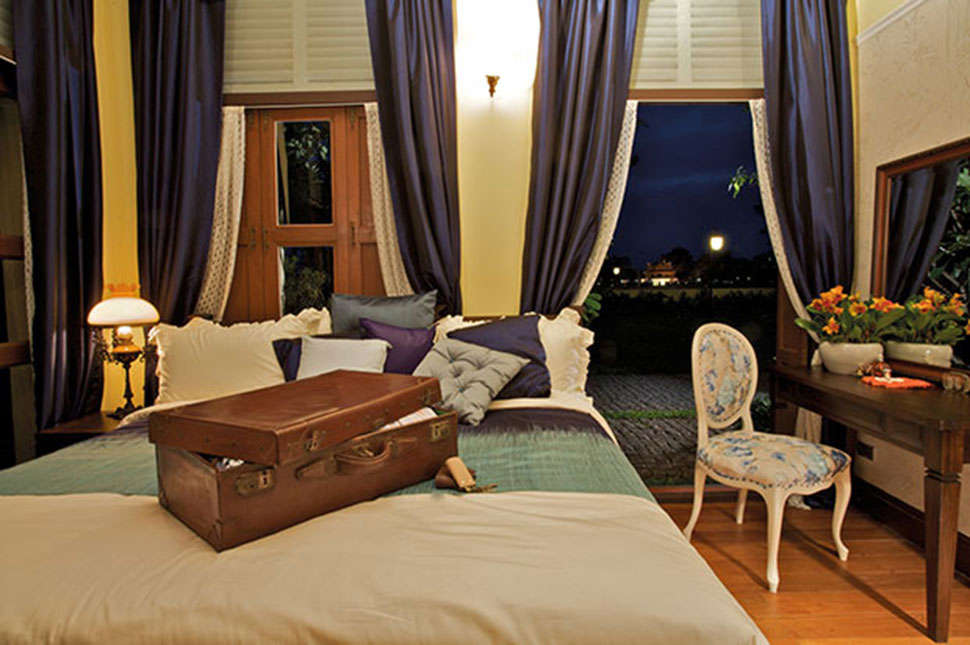
This is the kind of address where the details of the day matter. A boat arrival changes the opening chapter; a historic staircase or shaded courtyard changes the pace; a small number of rooms can make the atmosphere feel personal. None of these qualities requires extravagant claims about being the city’s finest hotel. The house makes its own case through its setting and history.
@ Praya Palazzo
The Chao Phraya as a cultural itinerary
Staying on the river is also an invitation to explore Bangkok differently. The Chao Phraya connects important districts and landmarks, from historic temples to the city’s more contemporary waterfront. Wat Arun, the Grand Palace precinct and other sites help explain why a river-focused stay is especially rewarding for visitors interested in architecture and Thai cultural heritage.
It would be a mistake, however, to imagine that the hotel places every attraction a short walk away. The river crossing is part of the property’s appeal, but it also calls for a little planning. Guests should confirm boat arrangements, pick-up points and operating hours with the hotel, particularly for early departures or late returns. In exchange, they gain a base that feels set apart from the city’s usual tempo.
For a first-time visitor, Praya Palazzo can offer a counterpoint to the grand international hotels of central Bangkok. For someone returning to the city, it provides an opportunity to discover a different chapter of its history. Both travellers may find that the most memorable part of the stay is not an amenity but the relationship between house, river and city.
A heritage hotel with a reason to exist
Historic hotels are sometimes described in terms of nostalgia alone. Praya Palazzo deserves a more thoughtful reading. Its Italian-influenced architecture, its former life as a school and its restoration all speak to the ways Bangkok has changed over a century. The hotel’s present identity draws on those layers rather than pretending they never existed.
For Travel & Luxury, the address belongs on a selective Bangkok itinerary precisely because it is distinctive. The Chao Phraya is not simply the view from the terrace; it is the reason the house was built where it stands and remains the key to understanding a stay here. The private boat crossing makes that history tangible, turning the simplest arrival into a small journey through the city.
Why the river matters more than the address
To describe Bangkok as a riverside city can sound like a cliché until one considers how thoroughly the Chao Phraya shaped its development. The river connected communities, markets, places of worship and royal institutions long before the capital’s modern roads began to dominate everyday movement. It is a working waterway rather than a decorative canal, and its traffic is part of the city’s character. Seen from the water, Bangkok’s contrasts make a different kind of sense: contemporary buildings and older neighbourhoods belong to the same changing landscape.
Praya Palazzo is particularly revealing in this context. Its owner did not choose the waterfront simply for a pleasing prospect. According to the hotel’s history, the location was associated with his duties in the customs administration. That detail anchors the residence in the economic life of its time. What a present-day visitor experiences as seclusion was once an exceptionally connected position, with the river offering access, information and movement. The same stretch of water has thus changed meaning without losing its importance.
The hotel’s private boat is more than a practical service. It offers a modest re-enactment of the way the city once worked. There is no need to romanticise every minute of the crossing: boats have schedules, weather matters and luggage needs to be handled. Yet the approach creates a natural threshold between the busy capital and the quiet residence. The experience begins before a guest reaches the front door.
@ Praya Palazzo
Reading the architecture without turning it into a museum
The Palladian influence identified by the hotel is an unusual aspect of Praya Palazzo’s identity. Palladianism, derived from the architectural principles associated with Andrea Palladio, favours balance, symmetry and a classical ordering of façades. Its appearance in a Bangkok residence reflects the international circulation of artistic ideas in the early twentieth century. It should not, however, be taken to mean that the building is simply an Italian villa transplanted to Thailand. The setting, climate and successive uses have made it part of Bangkok’s own story.
One of the pleasures of historic hospitality is noticing how a building resists standardisation. Older rooms rarely follow the perfectly repetitive geometry of a purpose-built contemporary tower. Corridors, windows and public spaces have proportions shaped by earlier domestic life. That individuality can be deeply appealing, although travellers should approach it with realistic expectations: heritage character and the uniformity of a newly built international hotel are different propositions.
Good conservation is not the same as freezing a property in time. Praya Palazzo’s conversion required the introduction of modern services and guest facilities into a house with an existing identity. Its history as a school is just as important as its origin as an aristocratic home. Generations of students and teachers gave the building a civic role, adding an unexpected chapter between its private past and its current hospitality use. A meaningful restoration makes room for all of these histories.
The pleasure of staying small in a very large city
Bangkok has no shortage of large, accomplished luxury hotels. Some offer dramatic skyline views, extensive restaurant collections and the predictable efficiency of a global brand. Praya Palazzo appeals to a different instinct. Its scale suggests a stay organised around atmosphere rather than spectacle. The strongest reason to choose it is not to compare its facilities item by item with those of a tower hotel, but to recognise that its intimacy is the point.
A smaller property can change how a guest uses time. Instead of rushing from one scheduled attraction to the next, the hotel invites slower transitions: returning by boat after a morning in the city, lingering near the pool, or allowing dinner to become the main event of an evening. Those possibilities are editorial observations about the setting, not claims that every stay will unfold in exactly that way. The value of the address lies in making such a rhythm possible.
For couples seeking a romantic escape, the architectural backdrop and river crossing offer a compelling combination. For design-minded travellers, the story of the residence may be the primary attraction. For a visitor with several nights in Bangkok, a stay here could provide an illuminating contrast with a more centrally located contemporary hotel. The choice depends on whether one values quiet character enough to plan around the boat connection.
Food, conversation and the meaning of hospitality
Dining in a heritage hotel can be particularly evocative because the room itself contributes to the occasion. Praya Palazzo’s restaurant is part of the property’s contemporary identity, and its official account notes that dining was the first hospitality activity to reopen following restoration, before overnight accommodation followed in 2011. This sequence is telling. The house returned to public life first as a place where people could gather around a table.
Rather than treating cuisine as a detachable amenity, a thoughtful stay can connect the meal to the destination. Bangkok is one of the world’s most rewarding cities for exploring Thai food, from modest neighbourhood kitchens to highly refined dining rooms. At a historic riverside property, the surrounding architecture adds another dimension to that experience. Menus and chefs change, so the responsible approach is to check current offerings directly rather than repeat the names or signature dishes from an old press release.
Service also matters in a property of this scale, though it cannot be judged honestly from a desk. A boutique hotel promises personal attention, but the quality of that attention must ultimately be experienced by guests. What can be established is the hotel’s stated positioning: a small historic retreat reached by private boat, with an emphasis on a distinctive and personal stay. Travel & Luxury’s recommendation rests on the strength of that concept and the verified history of the place, not on invented anecdotes about staff encounters.
@ Praya Palazzo
Planning a stay with the right expectations
Travellers should regard the river transfer as a defining feature rather than a detail to discover on arrival. It is sensible to ask the hotel about its designated pier, transfer frequency, arrangements for luggage and the latest possible return. Those questions are especially important when a flight lands late, when an early excursion is planned or when guests intend to explore Bangkok’s nightlife. A boat-access hotel rewards planning, and the effort is part of choosing a less conventional address.
Bangkok’s tropical climate also influences the experience. Warmth and humidity are present for much of the year, while rainfall can affect the ease of outdoor sightseeing and river travel. Rather than relying on a fixed seasonal promise, visitors should check the forecast close to departure and allow flexibility in their itinerary. The hotel’s shaded spaces and pool may be welcome at different times of year, but outdoor comfort is inevitably weather-dependent.
A balanced itinerary might pair one day of river-focused cultural visits with another devoted to Bangkok’s contemporary neighbourhoods, galleries or shopping districts. The historic temples and royal precincts provide essential context for understanding the capital, while newer districts reveal how rapidly the city continues to change. Praya Palazzo works best when used as a considered base for that contrast, not as a reason to remain entirely apart from the city.
A Bangkok address worth remembering
There are hotels that impress immediately through size, height or a list of celebrated facilities. Praya Palazzo asks for a quieter kind of attention. Its appeal emerges from the accumulated meaning of a house built in 1923, adapted to educational use, neglected, restored and eventually returned to the life of the city as a place to stay. That is a much richer narrative than a conventional boutique-hotel label suggests.
For the international traveller, the strongest argument is the relationship between history and experience. The river crossing is not a manufactured flourish; it echoes the transport geography that once made the residence possible. The architecture is not a theatrical theme; it is a surviving record of cultural exchange. The atmosphere is not simply an escape from Bangkok; it is a way of discovering another Bangkok, one that remains visible from the water.
That combination gives Praya Palazzo a distinctive place in a selective guide to the Thai capital. It may not be the right choice for every itinerary, and that is precisely why it deserves an individual story. Luxury travel is most rewarding when hotels are chosen for their character rather than their interchangeability. On the Chao Phraya, this restored mansion offers a persuasive reason to look beyond the obvious addresses.
Further information:
Praya Palazzo official website.
Historical details are drawn from the hotel’s
heritage account
and the original Références CHR feature. Facilities, room categories and transfer arrangements should be reconfirmed before travel.
Hotel Information
Praya Palazzo
757/1 Somdej Prapinklao Soi 2, Bangyeekhan, Bangplad
Bangkok 10700
Thailand
Telephone:
+66 81 402 8118
Website:
Praya Palazzo — Official Website