On Bangkok’s storied Chao Phraya, a hotel that has witnessed a century and a half of journeys continues to make history feel remarkably alive.
There are hotels whose addresses tell you where they are, and others whose names summon an entire era of travel. Mandarin Oriental, Bangkok belongs unmistakably to the second category. Its setting on the Chao Phraya is neither incidental nor merely picturesque. The river explains how this institution came into being, how visitors reached it, and why the meeting of cultures has remained central to its identity. To approach the property as simply another luxury hotel would be to miss the greater story: the transformation of a riverside hostelry into one of Asia’s most recognisable addresses.
In 2026, the hotel is marking 150 years of hospitality through an anniversary programme called Unfolding Legacies. The milestone provides a useful opportunity to look beyond the familiar adjectives of luxury travel. What survives after a century and a half is not only architecture, a celebrated name or a collection of awards. It is a particular relationship with Bangkok: a city that has changed almost beyond recognition while its river continues to carry the past through the present. That relationship makes the Mandarin Oriental a destination in its own right.
The river before the skyline
The Chao Phraya once functioned as Bangkok’s principal thoroughfare, linking commercial life, royal precincts, places of worship and communities on both banks. For early international visitors, arrival by water made geographical and practical sense. Even today, the sight of boats crossing between temples, modern towers and older waterfront buildings reveals something essential about the city. A stay beside the river offers a perspective that cannot be reproduced from a high-rise address farther inland.
The hotel’s historic location invites guests to experience this continuity rather than regard it as a picturesque backdrop. Morning light changes the colour of the water; boats carry commuters and visitors; the opposite bank remains part of daily life rather than a stage set. Such details matter because the most memorable luxury stays are often shaped by their surroundings. Bangkok’s river provides movement and atmosphere without requiring a manufactured spectacle.
Travellers should also understand that the river is a working environment. Traffic, weather and the rhythms of the city vary through the day. The hotel’s boat connections are therefore practical amenities as well as evocative experiences. They help join the property to places across the water and to onward transport, allowing a riverside stay to remain connected to the wider metropolis.
From the Oriental of 1876 to an international landmark
The hotel dates its origins to 1876, a chronology it is celebrating explicitly in 2026. This corrects a date sometimes repeated in older coverage: the present anniversary is the 150th, not the anniversary of an 1879 opening. The distinction is more than a minor historical footnote. A property that actively researches and presents its own past deserves to have that history treated accurately, especially when it has become part of the cultural memory of its destination.
The name Oriental came to stand for a particular kind of international hospitality in Bangkok. Generations of travellers arrived with different expectations, from the practical needs of a long journey to the pleasures of an extended stay. The hotel’s longevity suggests an ability to adapt rather than a refusal to change. The challenge for any historic luxury property is to modernise comfort and service without flattening the individual character that drew guests in the first place.
Anniversary programming has drawn attention to the hotel’s archives, photographs and the people associated with its development. The exhibition Unveiling Our Origins, announced as part of the celebrations, reflects a valuable editorial idea: history becomes most interesting when it is presented through evidence and human stories, not merely through dates carved into a commemorative plaque.
A literary address with a life beyond literature
Among the hotel’s best-known associations are the writers who have stayed there or become linked with its story. Joseph Conrad and Somerset Maugham are among the names cited in the hotel’s official account, while suites honour literary figures and the Authors’ Wing preserves a particularly evocative dimension of the property’s identity. These connections should be understood as part of a longer history of travel, writing and cross-cultural encounter, not as an invitation to invent scenes from an imagined visit.
For a reader interested in hotels as cultural places, this heritage adds another layer to the experience. The setting encourages a different sort of attention: to architectural details, the proportions of historic rooms, the stories behind names and the ways in which public spaces acquire memories over time. A hotel can be a repository of cultural history without becoming a museum, provided its present-day life remains as important as its past.
The Authors’ Wing is especially significant in that respect. It embodies the hotel’s ambition to preserve continuity while accommodating contemporary guests. The pleasure is not simply in knowing that notable figures once passed through Bangkok; it is in seeing how a place still makes room for reading, conversation and the unhurried intervals that travel can otherwise erase.
Contemporary rooms, enduring character
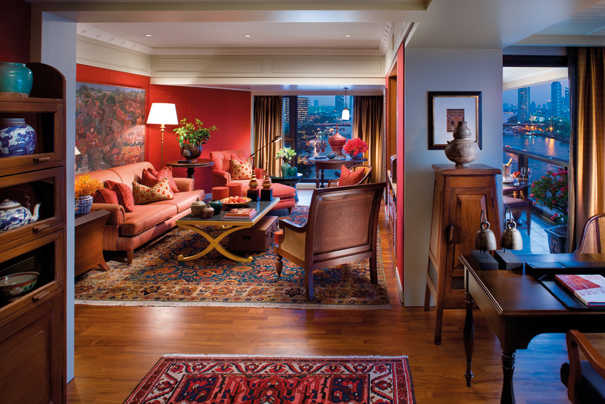
The current hotel describes 331 rooms and suites, a figure that should replace older archival counts which no longer reflect the present inventory. The accommodation combines the expectations of an international luxury hotel with the individuality of a long-established riverside property. Prospective guests should examine room categories carefully: a river view, a particular wing or a suite associated with the hotel’s history can make a meaningful difference to the character of a stay.
It is tempting to equate luxury with an ever-growing list of features, but the stronger question is how those features contribute to a coherent experience. In a heritage property, scale and atmosphere matter as much as specification. The possibility of moving between historic spaces and contemporary accommodation gives this hotel a character distinct from that of a newly built tower, even when both offer excellent facilities.
Choosing a room should therefore be part of the itinerary rather than an afterthought. Visitors celebrating a special occasion may be drawn to a suite with a particular story, while travellers spending their days exploring Bangkok may place greater value on the view and the ease of returning to a tranquil riverside base. The hotel’s reservations team can clarify current layouts and inclusions more reliably than descriptions copied from old articles.
A culinary institution on both banks
Food has long been central to the Mandarin Oriental’s identity. Its present official material describes eleven restaurants and bars, spanning Thai traditions, international dining and French fine dining at Le Normandie. The range is significant because it makes the hotel a place to visit even for travellers who are not staying overnight. A meal beside the river can become a distinct chapter of a Bangkok itinerary rather than simply a convenience attached to a room.
Le Normandie represents one strand of this culinary heritage, while Sala Rim Naam connects dining with the cultural traditions of Thailand. The precise menus, chefs and service arrangements should always be checked close to a visit: the restaurant world changes, and a responsible travel feature should not perpetuate the names or accolades of an earlier era as though they were permanent. What can be said confidently is that gastronomy remains part of the hotel’s contemporary positioning.
The Bamboo Bar adds another dimension to the address, illustrating how a great hotel can sustain different rhythms within a single property. An afternoon tea, a carefully planned dinner and an evening drink are not interchangeable experiences. Together, however, they create the sense of a hotel whose public spaces have a life of their own. That variety helps explain why the Oriental remains relevant to both resident guests and Bangkok visitors.
Wellness across the water
The Oriental Spa is housed in a restored century-old teakwood building across the river. Its location is an important part of the experience: wellness is presented not merely as a treatment menu but as a transition away from the pace of the city. The hotel describes therapies drawing on Thai traditions, other Asian approaches and contemporary techniques, with arrangements that visitors should verify when booking.
The crossing to the spa is a reminder that the hotel’s relationship with the Chao Phraya is functional as well as symbolic. Here the river connects separate parts of the guest experience. A thoughtful itinerary might allow time for a treatment, a leisurely return and an evening spent on the waterfront, rather than attempting to compress the whole stay into a sequence of reservations.
Wellness is a particularly revealing measure of how historic hotels evolve. A century and a half ago, expectations of comfort and leisure were very different. Today the ability to offer calm, privacy and professional care is part of the promise of a luxury address. At the Mandarin Oriental, those contemporary needs are framed by a setting that has retained its connection with the city’s past.
Bangkok beyond the hotel
The greatest hotels do not need to compete with the destination around them. They can instead help guests read it more clearly. From the Mandarin Oriental, the river opens routes towards historic temples, royal landmarks and contemporary waterfront districts. The contrast between old Bangkok and its rapidly changing commercial areas is one of the capital’s defining pleasures, and a stay that includes both offers a more complete picture of the city.
Travellers interested in architecture can devote time to the riverside and older neighbourhoods; those drawn to food will find Bangkok rewarding well beyond any single hotel; and visitors returning to Thailand may use the Oriental as a familiar base from which to discover something new. The most satisfying itinerary is likely to balance the hotel’s pleasures with curiosity about the city rather than treating the property as a sealed luxury enclave.
Planning remains important. Bangkok’s distances and traffic can be deceptive, while river services and transfers operate to their own schedules. A little attention to transport can turn an ambitious programme into a relaxed one. That practical consideration does nothing to diminish the romance of the address; it helps make the experience work.
What 150 years really mean
The hotel’s anniversary programme runs through 2026 and into 2027, with exhibitions and experiences intended to connect historical memory with contemporary hospitality. It is easy for anniversaries to become occasions for self-congratulation. The more interesting question is what they reveal about the durability of a place. At the Oriental, longevity has been accompanied by continual reinvention, while the Chao Phraya has remained the enduring reference point.
This is why Mandarin Oriental, Bangkok deserves a place in a selective international travel magazine. Its reputation alone would not be enough. What makes it worth travelling for is the combination of a historically significant address, a living cultural identity, substantial contemporary facilities and a location that encourages guests to experience Bangkok through its river.
For travellers planning a first encounter with the Thai capital, it offers a distinguished introduction to riverside hospitality. For those who know Bangkok well, it offers the chance to return to a place that has watched the city transform. The most compelling luxury is not the illusion that time has stopped, but the sense that a hotel has learned how to carry its history forward.
Planning your stay
Mandarin Oriental, Bangkok is located at 48 Oriental Avenue on the Chao Phraya River. Room categories, restaurant reservations, spa appointments and river transfer arrangements should be checked through the hotel’s current official channels. The property’s official website provides the most appropriate starting point for current information.
This feature draws on the original Références CHR archive and the hotel’s official 150th-anniversary documentation. Historical references, present-day room numbers and dining information have been treated separately so that the romance of the story does not come at the expense of accuracy.
Hotel Information
Mandarin Oriental, Bangkok
48 Oriental Avenue
Bangkok 10500
Thailand
Telephone: +66 2 659 9000
Website: Mandarin Oriental, Bangkok — Official Website