At the edge of Cathedral Square
The Grand Hotel Vilnius occupies an address that manages both. At Universiteto Street 14, facing Cathedral Square, the property sits at the meeting point of Lithuania’s ceremonial centre and the narrow streets of its historic capital. Step outside and the neoclassical cathedral, the Palace of the Grand Dukes and the approaches to the old town are already part of the day. There is no need to negotiate a long transfer before the first encounter with Vilnius.
The position is unusually revealing. Cathedral Square is not a decorative backdrop invented for visitors. It is a place where the city gathers, where national history is made visible and where the rhythms of daily life intersect with the monuments. The cathedral’s present neoclassical form dates from the late eighteenth century, while the site contains much older religious and archaeological layers. The square offers a compelling introduction to a capital whose identity has been shaped by successive cultures, political upheavals and architectural traditions.
Inside, the Grand Hotel belongs to Curio Collection by Hilton, but its story is more particular than a brand affiliation. The 93-room property draws much of its character from a building with a varied public history. Its interiors, restaurants and spa offer the comforts of a contemporary luxury hotel, while its address encourages the visitor to experience Vilnius as a place with a distinctive intellectual and artistic life, rather than a brief stop on a Baltic itinerary.
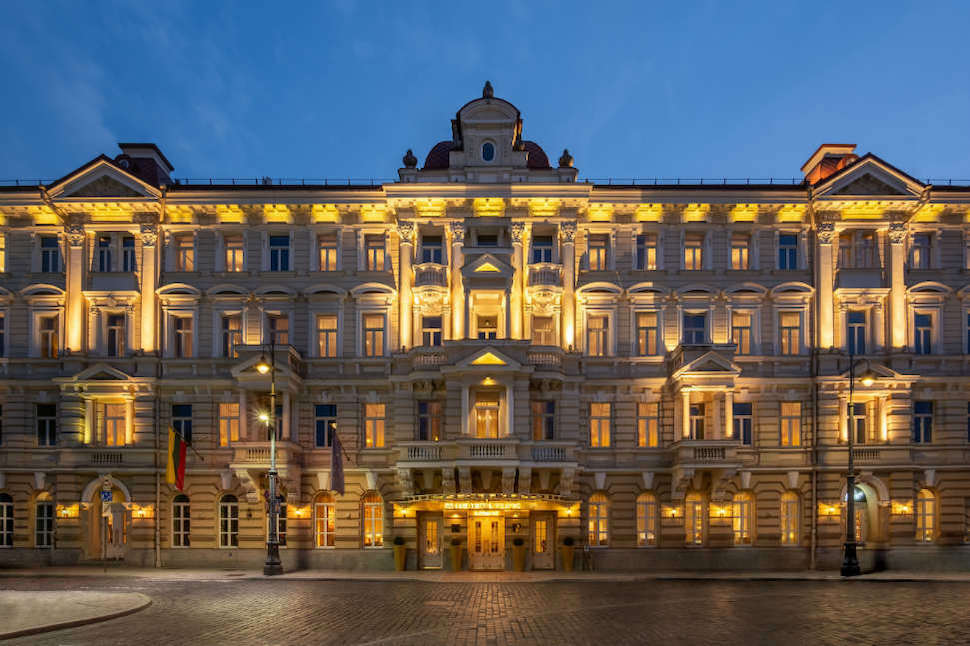
A building that has witnessed changing times
The hotel’s official history identifies the building as dating from 1900. It has served, at different moments, as a state treasury and a central telegraph office. Those former functions give an unusually apt name to Telegrafas, the restaurant that now overlooks Cathedral Square. They also help explain why this address carries a sense of civic presence rather than the anonymity of a purpose-built resort.
Grand urban buildings are rarely static. Their significance comes not only from the date of construction but from the ways a city has used and reinterpreted them. Vilnius is particularly rich in such stories. The historic centre was inscribed on UNESCO’s World Heritage List in 1994, in recognition of its medieval urban structure and the remarkable interaction of Gothic, Renaissance, Baroque and classical architecture. The hotel belongs to this layered urban landscape, although it should not be confused with the medieval buildings that define other parts of the old town.
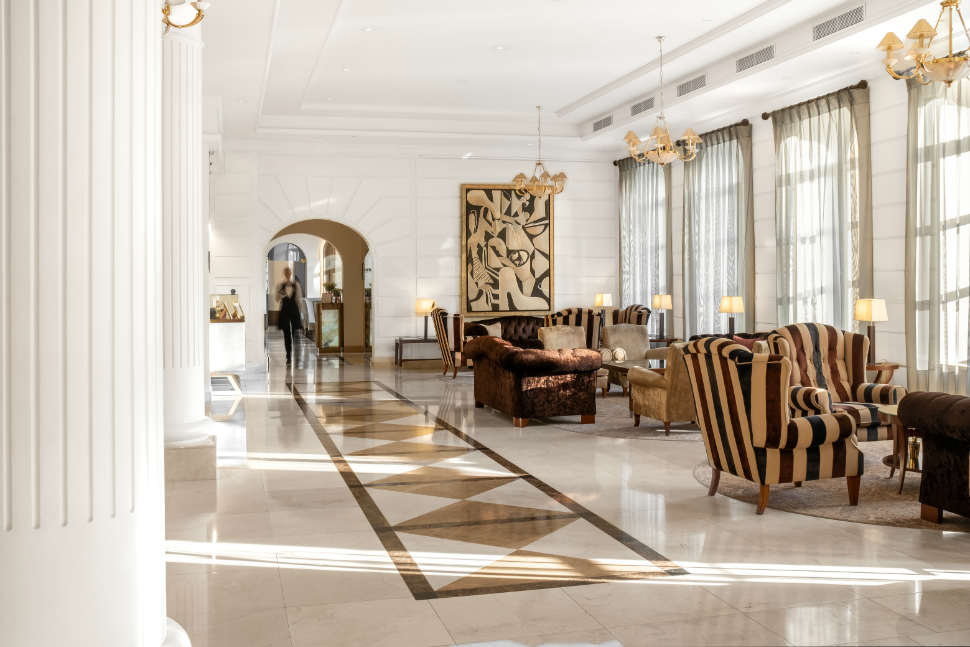
The white-marble lobby and generous windows create a bright, formal first impression. The design speaks in the language of a grand European city hotel, but it is the location that lends the experience its specificity. Through the windows and beyond the entrance, the city provides a changing sequence of perspectives: cathedral columns, streets leading towards the university, and the nearby gardens and historic buildings that make the centre so rewarding on foot.
For travellers who enjoy architectural history, this is a hotel best appreciated in conversation with its surroundings. The building’s previous lives as treasury and telegraph office belong to the modern history of the Lithuanian capital. The older monuments nearby tell the longer story of the Grand Duchy of Lithuania. Moving between the two creates a richer understanding of the place than either narrative could offer alone.
Rooms with a sense of the capital
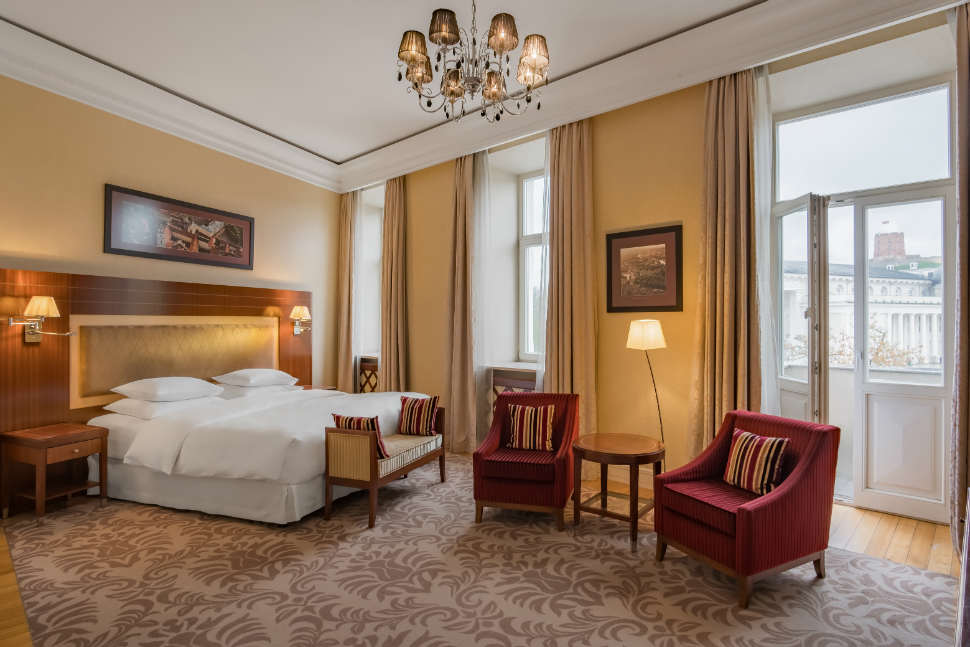
The Grand Hotel’s 93 rooms and suites include classic guest accommodation, deluxe rooms with balconies and a series of larger suites. Hilton’s current inventory lists categories such as the King Cupola Suite, Junior Suite, One Bedroom Suite, Grand Suite and Presidential Suite. The variety matters because the relationship to the city changes with the room: some outlooks are towards Cathedral Square, others across the old town, and balcony accommodation offers an additional connection with the streets below.
Rather than treat all 93 rooms as interchangeable, guests should choose according to how they intend to use the hotel. A room with a view may be particularly appealing on a first visit, when the city’s skyline is itself part of the experience. A larger suite may suit travellers staying longer, working between engagements or simply wanting space to relax between excursions. The hotel’s own information notes that bathroom configurations vary by category, with different combinations of bathtubs and showers.
The decorative vocabulary combines the formality associated with historic luxury hotels and the practical expectations of contemporary travel. There is pleasure in a room that provides a calm counterpoint to a day spent walking through cobbled streets, churches and galleries. Yet the most persuasive aspect of accommodation here is not any single furnishing. It is the ease with which the city remains present without becoming intrusive.
One might begin the day with the view from a window and end it with the illuminated square below. That simple change in perspective is a reminder that a city hotel can offer something a destination resort cannot: a continuous, almost intimate relationship with the life of the place outside.
Telegrafas and the pleasures of a Baltic table
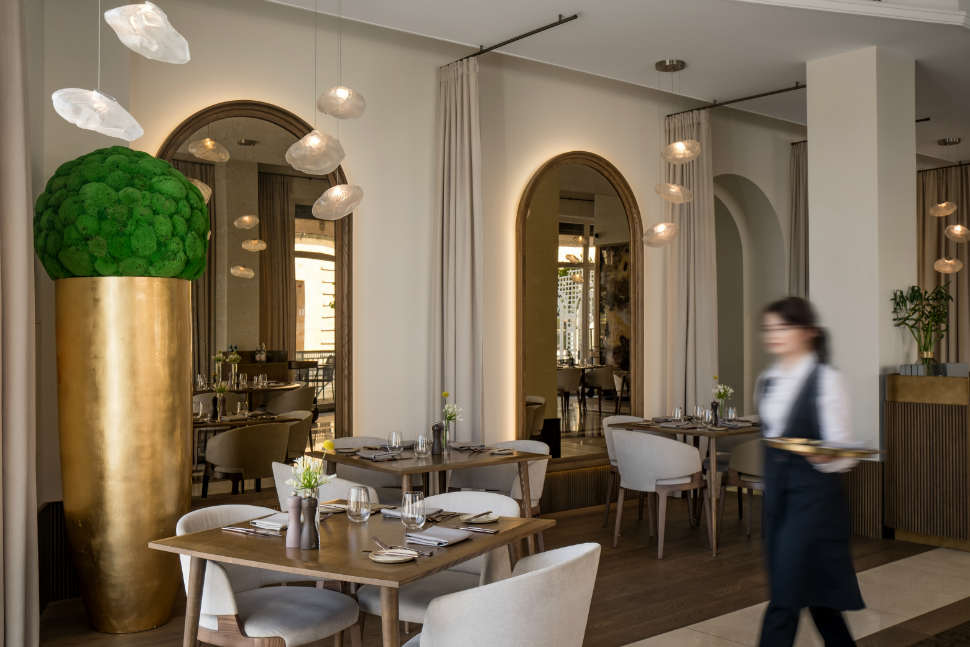
The restaurant’s name is a direct reference to the building’s earlier role as a telegraph office. Telegrafas now offers modern European cooking in a dining room overlooking Cathedral Square, and it is listed in the Michelin Guide. That last distinction is worth stating precisely: inclusion in the guide is not, by itself, a claim that the restaurant holds a Michelin star.
The hotel’s current dining description emphasises seasonal ingredients and a programme that stretches from breakfast and brunch to lunch and dinner. The setting makes these meals more than a purely gastronomic appointment. There is a pleasure in sitting at a table while the square beyond the windows changes with the hour, from the quieter morning to the movement of the afternoon and the evening lights.
Vilnius has developed a culinary identity that merits attention in its own right. Lithuanian produce, contemporary European techniques and a new confidence among local restaurants have broadened the city’s appeal for food-minded travellers. At Telegrafas, the opportunity is to enjoy that wider sense of ambition within the hotel’s historic setting. Specific dishes and chef appointments can change, so a serious travel feature should resist treating an old menu as a permanent record.
For a less formal occasion, Dukes Lounge & Bar provides another register of hospitality. The hotel’s current information describes a setting for cocktails, wine, champagne and light dishes throughout the day. Its appeal is straightforward: after a long walk or before an evening performance, a comfortable lounge allows the pace of the city to slow without requiring guests to leave the building.
The hotel also lists The Atelier Wine Boutique among its facilities. Together, these spaces create a range of experiences rather than a single prescribed dining ritual. The visitor can choose an extended meal, an aperitif or an informal meeting, depending on the occasion.
The quiet hours: spa and restoration
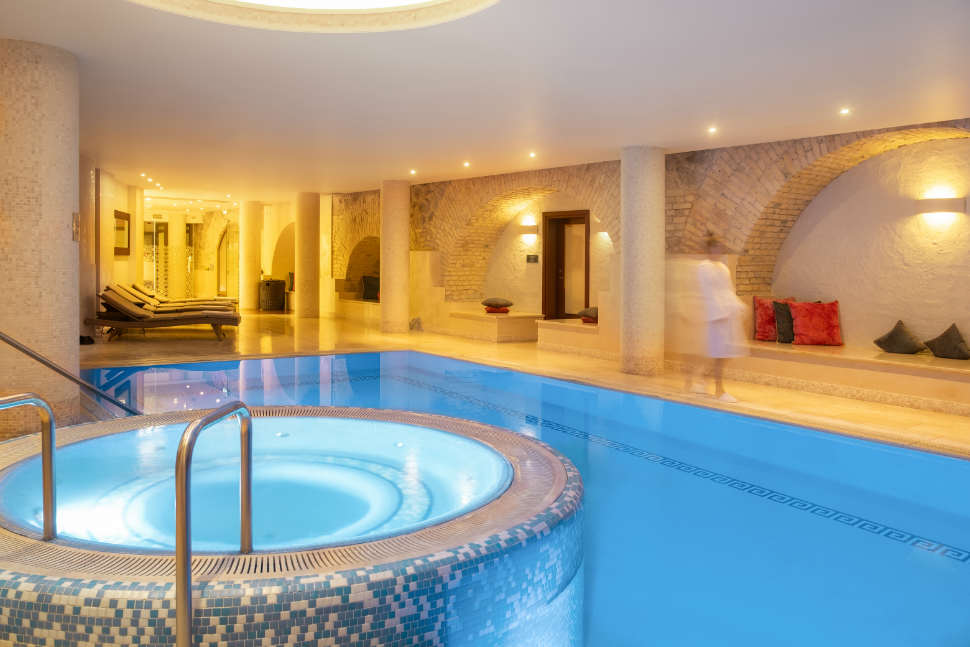
Vilnius rewards walking, but the pleasures of exploration are more satisfying when there is somewhere inviting to return. The hotel’s Iconic Spa offers a counterpoint to the stone streets and monumental squares outside. Its facilities include an indoor swimming pool, saunas, a jacuzzi and treatments, while the fitness centre is available around the clock according to the hotel’s current guest information.
Their value lies in the way they shape a stay. A warm pool after an afternoon of museums, or an hour in the spa before dinner, can change the rhythm of a short city break. The contrast is particularly attractive in colder months, when Vilnius’s architecture has a dramatic quality and the return indoors becomes part of the day’s pleasure.
The property states that resident guests may use the spa and fitness centre during their stay, while massages and other treatments are booked separately. Families should note that children’s spa access is subject to specific hours. Such practical details are worth checking directly before travel, particularly when wellness is a central reason for choosing the hotel.
A city-centre spa is at its best when it encourages travellers to make room for unstructured time. Vilnius offers more than enough monuments and cultural attractions to fill an itinerary, but the experience becomes richer when there is space to absorb what one has seen.
The old town beyond the hotel doors
Vilnius’s historic centre is one of Europe’s most absorbing urban landscapes. UNESCO highlights the survival of its medieval street pattern and the remarkable variety of buildings that grew across several centuries. The result is a city that changes character from one street to the next: a Gothic church here, a Baroque façade there, a university courtyard or an unexpectedly intimate square around the corner.
From the hotel, the cathedral provides an obvious first stop. The neighbouring Palace of the Grand Dukes introduces the political history of the region, while Gediminas Tower offers an elevated perspective on the city’s geography. Pilies Street leads deeper into the old town, its shops and cafés providing reasons to wander without a rigid schedule. The university ensemble, with its courtyards and St John’s Church, is another essential part of the neighbourhood’s cultural fabric.
Further afield, St Anne’s Church and the Bernardine complex demonstrate the extraordinary variety of the city’s religious architecture. The independent-minded district of Užupis, with its artists’ associations and playful constitution, offers a contrasting contemporary mood. It is possible to spend a day moving between these places and feel that each reveals a different facet of the capital.
The city also asks visitors to look beyond a picturesque reading of history. Its architectural layers reflect periods of prosperity, occupation, destruction and renewal. That complexity is part of what makes Vilnius so compelling. A thoughtful visit leaves time for museums and historical interpretation, not only for the photographically attractive streets.
A hotel for the city, not apart from it
The Grand Hotel Vilnius has the facilities expected of a substantial luxury address, including meeting and event spaces alongside its restaurants and wellness offer. Yet its strongest quality is not scale. It is the relationship between the building and the capital around it. This is a hotel whose history makes sense in Vilnius, and whose location makes the city’s own history immediately accessible.
The appeal extends to different kinds of traveller. A couple visiting for a cultural weekend can walk to major landmarks and return for dinner overlooking the square. A business guest can move between meetings and the old town without sacrificing the sense of being somewhere distinctive. Visitors interested in food can use Telegrafas as one part of a wider exploration of the city’s restaurants.
Grand hotels sometimes create worlds so complete that the destination beyond their doors becomes almost incidental. Here the opposite is true. The cathedral, university, streets and public spaces give the hotel its character, while the hotel’s comfort makes it easier to experience those places at leisure. The most memorable luxury is not separation from Vilnius, but a privileged connection to it.
That is why the address works particularly well for a first encounter with Lithuania’s capital. It offers a gracious point of arrival, but the city itself remains the protagonist.
Practical Information
Grand Hotel Vilnius