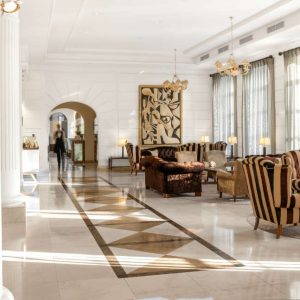
Madrid, with a different point of view
Madrid rewards the second glance. The first glance takes in the grandeur: formal façades, monumental squares, the ceremonial sweep of its boulevards. The second notices a different capital, one of inventive kitchens, small galleries, late conversations and unexpected juxtapositions. Hotel Urban belongs to that second Madrid. Its address, Carrera de San Jerónimo, puts it in the centre of the action, yet its identity is defined less by proximity to famous sights than by the remarkable things waiting inside.
The building does not attempt to impersonate the historic architecture around it. Glass, metal and contemporary lines announce a distinctly modern hotel, an intriguing interruption in a neighbourhood shaped by older stonework. Inside, the relationship between objects, materials and space is more complex. The Urban is a hotel in which a journey through the lobby can feel like an encounter with a collection, and where the familiar rituals of a city stay are given an unusually cultural setting.
This is not a museum masquerading as a hotel. It is an address with rooms to sleep in, a serious restaurant, a cocktail bar and a rooftop for warm-weather evenings. But it makes a persuasive argument that luxury need not be expressed through uniformity. Sometimes the most memorable room is the one that makes you curious about what you have just seen.
A collection that gives the hotel its character
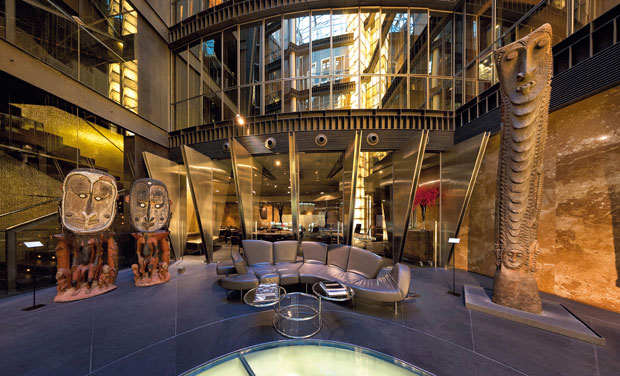
Since opening in 2004, Hotel Urban has developed a collection of approximately 200 works of tribal art from Papua New Guinea, according to the hotel, with around one hundred on permanent display. These are not incidental accessories chosen to fill an empty corner. They are central to the property’s self-image, part of a wider collecting sensibility associated with Jordi Clos and Derby Hotels Collection. The hotel also describes original art and archaeological objects in its rooms and shared spaces.
For a traveller, the pleasure lies in the contrast. The forms and surfaces of historical objects meet polished contemporary architecture; a piece that might demand concentrated attention in a gallery becomes part of a changing sequence of everyday encounters. One might notice it on the way out for breakfast and see it differently on returning at night. The effect is less about accumulating visual statements than about giving a hotel an interior life.
There is, of course, an important distinction between appreciating the collection and claiming to interpret the cultural meaning of every object. Papua New Guinea encompasses a great diversity of communities and artistic traditions. Without object-by-object provenance and contextual information, it would be misleading to assign a particular ritual use or origin to an individual work. What can be said with confidence is that the collection gives the Urban a distinctive identity and invites a more attentive kind of looking.
In a city that houses some of Europe’s most consequential art collections, this hotel does not compete with the Prado or the Reina Sofía. It offers something different: the possibility of living, briefly, in an environment where collecting and hospitality intersect.
Contemporary rooms, without anonymous luxury
The Michelin Guide lists 96 rooms at the Urban, a scale that makes the property substantial without turning it into an impersonal convention hotel. The interior language is deliberately contemporary, with an emphasis on dark surfaces, reflective finishes and the interplay of texture and light. It is a design vocabulary that suits the building’s outward confidence.
What matters is the continuity between the shared areas and the private ones. The collection is not confined to a single showcase near reception; the hotel presents art and archaeological pieces as part of the broader guest environment. This does not mean that every room should be imagined as an exhibition gallery. Rather, the property avoids the common division between a dramatically styled lobby and a bedroom that could belong to almost any international chain.
There is a particular appeal to returning here after a day among Madrid’s museums. Instead of abandoning the city’s visual conversation at the door, the guest enters another interpretation of it. The atmosphere is contemporary, sometimes assertive, but it also encourages the small pleasures of a good city hotel: shutting out the traffic, putting down a bag, opening a book, and deciding whether the evening belongs to a restaurant table or the streets outside.
As always with a design-led hotel, room categories and individual layouts matter. Travellers for whom natural light, a specific outlook or generous floor space is essential should select their accommodation accordingly rather than assume that every room delivers an identical experience.
The city beyond Carrera de San Jerónimo
The location is an essential part of the story. Carrera de San Jerónimo connects the Urban to the rhythm of central Madrid, with Puerta del Sol and the historic core close at hand. The hotel places itself within the orbit of the city’s celebrated art museums: the Prado, the Thyssen-Bornemisza and the Reina Sofía. It is the kind of base from which a morning can begin with a major collection and end in an entirely different neighbourhood without the journey becoming an expedition.
Madrid is particularly satisfying when explored without treating its monuments as a checklist. The Prado deserves time rather than a hurried procession past masterpieces. The Thyssen’s breadth invites unexpected detours through art history, while the Reina Sofía offers a different perspective on modern Spain and the international avant-garde. Around them, cafés, bookshops and street life make the transitions between museums part of the experience.
A walk towards the Retiro brings a change of pace: formal gardens, avenues of trees and space to observe the city at leisure. In the other direction, the centre becomes denser and more theatrical, with old streets opening onto busy squares. Gran Vía supplies another register altogether, from shopping and performance to the exuberant visual language of Madrid after dark.
The Urban’s appeal is that it can accommodate these different versions of the capital. You need not choose between a museum-focused weekend, a restaurant-led escape and an evening of cocktails. All three can comfortably shape the same stay.
CEBO: a kitchen that begins with the ingredient
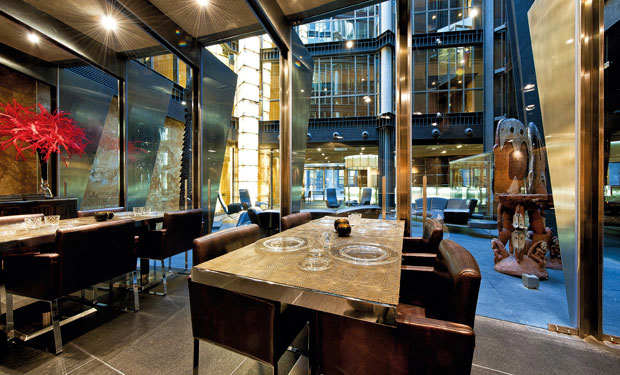
The most compelling culinary reason to stay in is CEBO, the hotel’s intimate fine-dining restaurant. Its chefs, Javier Sanz and Juan Sahuquillo, are known for an approach that places the ingredient before the flourish. The Michelin Guide describes cooking attentive to the natural flavour of produce, careful technique and the work of small suppliers from across Spain. CEBO’s own account emphasises seasonality, restraint and the different ways time can transform an ingredient.
This is a useful corrective to the assumption that ambitious dining must always announce itself through elaborate performance. At CEBO, the proposition is more exacting: the apparent simplicity of a plate should be supported by precision in sourcing, preparation and balance. Sauces, textures and presentation matter, but the central question remains what the main ingredient has to say.
The hotel describes a dining room seating a maximum of 22 guests, a scale that allows service and pacing to become part of the experience. It currently presents two tasting-menu formats, Classic and Seasonal, although their contents and number of courses may change. For that reason, a magazine feature is better served by explaining the kitchen’s philosophy than by promising a particular dish that may have disappeared by the time a reader arrives.
CEBO holds one Michelin star and two Repsol Suns, distinctions confirmed by the restaurant and hotel. Awards can direct attention, but they do not tell the entire story of a meal. Here the more interesting connection is between the restaurant and its setting: a hotel devoted to objects, craft and considered display houses a kitchen equally concerned with the relationship between substance and form.
For a visitor planning an evening around CEBO, advance reservations are sensible. The restaurant operates independently of the spontaneity of a hotel bar, and its tasting-menu format rewards arriving with time to spare.
Cocktails, glass and the changing Madrid sky
The Glass Bar introduces a livelier note. The hotel describes a cocktail programme designed to be playful and surprising, with the possibility of pairing drinks with small bites associated with CEBO. It is an appropriate counterpoint to the quieter attention invited by the art collection: a space for conversation, movement and the sociability that Madrid does so well.
It is tempting to load a hotel bar with extravagant claims about being the city’s most fashionable address. The Urban does not need them. Its position within a hotel of such a distinctive aesthetic is interesting enough, and the broader capital offers a flourishing cocktail culture that makes comparisons both subjective and quickly dated. What counts is the prospect of a drink in surroundings that have a personality of their own.
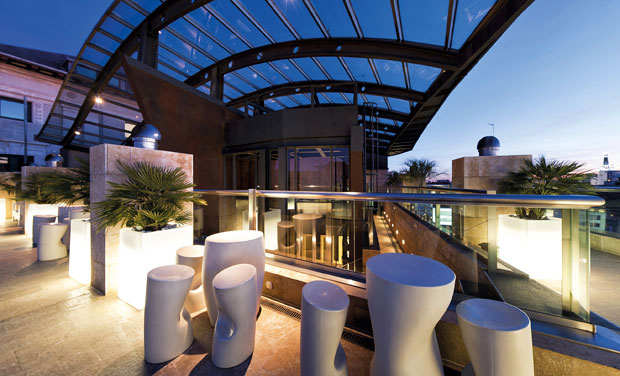
Above, the rooftop terrace provides another change of perspective. The hotel operates its outdoor pool, solarium and terrace seasonally, with the terrace promoted for spring and summer and panoramic views across central Madrid. These are pleasures to plan around the calendar, not facilities to assume will be available on a winter visit. In the warmer months, however, a rooftop drink can be a satisfying way to watch the city move from the brightness of afternoon into evening.
The rooftop is also a reminder that Madrid’s pleasures are not exclusively indoors. The museums may draw travellers to the capital, but the city’s cafés, terraces and long evenings often determine how a visit is remembered.
An urban address with a wider perspective
Hotels that build their reputation on design face a particular challenge: novelty ages. A dramatic lobby can become familiar; a fashionable finish can begin to look like a period piece. The Urban’s answer is to ground its visual identity in something more enduring than a decorative trend. Its art collection gives the interiors a narrative that cannot be reduced to a palette of materials, while the restaurant and bars connect that narrative to contemporary Madrid.
The result is not a neutral sanctuary. Travellers who want pale minimalism and complete visual silence may prefer a different kind of hotel. The Urban is for people who enjoy a place with opinions: a building prepared to stand apart from its surroundings, rooms with a deliberate aesthetic, and public spaces that reward curiosity.
There is also a practical advantage in its centrality. A successful city break often depends on the freedom to change plans. A museum visit runs long; lunch becomes a late afternoon; an unexpected exhibition replaces an afternoon of shopping. Staying near the cultural heart of Madrid makes such changes easier, allowing the itinerary to follow the city rather than the other way around.
Hotel Urban ultimately offers an interpretation of luxury that is less about withdrawal than participation. It places guests among art, within walking distance of major cultural institutions, and close to a city whose best moments often arrive between the scheduled attractions. The pleasure is not simply in having somewhere handsome to return to. It is in returning to a hotel that still has something to show you.
Practical Information
Hotel Urban Madrid